His willingness to acknowledge his behavior was noted.
It didn’t erase what had happened.
When Ellen touched my arm and told me the decision was final for now, I looked toward Thomas.
He was wiping his eyes.
I was sixty-three.
I’d been retired.
I’d expected the next years of my life to be quiet.
Now an eight-year-old child was coming to live with me.
And I knew the most important work wasn’t finished.
Maya arrived that Saturday carrying two bags, a box of books, and her one-eyed rabbit.
I showed her the yellow guest bedroom.
“You can arrange your things however you like,” I told her.
She looked at the shelves.
“Can Gerald sit on the windowsill?”
I hadn’t known her rabbit had a name.
“Gerald can have the whole windowsill.”
She carefully positioned him facing the backyard.
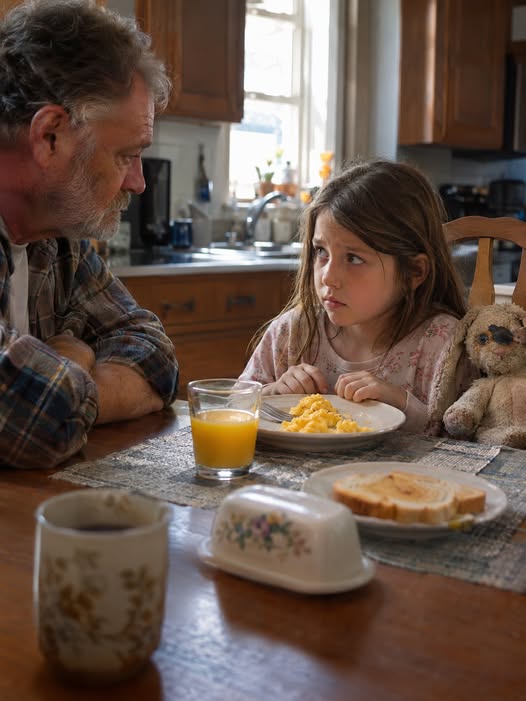
For the first week, Maya still watched the doorway during meals.
She ate what I offered but sometimes seemed uncertain whether she was allowed to ask for more.
One night, I found her sitting at the kitchen table in the dark.
I sat across from her.
We didn’t talk much.
Eventually, she asked whether we could have biscuits again.
“Of course.”
“Not just for something special?”
I shook my head.
“We can have biscuits for breakfast whenever we want.”
She considered that.
Then she went back to bed.
During her second week, I discovered food hidden in her bedroom.
Crackers beneath the nightstand.
Granola bars in a coat pocket.
An apple core wrapped in a napkin inside a drawer.
I didn’t punish her or make an issue of it.
I placed a small basket of snacks in her room and told her she could eat when she was hungry.
Over time, she began using it without hiding everything away.
Thomas called regularly.
He talked to Maya about school and ordinary things.
She became more comfortable answering him.
Her nightmares gradually became less frequent.
When she needed reassurance at night, I stayed nearby.
My back complained about sleeping on a floor mat, but I bought a better one.
I was learning how to care for a child again.
Not as a doctor.
As her uncle.
In November, Patricia contacted me about Dennis.
He’d continued therapy and requested supervised contact.
I wanted Maya’s feelings to be taken seriously.
I also understood that her relationship with her father was complicated.
We arranged a supervised visit consistent with the protective arrangements.
Dennis arrived looking thinner and less certain of himself.
He sat on the living room floor several feet from Maya rather than expecting her to approach him.
He apologized.
Then he explained that he was learning to change the way he behaved.
Maya looked at him for a while.
“Mrs. Holloway says sorry means you try to change.”
Dennis nodded.
“She’s right.”
“Are you trying?”
“Every day.”
They talked about cartoons and a friend’s dog.
When the visit ended, Dennis didn’t demand a hug or ask for promises.
At the door, he thanked me.
I reminded him that changing needed to be something he did for Maya and himself, not simply to satisfy the court.
He agreed.
After he left, Maya asked whether her father would be okay.
I told her I hoped so.
Then she returned to her cartoon.
I couldn’t guarantee how their relationship would develop.
The custody review was still ahead.
But Maya was safe, and Dennis was receiving help.
For the moment, those were the things I could do something about.
December arrived.
We raked leaves together and drank hot chocolate on the porch.
Maya helped me make biscuits on three different Saturdays.
The little basket of crackers remained in her room, but she gradually stopped hiding extra food in drawers.
Sometimes she came into the kitchen and asked for oatmeal with brown sugar.
Without hesitation.
One evening, while I was washing dishes, she stood in the doorway.
“Uncle Frank, can I ask you something?”
“Anything, sweetheart.”
She sat at the table with Gerald.
“Why did you do all this?”
I dried my hands and sat across from her.
“Because you’re my niece.”
“But you hadn’t seen me in a long time.”
“That was my mistake.”
She looked down at the rabbit.
Then she asked how I’d known something was wrong after only one breakfast.
I thought about her hands in her lap and the fork she’d been afraid to pick up.
“I spent a long time learning to pay attention to children,” I said. “And you’re very easy to care about.”
She reached into her pocket.
At school, she’d been writing thank-you letters.
She’d written one for Mrs. Holloway.
Another for Mr. Reardon.
And one for me.
She placed a folded sheet of paper on the table.
The words were written carefully in purple crayon.
I opened it.
Dear Uncle Frank,



