Dennis learned about the inquiry before it happened.
On Wednesday evening, his fiancée, Renee, arrived at my door.
She was furious.
She accused me of trying to destroy Dennis’s life when he was already struggling.
I told her I was concerned about Maya’s meals and the bedroom lock.
Renee claimed the lock was for safety because Maya wandered at night.
Then she described the food restrictions as ordinary discipline.
When I mentioned the bruise, she accused me of inventing evidence.
Finally, she warned that Dennis would stop me from seeing Maya if I continued.
I told her the investigation wasn’t about my relationship with Dennis.
It was about his daughter.
She left.
The following morning, Patricia called after the home visit.
Investigators had found combination locks on the kitchen cabinets.
Only one cabinet remained accessible, containing cereal and a limited supply of snack bars.
Maya’s bedroom had a slide bolt on the outside.
The hardware appeared recently installed.
Her room contained very few personal belongings.
Patricia had also spoken with Maya’s teacher and school counselor.
They’d noticed troubling behavior involving food.
Maya kept crackers in her pockets and saved apple cores.
Her teacher, Mrs. Holloway, had been recording concerns for weeks.
A medical evaluation was ordered.
When it arrived, the findings were serious.
Maya was around the fifteenth percentile for weight for her age.
She had mild iron and vitamin D deficiencies.
The assessment described evidence consistent with prolonged inadequate nutrition.
I had spent thirty-one years treating children.
But knowing the medical terminology didn’t make it any easier to read when the patient was my niece.
Dennis hired an attorney.
His lawyer challenged my credibility, pointing out that I hadn’t seen Maya regularly and suggesting that old family disagreements had motivated the report.
He also questioned whether the bruise could have occurred during her stay with me.
Ellen prepared our response using my dated records, the available medical findings, and observations from people who’d seen Maya more regularly.
Mrs. Holloway agreed to testify.
The school counselor, David Reardon, had already filed his own report about Maya’s behavior and Dennis’s explanations.
A neighbor also described an occasion when she’d seen Maya outside her home after dark, apparently unable to open the door.
Individually, not every observation proved what had happened.
Together, they gave investigators a clearer picture of Maya’s daily life.
The hearing was scheduled for October 9.
Thomas flew in from Austin to support me.
The night before, Dennis called unexpectedly.
His voice sounded different.
He told me he’d started therapy.
His therapist had asked him to write down the rules he imposed on Maya and explain why he believed each was necessary.
He’d filled four pages.
Then he’d looked at the reasons.
Almost every explanation was something our father had said to us when we were children.
Dennis began crying.
He said he’d convinced himself he was teaching his daughter discipline and preparing her to be strong.
But he was repeating the very things he’d once hated.
He told me he wouldn’t oppose whatever protective arrangement the court believed Maya needed.
Then he said something I hadn’t expected.
“She asked whether you’d be there when she came home from school.”
I put my hand over my eyes.
“She did?”
“She felt safe with you, Frank.”
I wanted to tell my brother everything would be all right.
But I couldn’t promise that.
“Keep going to therapy,” I said.
He told me he intended to.
The following morning, I sat beside Ellen in Franklin County Family Court.
Judge Katherine Welch reviewed the evidence.
Dennis’s attorney presented people who described him as a hardworking father who’d struggled after a difficult divorce.
Then Ellen presented the concerns documented by investigators and Maya’s school.
Mrs. Holloway described the food Maya saved and the notes she’d kept.
Patricia explained what investigators found inside the home.
The medical evaluation established nutritional concerns that required attention.
Dennis testified.
He admitted using food restrictions as punishment.
When asked whether the approach had helped Maya, he answered no.
Then he acknowledged that our father had used similar disciplinary methods when we were growing up.
He began crying again.
The judge considered the testimony and arranged for Maya to be interviewed separately in an appropriate setting.
When Maya was asked where she’d felt safe, she mentioned my house.
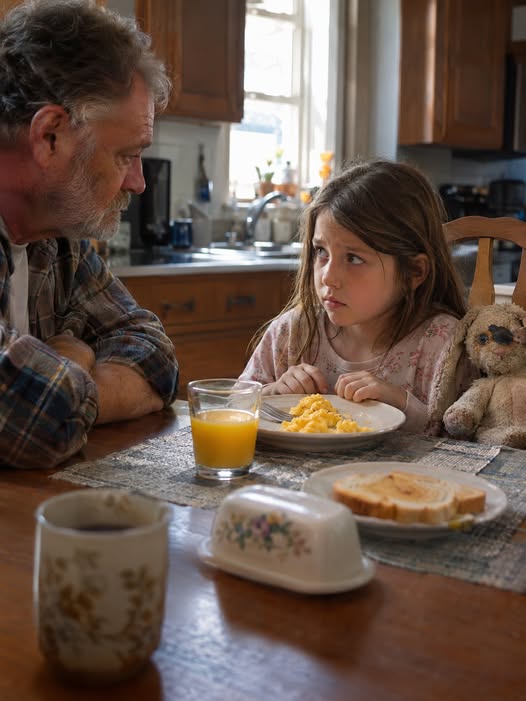
I thought about that first breakfast.
I’d done nothing extraordinary.
I’d made scrambled eggs and told her she could eat them.
Yet for Maya, that small reassurance had mattered enough to remember.
Five days after the hearing, Judge Welch issued her ruling.
She found that Maya had experienced serious harm involving food restriction, confinement, and fear-based discipline.
The medical evidence supported concerns about her nutrition and well-being.
The judge granted me temporary full custody.
Dennis would have supervised contact while continuing treatment, with a review scheduled six months later.



