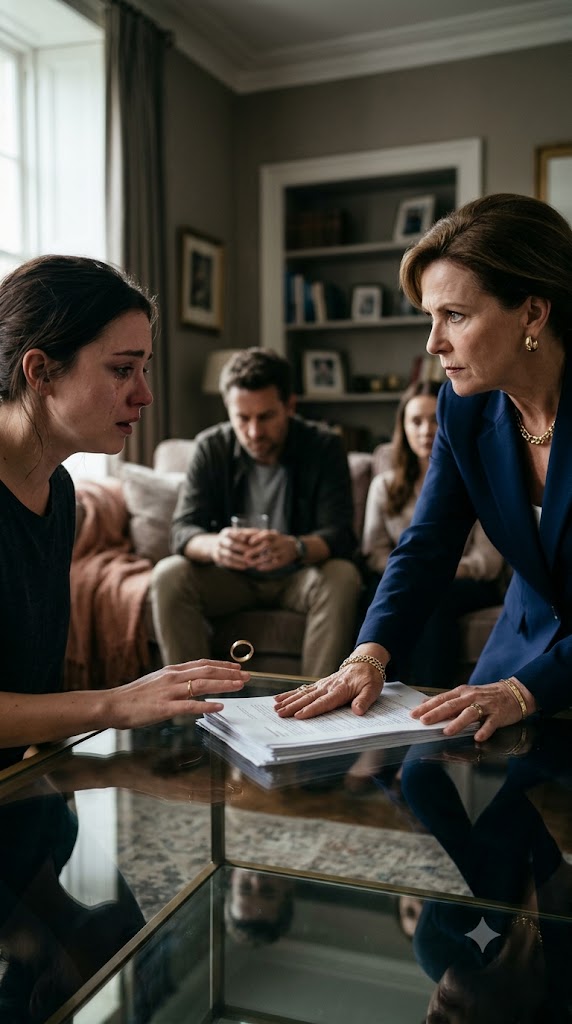
I signed my divorce papers while my husband sat beside his mother drinking whiskey — six hours later, his phone rang
My mother-in-law slammed the divorce papers onto the glass table so hard that my wedding ring jumped on my finger.
“Sign them. You’re finished with this family.”
I looked at the papers. Then at my husband.
“Marcus?”
He was on the cream sofa we’d picked out together, holding a whiskey. He didn’t look up. Not once.
“Marcus, please. Just tell me what’s happening.”
He took another drink.
“Just sign, Nia.”
Five years of marriage, and that was all he had for me.
My name is Nia Bennett. I was thirty-two, and until that afternoon I believed my marriage was worth fighting for.
I met Marcus when I was working as a nurse at a community clinic in Atlanta. He had an old car, a rented apartment, and a plan to build his own construction company. When the business stalled, I picked up extra shifts. When he couldn’t pay his suppliers, I handed over my savings. I sold my car so he could buy equipment for his first real contract.
Then his mother, Evelyn, started investing. Fifty thousand. Then two hundred thousand. Suddenly there were designer suits and cars I’d never imagined, and she never let me forget whose money paid for them.
“You were lucky my son married you,” she said to me once.
I laughed. I thought she was joking. She wasn’t.
That afternoon she sat across from me in a champagne blazer dress, platinum hair perfect, diamond bracelet catching the light. She looked delighted.
“Can we discuss this privately?” I asked him.
“There’s nothing to discuss.”
“Did you stop loving me?”
He stared into his glass a long time. “I’m tired, Nia.”
Evelyn pushed the pen toward me. “You came here with nothing.”
I stared at her.
“And you’ll leave with nothing.”
Marcus said nothing at all. That was the part that broke me. Her cruelty was familiar. His silence was something new.
I signed. Then I slid off my wedding ring and set it on top of the papers. The small sound it made against the glass nearly finished me.
I looked at her one more time. “You’re going to remember those words.”
“Is that a threat?”
“No. It’s a promise.”
I left my house key on the entry table and walked out. Nobody followed me.
Six hours later my phone started vibrating on my best friend’s coffee table. Across the city, Marcus’s phone was ringing too — his own lawyer on the line.
Whatever that lawyer told him made Evelyn set down her glass and stop smiling for good.
The Call That Wasn’t Mine
I only learned how it went later, partly from records and partly from him.
The number on his screen was one he didn’t recognize.
“Hello?”
“Mr. Bennett, I’m calling regarding the release of your former wife’s inheritance.”
He sat up. “Her what?”
“Her inheritance.”
“How much are we talking about?” Marcus asked.
The lawyer took his time.
“Mr. Bennett, the amount isn’t the part that should concern you.”
Because the document in front of him named me as the principal beneficiary of the Whitfield estate. And clipped to it was a legal notice directed at Bennett Construction.
My husband’s company. The company I had helped him build out of nothing. The company Evelyn had spent years insisting belonged entirely to her family.
I slept on my best friend’s couch that first night.
Tasha Williams and I met in nursing school. She opened her door, looked at my face, and pulled me inside before I could explain anything.
I fell apart before the door was even shut.
“He let her do it,” I said.
“Who?”
“Evelyn.”
I told her all of it.
By the end, Tasha was pacing her little living room.
“And you signed.”
“I couldn’t think straight.”
“Did you read every page?”
“Some of them.”
She shut her eyes. “We need a lawyer.”
“I don’t have money for a legal war.”
“Then we’ll find somebody who’ll help you anyway.”
I kept looking at my hand. There was a pale band of skin where my ring had been for five years. My finger looked unfinished.
Tasha noticed. She took my hand and held it.
“You’re still you.”
“I don’t feel like me.”
She didn’t argue. She just held on until my breathing evened out.
Forty-Eight Million
The next morning my phone rang with a number I didn’t know.
“May I speak with Nia Whitfield Bennett?”
“Speaking.”
“My name is Daniel Brooks. I represent the estate of your grandmother, Ruth Whitfield.”
Grandma had died four months earlier. She was seventy-eight. She raised me from the time I was sixteen, after my parents were killed in a car accident, and losing her felt like losing my mother twice.



