Seeing it typed on the final page put tears in my eyes. I wasn’t erasing those five years. Some of them were beautiful. They shaped me. But I chose the name that reminded me where my strength actually started.
The criminal proceedings ran on their own track. Evelyn eventually pleaded guilty to several financial offenses, and the court imposed a prison sentence, restitution, and other penalties. Dr. Reeves faced professional discipline and legal consequences for his part in the misleading medical records. Peter Langford cooperated and accepted responsibility for his role.
I didn’t attend every hearing. I had already stopped letting that woman run my life, and watching her fall wasn’t what healing required.
The First Scholarships
That spring, the Ruth Whitfield Foundation awarded its first nursing scholarships.
I stood on a stage in front of a room full of students and their families with my hands shaking on the podium. Then I spotted Tasha in the front row, and I touched the little silver heart at my throat.
“My grandmother taught me that money is only worth something when it helps a person live with dignity.”
The room went quiet.
“She believed education could change an entire family. She believed kindness should never be mistaken for weakness. And she believed every person deserves a chance at a better future. Today we’re honoring that.”
The applause went on a long time. I looked at her photograph on the screen behind me and felt no urge to apologize for standing in a room full of wealthy people. I belonged there, not because of what I’d inherited, but because I had something worth doing.
Afterward Tasha grabbed me. “You did it.”
“We did it.”
“No, ma’am. You did.”
Then Andre texted: the foundation’s first housing project had been approved. Tasha shrieked in the middle of the lobby and half the room turned around, and for the first time in years I was genuinely excited about what came next.
One Year Later
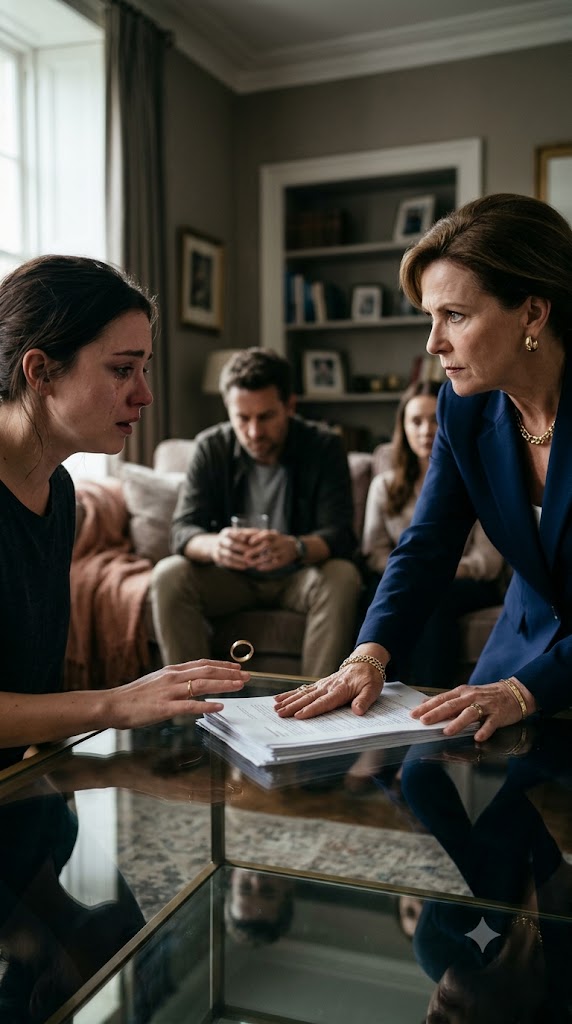
A year after Evelyn slammed those papers onto her glass table, I stood in the doorway of a brand-new community health center.
Bright rooms. Comfortable chairs in the waiting area. A reading corner for kids. Private exam rooms. And near the entrance, a large photograph of my grandmother with words underneath it.
THE RUTH WHITFIELD COMMUNITY HEALTH CENTER. CARE WITH DIGNITY. HOPE WITH PURPOSE.
She used to talk about a place like this. She hated watching people put off treatment because they couldn’t afford an appointment. She knew exactly how fast a life comes apart when somebody gets sick.
“We did it, Grandma,” I said, with my hand on the necklace.
Tasha appeared at my shoulder. “Ready?”
“Not even a little.”
“You’ve spoken to bigger crowds.”
“This one feels like home.”
Families were already gathering outside. Nurses, volunteers, a few local officials, and several of our scholarship recipients. One young woman came up to me, twenty-three years old, name of Jasmine Taylor.
“Ms. Whitfield? I wanted to thank you. My mother works two jobs. I was going to drop out of nursing school because I couldn’t cover tuition.”
“What are you doing now?”
She beamed. “I start working here next month.”
I hugged her and we both ended up crying in front of everyone.
This was the thing Grandma wanted. Not luxury cars or parties or people bowing because of money. Opportunity. Dignity. A chance for families to breathe.
When the ribbon-cutting started, I stepped to the microphone.
“A year ago my life fell apart. I lost my marriage, I lost the future I thought I was building, and I was grieving the woman who raised me.”
I paused.
“But my grandmother left me more than an inheritance. She left me a reminder that my worth was never up to anybody else’s approval. She taught me money should open doors, not close them. Today we’re opening one.”
Applause rolled across the parking lot.
“This center is for every person who has ever felt invisible or forgotten. You matter. Your health matters. Your dreams matter. Your future matters.”
We cut the ribbon, people cheered, and the doors opened.
I spent the rest of the afternoon shaking hands and walking families through the building. By evening I was worn out in the best way there is.
Andre found me in the courtyard. “Congratulations. Your grandmother would be proud.”
“I hope so.”
“I know so.” Then, after a moment, “Have you considered taking a vacation?”
I laughed. “What is that?”
“Something people do when they’re not running an entire foundation. You’ve earned some rest.”
Over that year Andre had become a colleague I trusted and a friend besides. He never made me feel stupid for not knowing something. He explained, listened, and pushed back when he thought I was missing something. I learned from him what healthy respect feels like. It doesn’t demand silence. It allows disagreement without humiliation.



