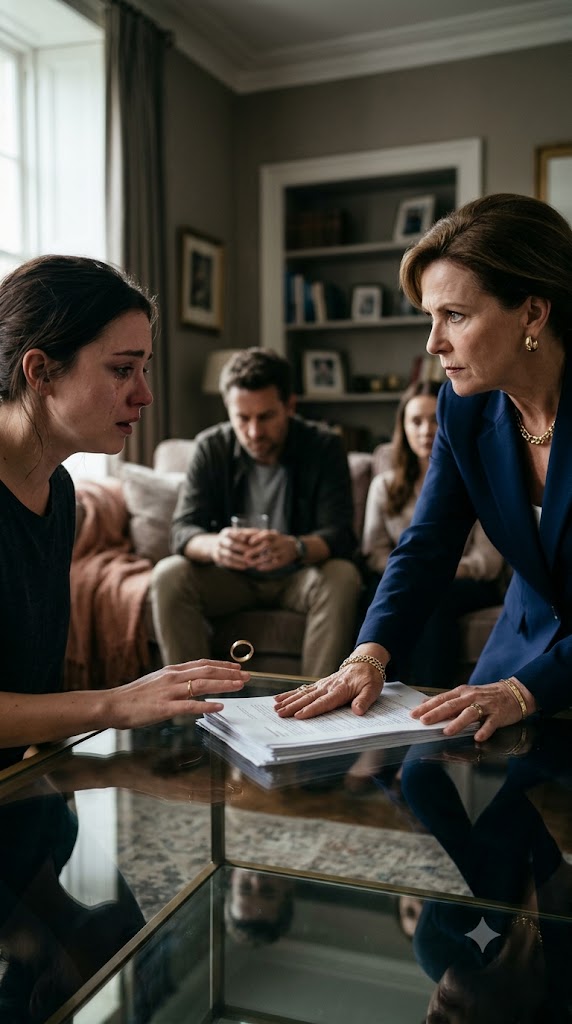
My ring came back to me that same week, returned through counsel in a small padded envelope. I sat with it in my palm for a while, remembering Marcus in a public garden with shaking hands, telling me he didn’t have much but he’d spend his life making me happy.
I think he meant it. Somewhere along the way he stopped protecting it.
I put it in a jewelry box and closed the lid, and I didn’t cry.
Special Intervention Services
Then Jasmine called with something that put the floor at an angle.
“We found a payment connected to the period of your grandmother’s final hospitalization. It came from EB Consulting to a private medical services firm.”
Grandma died after a sudden decline. The doctors said she deteriorated fast. I had never questioned a word of it.
“Jasmine, what are you telling me?”
“I’m telling you the invoice description is unusual. We don’t know that it has any bearing on her death.”
“What does it say?”
She read it. “Special intervention services. Ruth Whitfield.”
Tasha drove me to the office because I was in no condition to drive myself. Jasmine was waiting with Mr. Brooks and a private investigator named Caleb Foster, a former financial-crimes detective who chose his words like they cost him money.
“Let’s be clear,” he said. “A suspicious payment doesn’t prove anything happened to your grandmother’s care.”
“I understand. Show me.”
Seventy-five thousand dollars, paid by EB Consulting two days before she was hospitalized, to a company called Meridian Private Health Services. Private nursing, medical transport, home-care coordination.
“She already had care,” I said. “Why would Evelyn pay anybody?”
“That’s what we’re trying to establish. And it wasn’t the only one. Three transfers to Meridian across six weeks. Just over two hundred thousand dollars.”
Jasmine added, “There’s also correspondence between Evelyn and the owner. A Dr. Samuel Reeves.”
The name snagged on something. Then I placed it. A charity gala the year before, Evelyn introducing a pleasant man in a good suit as a family friend.
“Can you find out what they were doing?”
“We’re working on it,” Caleb said.
The Recipe Box
Afterward, I went to Grandma’s house for the first time since the funeral.
The white porch swing. The flowerpots on the steps. The curtains she’d sewn herself. The smell of lavender still in the front room.
Her Bible sat on the side table. Her blanket was folded over the arm of the couch. A photograph of my parents stood by the fireplace, my mother laughing, my father’s arm around her.
I sat down in her desk chair in the study and cried like a child. I had inherited millions of dollars and I would have handed over every cent to hear her voice for ten minutes.
Tasha, standing in the doorway, pointed at the desk.
“Nia. What’s that?”
A small envelope tucked behind a folder. My name on it.
If anything ever feels wrong, trust your instincts. I keep copies of important things where I know you’ll look. Remember our Sunday tradition.
Every Sunday of my teenage years, we watched old movies and ate peach cobbler. Before the film started she always asked the same question.
“What’s the one thing money can’t buy?”
“Peace.”
“Exactly.”
I was already moving toward the kitchen. “Her recipe box.”
The blue metal tin was on top of the refrigerator where it had lived my whole life. Sweet potato pie. Cornbread. And behind the peach cobbler card, a folded sheet of paper.
Dates. Names. And in her handwriting: Evelyn met Reeves without my approval. Do not allow him access to my medical records.
Under that: Reeves claims he can arrange specialized treatment. I declined.
And at the bottom: Ask Nurse Daniels about the visit on Tuesday.
“Who’s Nurse Daniels?” Tasha asked.
“Patricia Daniels. She did Grandma’s home nursing visits.” I stared at the line. “She stopped coming not long before Grandma went into the hospital. I assumed her schedule changed.”
Caleb came out to the house that afternoon, documented where the note was found, and told me to leave everything exactly where it was.
“Do you think she was in danger?”
“I think she was worried about something specific. We need to find out what.”
I sat at her kitchen table a long time after he left, with my hand on that worn cobbler card. She hadn’t hidden evidence there because she expected me to solve a crime. She hid it there because she trusted me to ask questions.
Patricia
Two days later Patricia Daniels joined us on a video call from Savannah. When she saw my face, her eyes filled.
“Your grandmother was a wonderful woman.” She looked down. “I’ve been carrying something since she died. Somebody tried to pressure me to change her care notes.”
“Who?”



