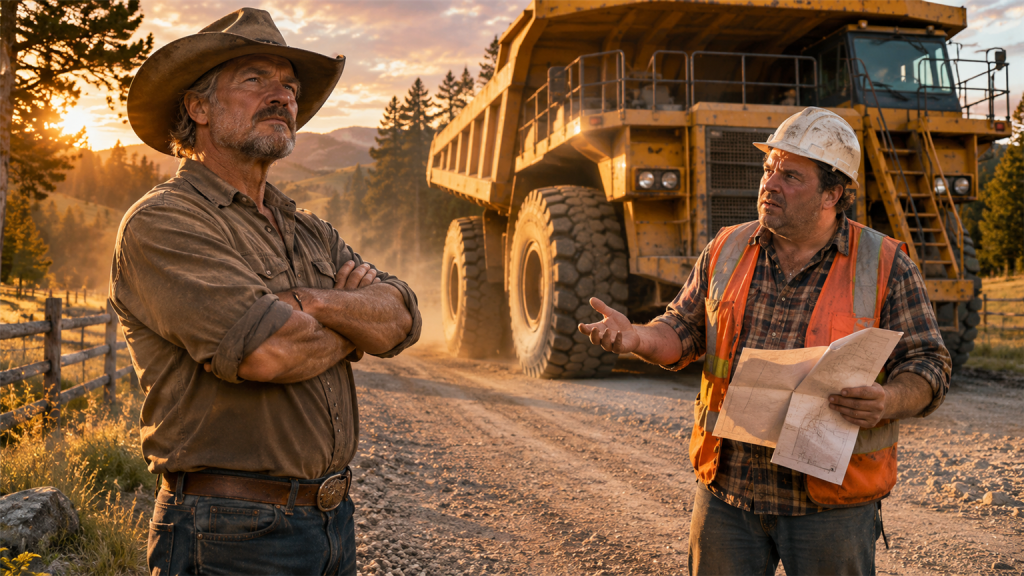
The first dump truck came around the bend at 6:07 in the morning.
I almost put my feed truck in the ditch avoiding it.
A second truck followed.
Then a third.
By the time the dust cleared, six fully loaded construction trucks were rumbling down the private gravel road my family had maintained for nearly sixty years.
My road.
Not a county road.
Not an HOA road.
Not a shortcut.
Mine.
I stepped out beside the cattle guard and raised one hand.
The next driver slowed his Peterbilt and leaned through the window.
“You lost?”
“No,” I said. “Are you?”
He frowned.
“This is the haul route.”
“For what?”
“The Ridgeview project.”
He pointed beyond my north pasture, where a developer had begun carving two hundred homes into the hillside.
I looked at the ruts his tires had already pressed into gravel I had graded six days earlier.
“Who told you this was a haul route?”
“Site office.”
I photographed the truck.
Then the license plate.
Then the mud packed around my cattle guard.
The driver shook his head.
“Man, I just follow the sheet.”
That sentence would explain almost everything that happened over the next six weeks.
My name is Cole Barrett.
My family’s ranch sat outside Fort Collins, Colorado, on just under four hundred acres of pasture and pine.
The road crossed a little more than a mile of our land from the county highway to the house, barns, and north pasture.
My grandfather built it.
My father improved it.
I maintained it.
Every spring, I ordered gravel.
Every heavy rain, I checked culverts.
Every winter, I plowed it myself.
At the highway stood a wooden gate and a sign.
BARRETT RANCH
PRIVATE DRIVE
NO THROUGH TRAFFIC
Neighbors occasionally used it with permission.
Delivery drivers used it when we invited them.
A local rancher named Pete sometimes crossed to reach a leased pasture.
Nobody had ever suggested those favors created ownership.
Until Ridgeview Development arrived.
I drove straight to the construction site.
The foreman, a man named Luis Herrera, listened while I explained the problem.
Then he pointed to a laminated site map.
A thick red line ran from the subdivision entrance directly across my ranch road.
“Developer gave us this route,” he said.
“Who approved it?”
“The project office.”
“Not me.”
Luis rubbed his jaw.
“I believe you. But I’ve got fifty drivers rotating through this project. Unless management changes the route in writing, they follow what’s in the cab.”
I looked at the map.
“Do you have an easement?”
“A what?”
“A recorded right to cross my property.”
He shook his head.
“That would be above me.”
The project manager was Grant Weller.
When I called him, he didn’t apologize.
He sounded surprised I had a problem.
“The HOA cleared that route months ago.”
“What HOA?”
“Ponderosa Hills.”
I laughed.
“Ponderosa Hills doesn’t own my ranch road.”
“They said it was historical community access.”
“Historical according to what?”
Grant paused.
“Their president, Linda Mercer, gave us written confirmation.”
“Did your attorney check title?”
“He reviewed the route.”
“That isn’t what I asked.”
Another pause.
Then the sentence that told me how careless this had been.
“He looked at it and said it should be fine.”
Should be fine.
That afternoon, I drove to the HOA clubhouse.
Linda Mercer was president of Ponderosa Hills, a subdivision built east of our ranch fifteen years earlier.
She wasn’t hostile.
That almost made it worse.
She genuinely believed what she was saying.
“That road has always served this area.”
“No. My family has let neighbors use it.”
“Same difference.”
“No, Linda. Courtesy and legal access are not the same thing.”
She opened an old marketing brochure from the original subdivision developer.
It described Ponderosa Hills as having “convenient western access via Barrett Ranch Road.”
I stared at it.
“This is advertising.”
“It shows intent.”
“It shows somebody wrote a sentence in a brochure.”
She searched meeting minutes.
No vote authorizing construction traffic.
No access agreement.
No easement.
No signed permission from my family.
Nothing.
Still, the trucks kept coming.
Twelve a day became eighteen.
The gravel began breaking apart.
One truck cracked a culvert near the north pasture.
Another parked across the narrow section beside the barn while my daughter, Emma, was trying to move cattle.
Then our veterinarian lost twenty minutes behind a dump truck while one of our cows was in distress.
That was when I called Sheriff Warren Cole.
He arrived that afternoon.
He walked the road.
Photographed the damage.
Then asked Luis for the construction paperwork.
Luis handed him the site plan.
Sheriff Cole studied it.
Then asked one question.
“Where is your right-of-way recorded?”
Luis stared at the map.
“I don’t know.”
“The developer’s paperwork?”
“Yes, sir.”
The sheriff looked at me.



