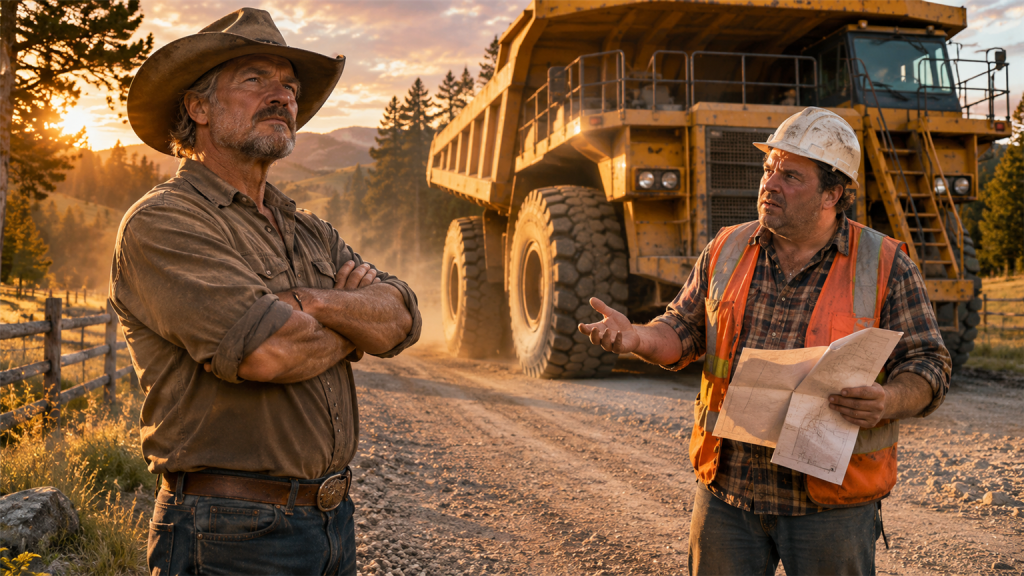
Grant, Linda, Luis, and I signed the agreement.
On the fourth day, Luis brought me a laminated route sheet showing a red X across Barrett Ranch Road and the words “PRIVATE—NO CONSTRUCTION ACCESS.”
On the sixth afternoon, Emma and I stood beside the cedar gate as the final empty dump truck passed. The driver raised two fingers, turned toward the county highway, and disappeared.
Dust settled behind him.
No other truck followed.
“It’s quiet,” Emma said.
I nodded.
I had almost forgotten what quiet sounded like.
Road repairs began the following Monday. The developer’s crew installed quality gravel matching my maintenance records, replaced the damaged culvert, rebuilt the drainage ditch, straightened the cattle guard, and regraded the affected section.
During inspection, I kicked through the gravel near the north pasture crossing. The agreement required six compacted inches, but the crew had installed only four and three-quarters.
Nobody argued. Written specifications made memory irrelevant.
The workers returned, added material, corrected settled backfill, and tightened two improperly secured bolts on the cattle guard. Only after every punch-list item received a checkmark did I sign the completion form.
A week later, heavy mountain rain tested the repairs. Emma and I drove down in the feed truck and found the culvert flowing correctly, the ditch holding, and no gravel washing into the pasture. I photographed everything and added the pictures to my growing maintenance binder.
Afterward, Linda called a special HOA meeting and publicly accepted responsibility. She admitted authorizing construction traffic on land the association did not own because she had relied on years of assumptions without checking the record.
The board adopted a new policy: no officer could claim access rights without a board vote, supporting documentation, and legal review identifying the source of authority.
Grant changed Ridgeview’s procedures as well. Every future haul route required written confirmation from the public road authority or private landowner. Luis prohibited verbal route changes and required every driver to carry an updated, dated route sheet.
The system was boring, which was exactly why it worked.
Six months later, Ridgeview’s first houses appeared. Construction had not collapsed. Grant had paid more, and the schedule had slipped, but the project adapted to the longer county route.
Respecting my property had not made development impossible.
It had merely made development less convenient.
That difference mattered whenever I remembered our broken culvert, the delayed veterinarian, and Emma struggling to move frightened cattle around idling trucks.
Life on the ranch returned to ordinary problems: fence wire, hay prices, frozen troughs, and veterinary bills.
Sheriff Cole later visited and admired the repaired road. We remembered the first morning he asked where the developer’s right-of-way was recorded. That simple question had become expensive for everyone.
He said he was glad I had relied on records instead of chaining the gate shut. I had considered blocking the road, but anger might have caused an accident or allowed Grant to blame me for delays. The legal process moved more slowly than anger, cost money, and allowed additional damage—but it produced something anger could not.
An ending everyone had signed.
The following spring, I opened the maintenance binder to record our annual grading. Inside were the settlement, repair photographs, HOA acknowledgment, and the old 1964 survey proving the road belonged to my ranch.
Emma entered carrying work gloves and announced that it was time to grade my “precious road.”
“My precious private road,” I corrected her.
We spent the morning dragging the grader behind the tractor. At the highway entrance, we stopped beside the faded sign reading “PRIVATE DRIVE—NO THROUGH TRAFFIC.”
Emma suggested replacing it with something larger, perhaps with flashing lights or even a moat.
I looked along the mile of gravel stretching past the barn and cattle fields beneath the morning sun. It was not dramatic or expensive-looking. It was simply a ranch road.
But I understood it differently now.
Private ownership is not protected by how obvious it feels. It is protected by deeds, surveys, agreements, records, and people willing to request proof before treating another person’s land as their own.
Ridgeview had a glossy route map. The HOA had years of assumptions. Grant had deadlines, and the contractor had dozens of drivers.
I had one question: “Show me the right.”
Nobody could.
When everyone finally stopped pointing at someone else and opened the actual records, the truth had been waiting there all along.
The road was mine.
The trucks belonged somewhere else.
THE END



