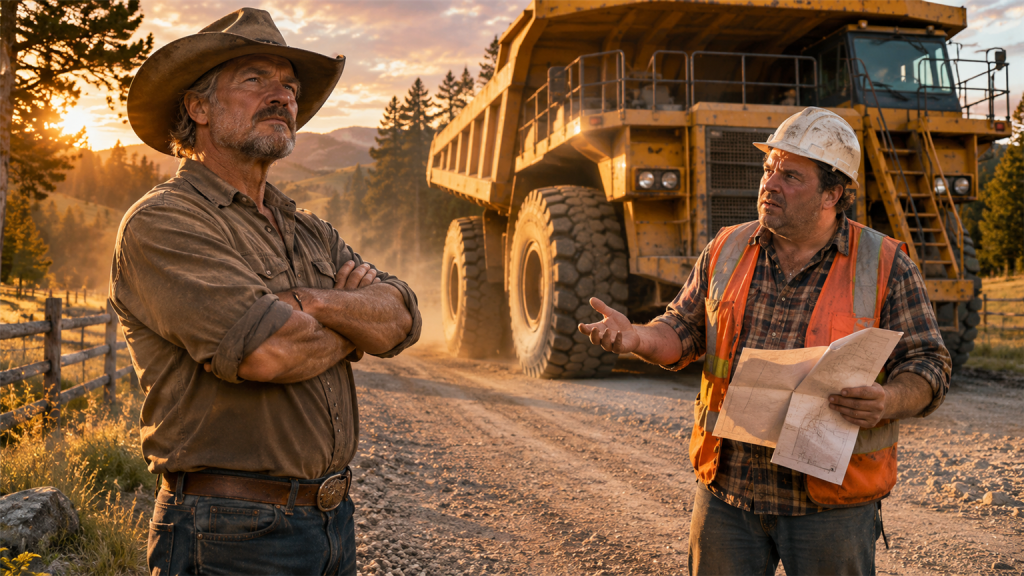
“I can deal with blocked access and unsafe driving. I cannot decide ownership standing beside a culvert.”
“I understand.”
“You need records.”
Then he looked back at Luis.
“Until somebody proves otherwise, keep this road open for the ranch owner. No parking. Slow the trucks down.”
For one day, they did.
The next morning, new drivers arrived.
They had never heard the warning.
They followed the same laminated route sheet.
That evening I hired land attorney Sarah Bennett.
I told her about the map.
The HOA email.
The sheriff.
The damage.
She listened until I finished.
Then she asked:
“Cole, has anybody shown you one recorded document giving them a right across your road?”
“No.”
She leaned back.
“Good.”
I frowned.
“How is that good?”
“Because everybody is arguing from assumptions.”
She opened a legal pad.
“We’re going to argue from records.”
Two days later, the title report arrived.
Sarah opened the packet.
My grandfather’s deed.
My father’s deed.
Mine.
A 1964 survey.
The Ponderosa Hills declaration.
The developer’s purchase documents.
We followed the chain page by page.
Then Sarah stopped.
She placed one finger on the subdivision access plan.
I leaned closer.
“What?”
She looked at me.
“The developer’s own recorded documents show their legal construction access from the county highway.”
“Not my road?”
“Not your road.”
Then she turned another page.
“And Cole?”
“Yeah?”
“The HOA declaration doesn’t mention Barrett Ranch Road anywhere.”
For the first time since the trucks appeared, I smiled.
But Sarah didn’t.
“Don’t celebrate.”
“Why?”
“Because somebody built an entire construction schedule around your road.”
She closed the title report.
“And people who are losing sixty thousand dollars and six weeks rarely surrender just because the paperwork says they should.”
Sarah called everyone to the damaged culvert: me, Linda from the HOA, Grant the developer, and Luis the foreman. She laid five documents across the hood of my truck and reduced six weeks of arguments to five minutes.
“The site plan is not an easement. The HOA email is not an easement. The HOA declaration does not include this road. The ranch plat identifies it as a private drive. And the developer’s own recorded papers identify county-highway access.”
Grant stared at Linda.
“You told us the road was cleared.”
“I believed it was.”
“Based on what?”
Linda looked toward the subdivision.
“People have used it for years.”
Sarah nodded.
“Neighbors using a road with permission is not the same as eighteen loaded construction trucks using it commercially.”
Grant’s face tightened.
“The highway route adds almost sixty thousand dollars and at least six weeks.”
Sarah did not blink.
“That is a business problem. It is not a property right.”
Nobody answered.
That afternoon she sent a formal demand: stop the trucks, repair the road, or face a court filing.
The trucks continued while Grant consulted his attorney.
Then another loaded truck broke the cattle guard during a rainstorm.
Emma and I photographed everything.
Ruts.
Bent steel.
Washed-out gravel.
Damaged culvert.
The next morning, Grant’s lawyer called Sarah.
They would not file a claim asserting permanent rights over the road.
They wanted a settlement meeting instead.
Sarah hung up and looked at me.
“They finally understand the route sheet isn’t enough.”
“So the trucks stop?”
“Only when the agreement says they stop.”
She picked up her pen.
“This time, nobody leaves the room with an assumption.”
We met inside my equipment barn, surrounded by thirty years of gravel receipts, grading logs, drainage repairs, and culvert inspections. Sarah placed the written agreement before Grant Weller, HOA president Linda Mercer, contractor Luis Herrera, and their attorneys.
Construction traffic had six days to stop using Barrett Ranch Road. After that, every truck would follow the county-highway route shown in the attached map.
Grant complained that it added nine minutes each way, but that inconvenience changed nothing. His company would also pay to restore my road through full regrading, new gravel, culvert replacement, cattle-guard repairs, compaction, drainage stabilization, and final inspection.
The most important clause required Ponderosa Hills HOA to acknowledge that it possessed no ownership or access rights over Barrett Ranch Road and could not authorize commercial use.
Linda agreed to sign.
“I should have checked,” she admitted.
Luis confirmed that dispatch software, printed route sheets, and driver instructions would all be changed. He reminded everyone that he had requested written authorization from the beginning. His drivers had not created the problem; they had followed the route sheets management gave them.
That was how the damage happened. Linda relied on neighborhood lore. Grant relied on her email. The construction office transformed those assumptions into paperwork, and dozens of drivers followed it.
Nobody had deliberately planned to steal my road. That made the lesson more important: property rights can disappear beneath layers of administrative convenience when everyone assumes somebody else verified them.



