“Baker. He told me to look it over before he filed it.” Ortiz took a breath. “My signature looked weird, so I zoomed in on the picture. There’s a blue dot under the O. I remember making that dot. The pen leaked when I signed my field training evaluation.”
“Who kept your evaluation?”
“Meyers. He was my training officer.”
Two days later, I sat with Chief Simpson and the city attorney in a conference room at City Hall. A city records technician named Dana Bell brought in a laptop and set it down gently enough that I knew she was nervous. The precinct archive had lost the clip. The city’s backup had received it before the deletion, and Dana had recovered a copy. She pressed play.
On the screen, I saw myself pick up the page under the bench. That was the part I asked her to pause. In the doorway behind me, Baker was watching Meyers. His lips moved. Dana backed up a few seconds and raised the volume.
“Same as last time,” Baker said. “Let me handle the paper.”
I’d spent the previous month reviewing civilian complaints as the independent deputy director of compliance assigned to Fairmont’s federal audit. Thirteen people had described being hurt in that building. In nine of those cases, a second officer claimed to have witnessed the civilian start the confrontation. Until that morning, I’d taken those witness statements as evidence that nine people had chosen to back a colleague. Ortiz’s signature made me wonder how many of them had ever been asked.
Dana opened the access records. Baker’s supervisor account had authorized a password reset for Ortiz, giving whoever initiated it temporary access under the rookie’s name. Then she showed us an older file she’d recovered from the same backup. It was a memo Baker had circulated to shift supervisors six weeks earlier, after my office announced the audit. My staff photo took up half the first page. Under it were my full name and the instruction to call Baker if I arrived without an escort.
“He knew who you were,” Simpson said.
I looked again at the doorway footage. Baker had been behind the glass when I arrived. He’d watched me hold up my authorization letter. He’d stayed there until I hit the doorframe. Afterward, he’d let Meyers tell me the camera was broken.
Over the next week, the city attorney arranged for Ortiz to give a statement to federal investigators. Dana kept recovering old files. I finished the audit briefing with my arm in a sling and went home every night to find myself listening for footsteps in the hallway. I’d spent years asking people to describe what it felt like when an officer could write a version of their life that carried more weight than their own. Now I knew how often you could wake up thinking about a single line on a piece of paper.
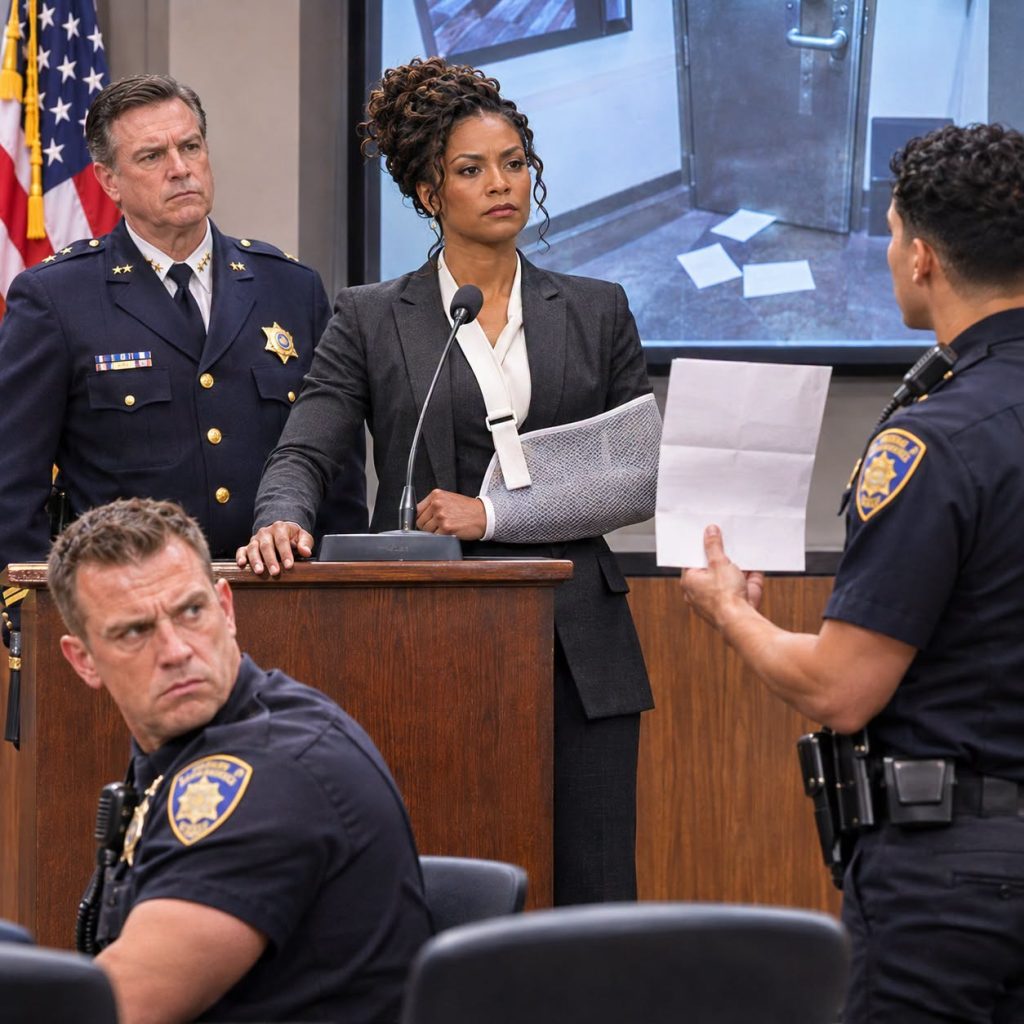
At the mandatory assembly, Meyers sat in the front row. Baker stood by the side doors, his hands folded over his belt. I waited in the hallway behind the stage until Simpson reached the part of his remarks about the federal audit.
“Director, please.”
I stepped into the room. Meyers looked at my sling, then at the screen. When the first frame appeared, he turned to Baker.
“Kev,” he said. “You told me it was gone.”
Everyone in the front row heard him. One officer turned all the way around to look at Baker. Then Meyers saw Ortiz sitting on the aisle, and his face changed.
“He’s the one who signed it,” Meyers said.
Ortiz went still. I’d seen that same look on his face when Baker told him to sit down. From the lectern, I could see two federal agents waiting at the back. Before either moved, Ortiz stood up. His knees bumped the chair in front of him. He steadied it with one hand.
“That’s my signature,” he said. “And I can tell you exactly where you got it.”
If you’ve read this far, don’t hesitate to leave a like and comment before reading part 3. It makes us as happy as reading a complete story! Thank you. 👍❤️
Part 3
Ortiz took a folded copy of his training evaluation out of his pocket. I’d seen it the day before, when he showed me the blue ink dot. Now he held it at his side and looked straight at Meyers.
“You said if I kept my head down, I’d make it through probation,” he said. “I thought you meant I’d get better at the job.”



