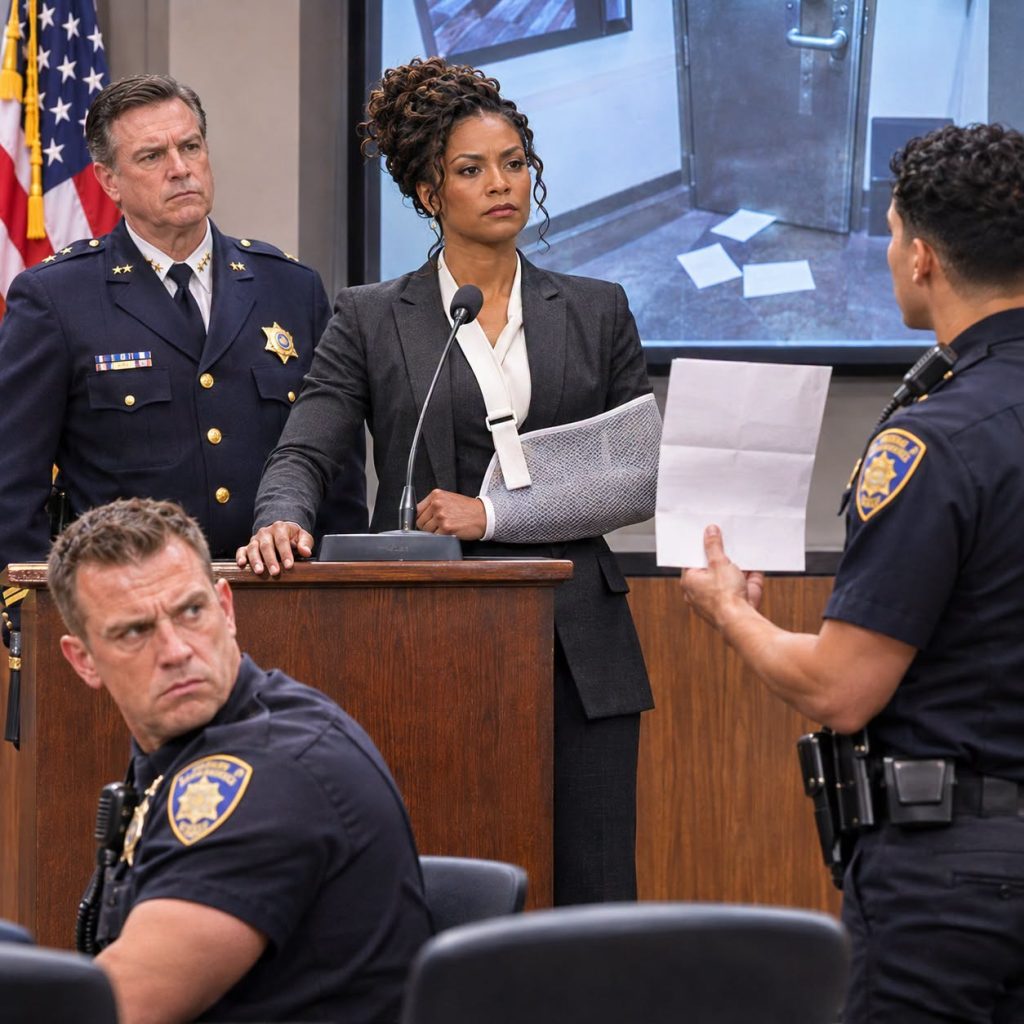
Meyers opened his mouth. One of the federal agents reached the front row and said his name. Simpson asked Meyers to remove his duty belt and place it on the empty chair beside him. The buckle caught on his uniform. For a second I thought he might ask Ortiz to help. He worked it free himself, then unclipped his badge and set it beside the belt. The agents took him into custody on a federal civil rights charge. As they walked him out, his radio crackled from the chair. Somebody on patrol needed an address confirmed. An officer near the aisle picked it up and answered.
The rest came out over months. Baker had circulated my photo because he wanted advance notice whenever I entered the precinct. Meyers had acknowledged the memo in writing. The investigators found it among the department emails preserved after the incident. When I arrived without an escort, both men knew I could ask for the original roll-call records. Those records placed officers in the building on days when their reports claimed they were out on calls. Several of those reports had helped close complaints against Meyers.
After I left that morning, Baker had reset Ortiz’s password and deleted the clip from the precinct archive. He’d figured the city’s backup only ran overnight. Meyers had prepared the false statement using the signature from Ortiz’s training evaluation. Investigators found the evaluation scan and a draft of the report on his department computer. Baker was demoted after a disciplinary hearing and removed from any role reviewing complaints. The city reopened the cases in which officers said their names or signatures had been used without permission.
At trial, the defense attorney asked me why I hadn’t announced my title the moment Meyers stopped me. I’d been waiting for that question since the first time I watched the footage.
“I gave him the letter that allowed me to be there,” I said.
“Would he have treated you differently if you had introduced yourself as the director?”
“I think he would have.”
The attorney waited for me to add something. So did I. Then I realized the jury had heard what I meant.
They convicted Meyers. The judge sentenced him to forty-eight months in federal prison. Ortiz came to the sentencing in plain clothes and sat beside me. Afterward, he admitted he’d spent most of his first year trying to sound like Meyers on the radio. He asked if I remembered him starting to stand when I hit the doorframe.
“I remember you standing the second time,” I said.
Fairmont made my position permanent the following spring. We moved complaint intake out of the precinct so people could report an officer without walking past that officer’s desk. We gave civilian reviewers direct access to preserved footage. Witnesses could verify their statements privately and receive a copy. The first week, a retired school secretary came in holding a receipt from a complaint she’d filed four years earlier. She’d kept it in her purse through two moves. I pulled up the case and turned the monitor so we could read it together.
The next time I observed roll call at Central Precinct, Ortiz was handing out assignments while his supervisor took a call. He held the steel door open for me. I still remembered the exact sound my folder had made when it hit the floor. My hand went to my shoulder before I thought to stop it. Ortiz saw the movement and waited.
“Where would you like to sit, Dr. Tucker?”
There was an empty chair by the doorway. I chose one halfway down the table, where I could see everybody’s face. Ortiz finished calling the assignments and asked if anyone had something to bring up before they went out. A rookie raised her hand, lowered it, then raised it again. Ortiz set his clipboard down. He let her take her time.
What do you think of this story? Please leave a like and share your thoughts in the comments. Your support means a lot to us and inspires us to keep writing more meaningful and powerful stories. Thank you! 👍❤️



