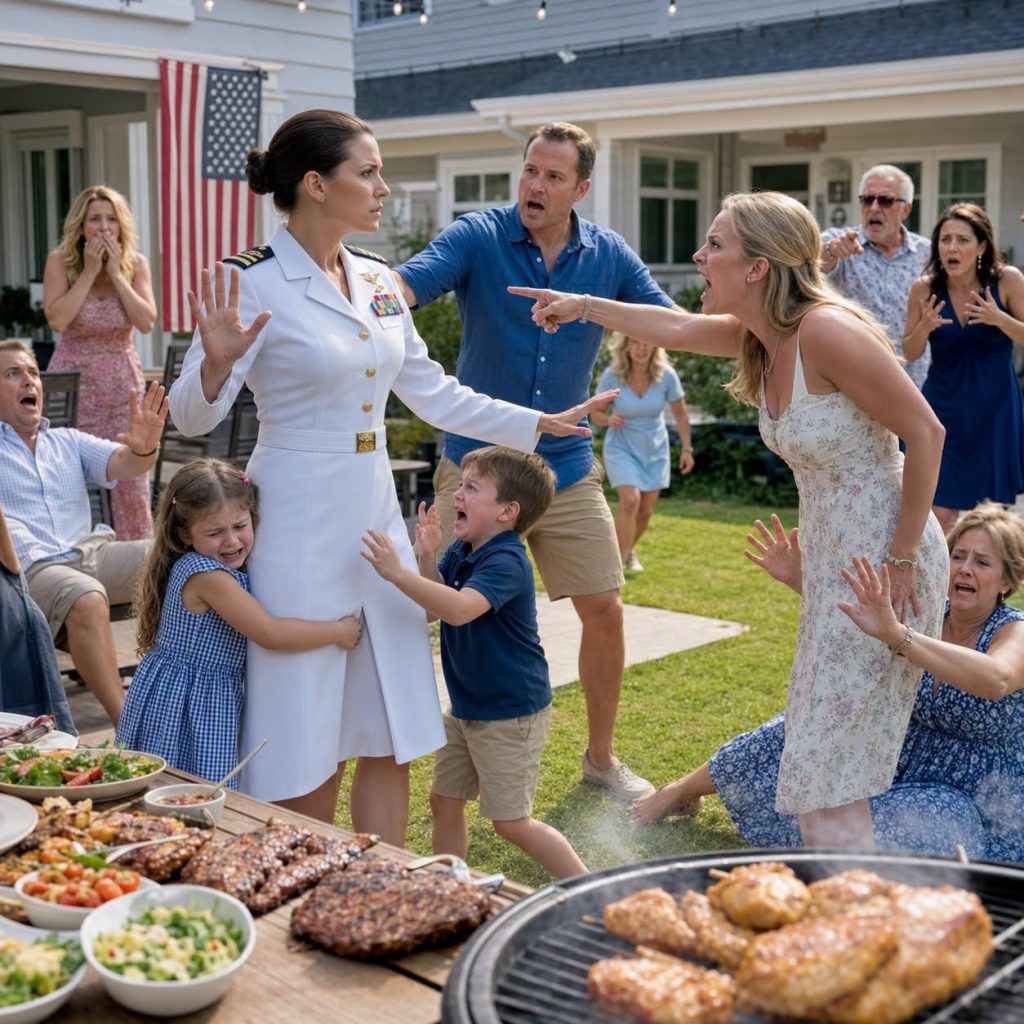
Vanessa sat at the defense table, her hair pulled back into a tight, severe bun. She looked smaller, stripped of her expensive jewelry and champagne-fueled bravado.
The prosecution’s case was surgical.
First, Commander Sarah Lin took the stand, testifying with clinical precision to the timeline, the lack of provocation, and the physical force of the strike.
Then came the key piece of evidence that Sterling had fought for weeks to exclude: the high-definition security camera footage from my parents’ pool house, which David Vance had subpoenaed directly from the security company before my father could delete it.
The large screen in the courtroom illuminated.
The video was crystal clear. It showed Vanessa storming across the patio, wineglass in hand, screaming in my face. It showed me standing still, hands at my sides. It showed her hand sweeping through the air and striking my jaw with maximum force. It showed the wineglass shattering, my daughters flinching, and the smear of blood across my face.
And then, it showed my reaction.
The cold, controlled smile. The steady, measured ten-second pause. The refusal to descend into violence.
When the video stopped, several members of the jury were staring at Vanessa with visible disgust.
When I took the stand, the prosecutor asked me only three questions.
“Commander Bennett, did you at any point physically provoke the defendant?”
“No.”
“Did you make any threats of physical violence against her or her family?”
“No. I offered her ten seconds to step away before I initiated legal protocols.”
“Why did you wait ten seconds?”
I looked directly at the jury, then shifted my eyes to Vanessa.
“Because in the Navy, we are trained never to react out of anger,” I testified, my voice firm and clear. “We are trained to assess the threat, consider the consequences, and act with absolute precision. I wanted to give her one final chance to choose the right path. She chose violence. And choices have consequences.”
The jury deliberated for less than forty minutes.
“We, the jury, find the defendant, Vanessa Marie Bennett, guilty of simple assault and battery.”
Judge Mercer sentenced Vanessa to ninety days in county jail, with sixty days suspended, thirty days to be served immediately, along with one hundred hours of community service and mandatory anger management courses.
As the bailiffs led a weeping Vanessa away to begin her sentence, Grant tried to reach for her, but his own defense lawyer pulled him back, warning him to save his energy for the federal prosecutors waiting for him outside.
Chapter 10 – The Reckoning
The fall of the house of Bennett came swift and relentless over the autumn months.
Following the forensic audit and the IRS investigation, Grant Bennett was formally indicted on four federal counts of wire fraud, tax evasion, and forgery. Facing overwhelming documentary evidence and my handwriting expert’s testimony, he entered a guilty plea to avoid a maximum twenty-year sentence. He was sentenced to three and a half years in federal prison and ordered to pay six hundred thousand dollars in restitution.
To cover the restitution and keep Grant out of a maximum-security facility, my father was forced to liquidate his retirement accounts, sell the family estate on Sycamore Crest Drive, and dissolve his accounting firm under the weight of professional misconduct inquiries.
Richard and Eleanor moved into a modest two-bedroom rental apartment on the outskirts of the city—far from the country clubs, the jazz quartets, and the high-society circles they had sacrificed their integrity to impress.
One evening in late November, a large cardboard box arrived at my doorstep.
It was from my mother. Inside were old photograph albums, my childhood ribbons from swim meets that I thought had been thrown away, and a handwritten letter on plain lined paper.
I sat at my desk and opened the letter.
Dear Lauren,
I don’t expect you to forgive me. I know now that no apology on paper can undo thirty years of making you feel second best.
When Grant was born, your father and I put all our hopes into him. We built an idea of what our family was supposed to look like, and we were too weak, too proud, and too foolish to see that he was crumbling under that pressure while you were growing strong on your own.
When you adopted Maya and Lily, I was afraid. I was afraid because you were building something real, something that didn’t depend on us, and it made me realize how hollow our own lives were. Vanessa brought out the worst in us because she fed the illusion we wanted to keep.
Your father doesn’t talk much anymore. He sits by the window and watches the cars go by. He asked me to tell you that he watched the video of your military promotion ceremony from three years ago on the computer last night. He cried.



