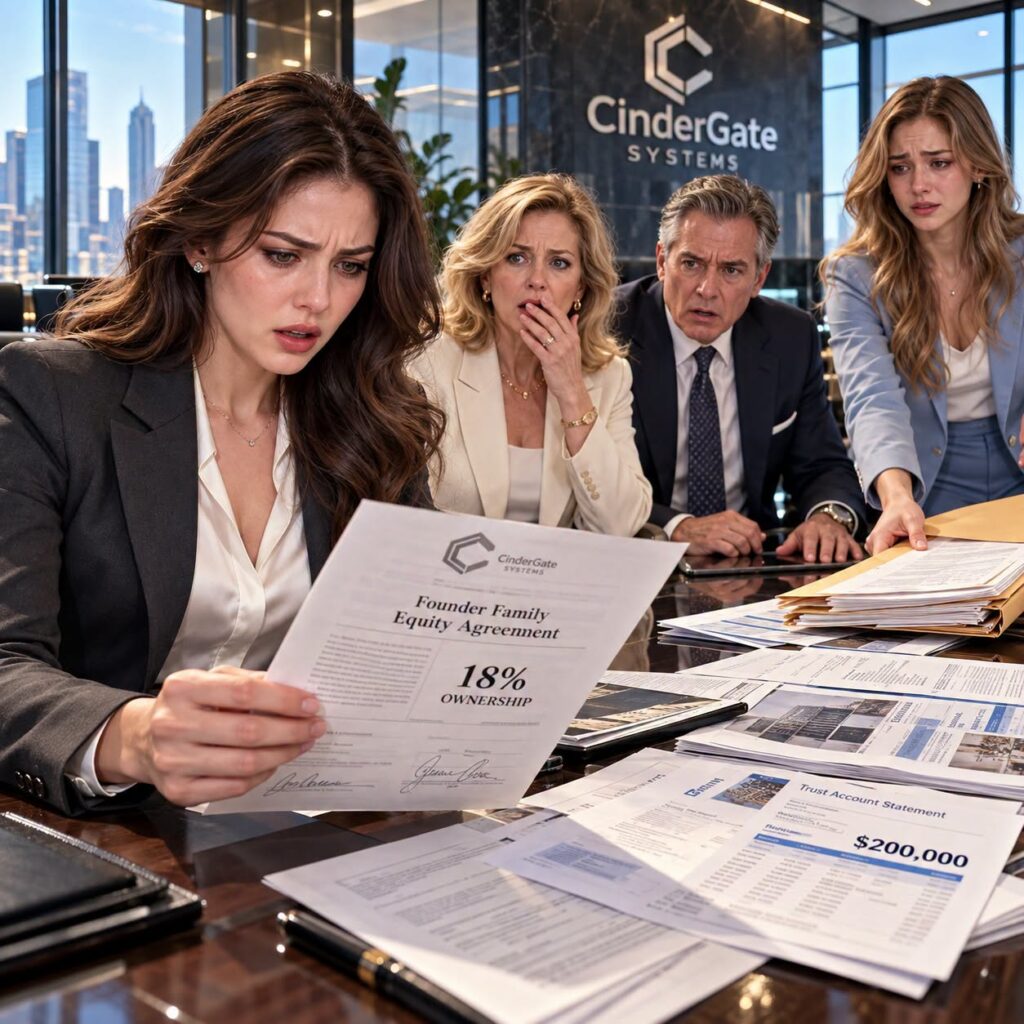
The money had been withdrawn when I was fifteen.
I had never known the trust existed.
“Where did this go?” I asked.
My mother’s expression finally cracked.
Nora answered. “That is what we’ve been investigating since Friday.”
Friday.
Three days earlier.
Before my parents ever walked into my building.
My phone vibrated.
A text from an unknown number appeared.
Maya, it’s Brianna. Don’t let them leave. I sent Nora the records.
I looked through the glass wall.
My sister was standing in the hallway, white-faced, clutching a thick manila envelope.
She entered without waiting to be invited.
Dad stood. “Brianna, go downstairs.”
“No.”
It was the first time I had ever heard her say that to him.
She put the envelope on the table.
Inside were old bank statements, copies of emails, trust documents, and printouts from my father’s accounting system.
Brianna looked at me, but she couldn’t hold my gaze.
“The $200,000 wasn’t invested in your company,” she said. “Dad moved it out of your trust, then used part of it to cover losses in his business.”
My mother snapped, “You have no idea what you’re talking about.”
Brianna flinched, but stayed seated.
Then she said something that made the room go completely still.
“Maya, they didn’t send you away because I didn’t like you.”
My chest tightened.
She pushed one final email across the table.
“They sent you away because Aunt Leah had started asking questions about your money.”
I didn’t touch the email at first.
For twelve years, I had carried one sentence like a stone in my chest: Your sister doesn’t want you here.
I remembered my mother saying it while she stuffed my clothes into garbage bags. I remembered my father refusing to look at me. I remembered five-year-old Brianna crying in the hallway.
Now she was sitting across from me with tears in her eyes.
“Read it,” she said.
The email was from my mother to my father, dated six weeks before they left me with Leah.
Leah is asking why Maya’s account is down again. If she keeps digging, she’ll figure out what Robert transferred. Let her take Maya for a while. We can say the girls can’t live together. It solves both problems.
I read it three times.
The story in the records was ugly, but simple.
My maternal grandfather had created educational trusts for Brianna and me before he died. My parents controlled mine while I was a minor.
By the time I was seven, they had already taken tens of thousands from it to cover debts in my father’s struggling industrial supply company.
Aunt Leah noticed irregularities and started asking questions.
Instead of answering, my parents created a family crisis.
They encouraged every argument between Brianna and me. They told relatives I was jealous and impossible to manage. When Brianna screamed that she hated me during a childish fight, my mother turned it into proof that our home had become “unsafe.”
Then they drove me to Leah’s.
They expected the arrangement to be temporary.
Leah made it permanent. She became my guardian, moved me to Denver, and later adopted me.
Years later, when I was fifteen, my parents removed another $200,000 from the trust using documents that described the withdrawal as approved expenses for my education.
The money went into Mercer Industrial Supply.
My father used it to keep his company from defaulting.
Now my mother had rewritten that theft as an investment in CinderGate.
If I accepted the story, they could demand 18 percent of a $6 billion company. If I rejected it publicly, they planned to accuse me of concealing a family investment from our board.
“That’s why they came today,” Brianna said. “Dad’s company is collapsing again.”
My father struck the table.
“Enough.”
Nora looked toward the security officer outside the glass wall.
Brianna kept talking. She had found the forged equity agreement two weeks earlier while helping our father prepare records for a lender. She also found a draft email he planned to send to business reporters if I refused to negotiate.
Then came the detail that hurt most.
My parents had known exactly who I was when they entered the building.
They had followed every article about CinderGate for years.
My mother had called me a cleaner deliberately.
I looked at her.
“You knew.”
She said nothing.
Brianna whispered, “Yes.”
Suddenly the lobby made sense. My father had planned to corner me after the supplier summit. My mother saw me first and decided humiliation would soften me up.
There was another reason they were there.
Mercer Industrial Supply was competing for a CinderGate facilities contract worth nearly $38 million over five years.
They were demanding a fake ownership stake while asking my company to rescue theirs.
Nora closed the folder.
“That procurement review is suspended immediately.”



