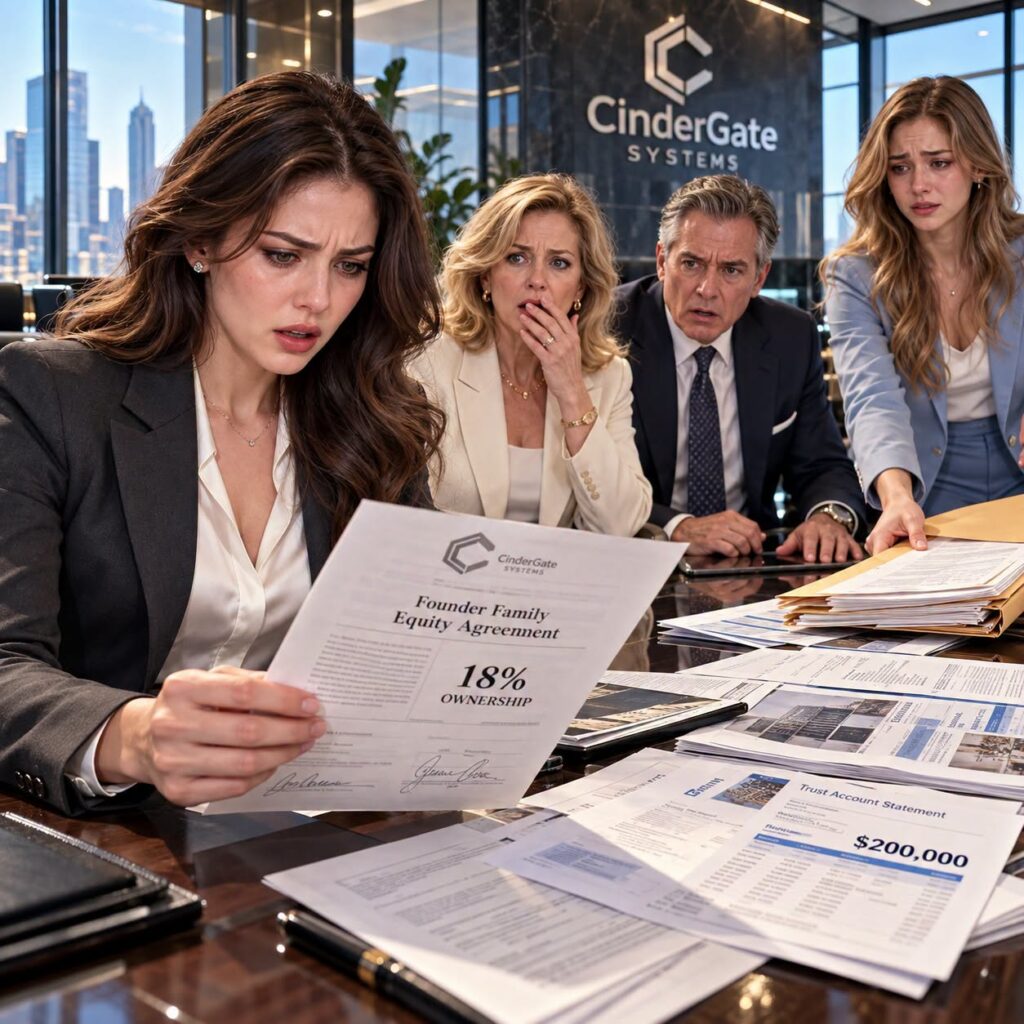
Dad looked at me. “Maya, don’t destroy hundreds of jobs because you’re emotional.”
That sentence erased the last bit of guilt I felt.
He had made the mess, and I was supposed to feel guilty for refusing to clean it up.
“I’m not destroying your company,” I said. “I’m refusing to let you use mine to save it.”
My mother leaned forward.
“We are your family.”
“No,” I said. “Leah was my family.”
Nora told them the documents would remain with our legal team. CinderGate would report the suspected forgery, and my personal attorney would pursue the missing trust funds.
Security escorted them out.
At the door, my mother turned.
“After everything we did for you, you’ll regret this.”
For the first time, the threat sounded small.
The next six months were exhausting.
An independent review confirmed my parents had never owned equity in CinderGate. The fake agreement appeared nowhere in our legitimate corporate records.
Investigators also traced transfers from my childhood trust into Mercer Industrial Supply and accounts controlled by my parents. Their lender uncovered altered records in a refinancing application.
My father’s company lost the CinderGate bid and entered restructuring. My parents sold property, and a civil settlement returned most of the trust money with interest. My father later accepted a plea agreement involving falsified financial documents. My mother received probation for her role.
None of it felt like revenge.
Mostly, it felt like paperwork.
The emotional part was harder.
Three months after the confrontation, Brianna came to Austin.
We met at a quiet coffee shop.
“I was awful to you,” she said.
“You were five.”
“I got older.”
That answer mattered.
She admitted our parents rewarded her whenever she repeated their version of the story. As she grew older, she learned not to ask about me. Being the favored daughter had felt like love until she realized it was control.
“I don’t expect you to forgive me.”
I believed her.
“I don’t know if I can be your sister the way you want,” I said. “But I’m willing to find out who you are now.”
We started slowly. Birthday messages. Occasional coffee. No dramatic reunion and no pretending twelve years had disappeared.
Aunt Leah was easier.
When I told her everything, she cried, then scolded me for waiting until after the board meeting to call.
“That company may be worth six billion dollars,” she said, “but apparently its CEO still doesn’t know when to call her aunt.”
I laughed harder than I had in months.
A year later, CinderGate launched a scholarship program for teenagers aging out of unstable homes.
I named it the Leah Hart Opportunity Fund.
At the launch, a reporter asked who deserved the most credit for my success.
I thought about my mother loudly claiming she had always believed in me.
Then I thought about Leah sitting with me at a kitchen table when I was eleven, telling me my ideas were worth listening to.
“My aunt gave me something more valuable than money,” I said. “She gave me a safe place to become myself.”
That night, I stood alone in the CinderGate lobby.
For years, I thought my greatest victory would be making the people who abandoned me regret it.
I was wrong.
My greatest victory was realizing I no longer needed their regret.
They could rewrite the past, call my survival their sacrifice, or claim ownership of what I built.
But they could not own the life I created after they walked away.
And for the first time since I was seven, that was enough.



