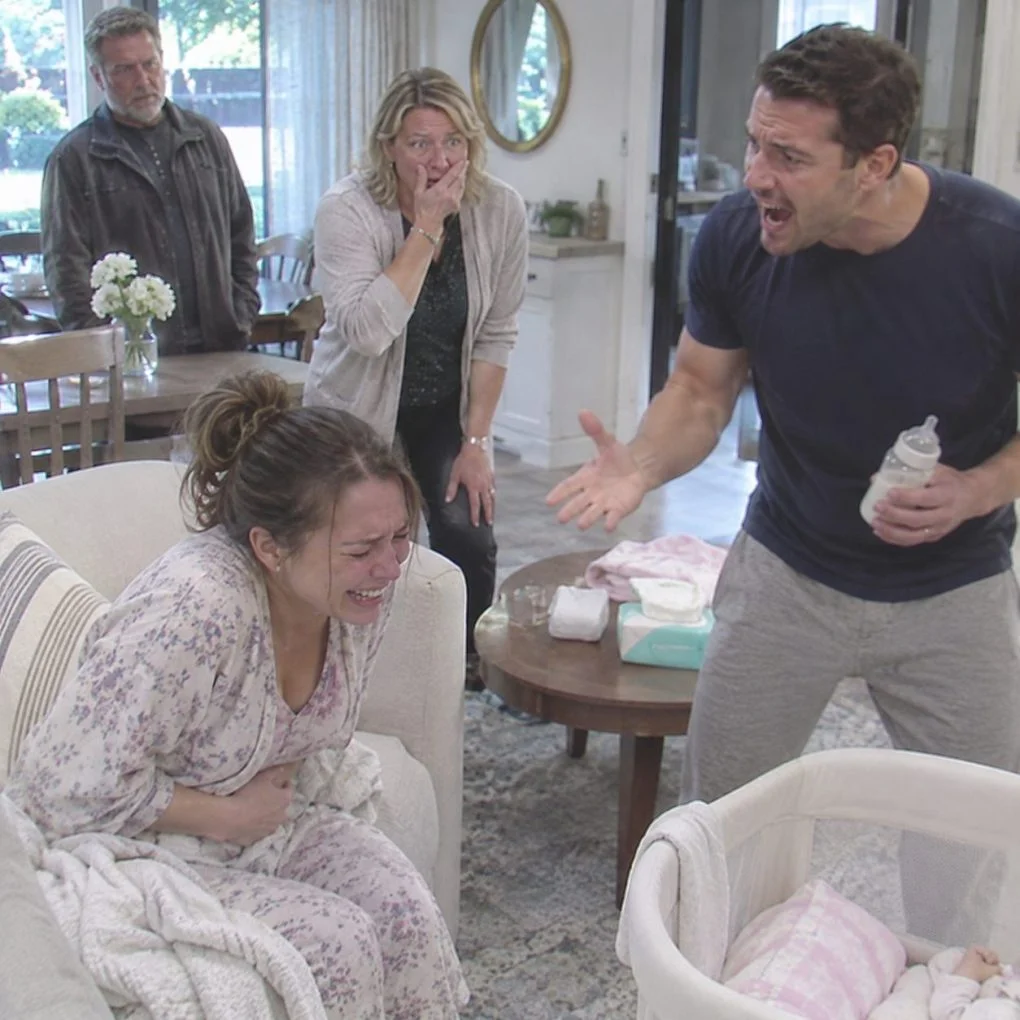
That afternoon the family chat started filling with messages. Jack’s mother, Diane, wrote that I’d “overworked myself trying to prove I could handle motherhood,” and Jack replied, “She didn’t listen when I told her to slow down.”
I read those words while a nurse checked my blood pressure. I wanted to type a furious answer, but my fingers were still clumsy, so I placed the phone facedown and asked Hannah to save screenshots.
The worst part was missing Lucy. Hannah brought her to visit when the doctor said it was okay, and I held her against my hospital gown with a pillow supporting my arm. Her mouth opened against my collarbone, searching for comfort, and I cried because she’d been safe in her bassinet while I lay unconscious inches away.
“Don’t worry,” Hannah whispered. “I can help until you’re stronger.”
Two nights later I discovered why Jack’s family suddenly wanted Lucy to stay at Diane’s house. A message arrived in the family chat from Diane: “Tell your lawyer she passed out while responsible for the baby. Send him the camera picture.”
Below it, Jack posted a cropped still from our nursery monitor: me lying motionless on the floor, with the bassinet cut completely out of the frame.
His message read, “If she fights me over custody, this shows she isn’t safe alone with Lucy.”
I opened the nursery app. The original recording was still there, showing Lucy asleep in the bassinet, and, hours earlier, Jack shouting at me before walking away.
He wasn’t simply trying to explain what had happened.
He was preparing to use the night I almost died as evidence that I didn’t deserve my daughter.
“Would you have come sooner if someone had brought you in?” she asked.
I stared at my hands. “I thought I was making too much of it.”
“You knew I asked the nurse for help,” I said.
He stared at the floor. “I thought she’d tell you to rest. I was tired too.”
“Don’t worry,” Hannah whispered. “I can help until you’re stronger.”
His message read, “If she fights me over custody, this shows she isn’t safe alone with Lucy.”
He wasn’t simply trying to explain what had happened.
He was preparing to use the night I almost died as evidence that I didn’t deserve my daughter.
I downloaded the complete nursery recording at the hospital. Hannah saved copies of the messages and the medical discharge summary, and I spoke to a family-law attorney once I was stronger.
When Jack visited, he brought flowers and said he wanted us to forget “the terrible misunderstanding.” I looked at the lilies, wrapped in plastic, and remembered asking him for water while bleeding; he’d told me to get it myself.
“You told your family I was careless,” I said. “Then you sent them a photograph to help take Lucy.”
His jaw tightened. “Mom was worried about the baby.”
“So was I. That’s why I called the nurse.”
I stayed with Hannah while I recovered, following my doctor’s advice about rest and feeding. Jack had regular time with Lucy by agreement, but I would no longer leave our daughter’s care—or the story of what had happened—to whatever he told his mother.
Diane demanded a family meeting, saying everyone needed to hear why I was “keeping Jack from his child.” I agreed to meet once, with Hannah beside me, because relatives were asking if I’d dropped Lucy.
At Diane’s dining table, Jack said I’d been overwhelmed by motherhood. His mother folded her hands and announced that she was willing to take Lucy “until Emma could be trusted again,” as though surviving a medical emergency were a character flaw.
I opened my laptop. First I showed them the nurse’s documented instruction to seek urgent medical evaluation and the messages I’d sent Jack asking for a ride. Then I played the nursery footage: his shout, my struggle to stand, and Lucy asleep in her bassinet when I collapsed.
No one moved. Jack’s aunt, who had repeated Diane’s story to the rest of the family, pressed a napkin against her mouth; Diane stared at the screen as though looking long enough might make the images change.
“You told everyone I couldn’t handle being a mother,” I said, keeping my voice steady. “I was bleeding badly enough to need surgery and transfusions, and when I survived, you tried to make that the reason I should lose my daughter.”
Jack whispered, “I was scared.”
“I know. I heard it when you called 911. But you chose to turn that fear into a lie about me.”
Diane began to argue, and I closed the laptop. “I’m not asking for permission to recover, and I’m not allowing you to tell Lucy that I endangered her because I got sick.”



