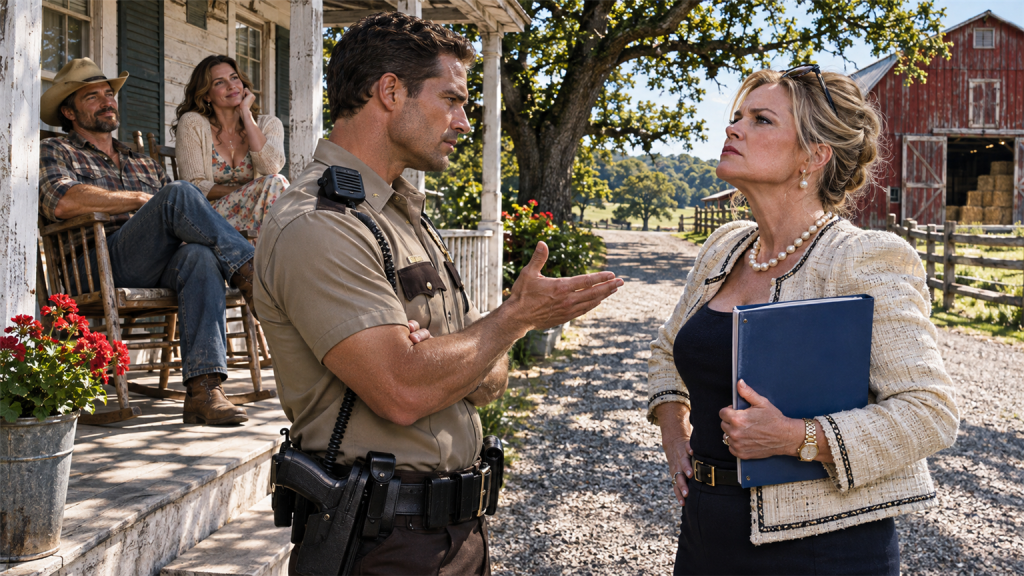
“You called 911?”
“I reported a dangerous situation.”
The deputy asked for documentation showing Hawthorne Ridge had authority over my property.
Cynthia eagerly opened her binder.
She produced the HOA bylaws.
The deputy read the highlighted paragraph.
Then looked at her.
“This says your association considers adjacent properties subject to certain standards.”
“Exactly.”
“No, ma’am.”
Her face stiffened.
“No?”
“This is an internal HOA document. Where is the deed restriction?”
Silence.
“County record?”
Nothing.
“Signed covenant?”
Cynthia’s fingers tightened around the binder.
“Our attorney is preparing a legal opinion.”
The deputy closed the binder.
“So you called 911 to enforce a claim your own attorney hasn’t established?”
For the first time in months, Cynthia Lowell looked uncertain.
Then the deputy glanced at me.
“Sir, how long has this been happening?”
I looked toward the farmhouse.
Then toward the camera above the porch.
“Long enough that I have every notice, every photograph, every trespass, and today’s visit on video.”
Cynthia stopped breathing for half a second.
And that was when I knew she had finally given me something more useful than another fake fine…
The deputy told Cynthia that an HOA violation was a civil issue and that calling 911 to force an inspection of property she could not even prove belonged to the association was another matter entirely. He advised her to leave and warned her not to use emergency services again for a non-emergency dispute. Before driving away, he recommended that I document everything and speak with an attorney if the harassment continued.
I did exactly that.
Attorney Melissa Crane reviewed my deed, title report, agricultural zoning, security footage, violation notices, and the sheriff’s incident report. Her conclusion was simple: Hawthorne Ridge had no recorded authority over our farm. She sent a cease-and-desist letter demanding that Cynthia and the HOA stop entering the property, stop issuing notices, stop claiming jurisdiction, and stop contacting Laura or me except through counsel.
Cynthia ignored it.
A camera caught her photographing the fence again.
Three days later, another notice appeared on our front door claiming we owed more than $3,000 and warning that “legal collection proceedings” were imminent.
Melissa called the HOA’s actual attorney.
He had never seen our parcel.
He had never approved Cynthia’s inspections.
He had never told her adjacent farms were mandatory members.
There was a long silence after Melissa finished describing the 911 call.
Then the attorney said:
“I need to speak to my client.”
Two days later, a Hawthorne Ridge board member called me.
“Mr. Grant, the board was not aware of what Cynthia has been doing.”
I looked out toward the fence.
“So she acted alone?”
Another silence.
“Mostly.”
That word told me the problem was much bigger than one woman with a binder.
of 5
Board member Patricia Wells called to apologize. After reviewing the records, Hawthorne Ridge had confirmed that our farm was outside the subdivision. Cynthia’s violation notices had never been approved by a board vote; she had created them herself through the management portal.
The board ordered every notice voided and decided not to oppose the protective order Melissa had requested after Cynthia’s 911 call.
Twelve days later, Cynthia entered court wearing her Hawthorne Ridge polo shirt, still trying to appear official. The judge reviewed surveillance footage, violation notices, the interior-inspection demand, my certified objections, Melissa’s cease-and-desist letter, and the sheriff’s report.
Cynthia claimed she had called 911 because our barn posed an immediate danger. Under questioning, she admitted it was neither burning nor collapsing and that nobody was injured or threatening violence. Her true “emergency” was my refusal to obey HOA demands.
“Refusing HOA compliance is not a 911 emergency,” the judge told her.
Melissa then presented our deed, agricultural classification, subdivision boundary, and title records. Nothing connected the farm to Hawthorne Ridge. Cynthia relied only on an adjacency provision but could produce no document granting the HOA jurisdiction.
The judge ordered her to stay off our property, avoid direct contact with Laura or me, stop placing notices on our home, and refrain from sending third parties to inspect or enforce anything against the farm. Cynthia also had to reimburse part of my attorney’s fees.
I expected the order to end the dispute. Instead, Hawthorne Ridge residents began contacting us.
Robert Chen had paid $1,800 over a basketball hoop. Denise Holloway spent $2,400 hiding her vegetable garden. Paul Mercer replaced a mailbox identical to those still used by his neighbors.
Most residents had surrendered because fighting seemed more expensive than paying.
Then Robert brought HOA financial statements. Nobody could clearly explain them, and residents suspected Cynthia’s authority extended far beyond violation notices.
Patricia soon called again.
The board was scheduling a special confidence vote.
of 5
Laura and I attended the packed special meeting as observers. Cynthia opened by accusing outside parties of spreading misinformation, but Patricia reminded her that the meeting concerned board governance, not me.



