The HOA’s attorney confirmed that our farm had never belonged to Hawthorne Ridge. Cynthia had no legal basis to fine us, demand inspections, or summon law enforcement in the association’s name.
Management records showed she had opened violation cases without board approval. When staff questioned whether certain actions were supported by the governing documents, Cynthia ordered them to proceed anyway.
Then homeowners began speaking.
Robert described the basketball hoop. Denise discussed her vegetable garden. Paul explained the selective mailbox demand. Others described fines involving trash cans, Christmas lights, fences, and countless small humiliations. Some residents had changed things they loved, paid questionable penalties, or even sold their homes because fighting felt impossible.
Cynthia hammered the gavel and called the meeting chaos.
“No,” Patricia answered. “This is what happens when people finally get to speak.”
When Robert questioned the finances, the HOA attorney recommended an independent audit. Cynthia objected, claiming the treasurer already conducted annual reviews. But the treasurer had resigned five months earlier, and no replacement existed.
Residents voted overwhelmingly to remove Cynthia as president.
The audit did not reveal a dramatic million-dollar theft. Instead, it uncovered something more believable and equally damaging: poor documentation, unexplained legal costs, contracts renewed without bids, fine revenue covering shortages, spending without complete minutes, and hundreds of inconsistent enforcement actions.
The system had become so weak that nobody could distinguish Cynthia’s personal judgment from legitimate HOA authority.
The new board reversed dozens of fines, issued refunds and apologies, replaced the management company, published financial records online, recorded meetings, created an independent appeals process, and required multiple people to approve major enforcement.
Most importantly, Hawthorne Ridge recorded a formal county document acknowledging that the Grant farm was outside its jurisdiction and exempt from its rules, fees, inspections, and architectural controls.
Two months later, Cynthia listed her house for sale.
of 5
After Cynthia left, residents felt both relieved and embarrassed that her behavior had continued for years. I understood why.
Resisting petty authority sounds easy from the outside. But lawyers cost money, court consumes time, and neighborhood conflict follows people home. Sometimes paying three hundred dollars seems easier than fighting someone who lives three doors away.
That is how overreach survives—not because everyone agrees, but because resistance is inconvenient.
Several months later, Laura and I bought six goats. Within forty-eight hours, one escaped through a fence I had spent three days repairing. A Hawthorne Ridge neighbor helped me catch her, and we stood laughing beside the pasture. Nobody mentioned HOA rules, photographed the barn, or tried to inspect anything.
That evening, Laura admitted the worst part of Cynthia’s campaign had been learning to listen for approaching cars. Our farm was supposed to represent freedom, but every engine on the gravel driveway had begun to sound like another threat.
Melissa’s legal work had not merely won an argument. It restored the boundary between someone else’s authority and our home.
I replaced the old gate sign with one reading, “GRANT FAMILY FARM—PRIVATE PROPERTY—PLEASE CALL BEFORE ENTERING.”
Laura called it too polite. I said I was trying to rebuild my reputation with the goats.
Property boundaries are more than lines on maps. There are also boundaries between requesting and demanding, concern and control, community rules and another person’s home.
Cynthia crossed every one because she believed nobody would force her back.
I did not defeat her by shouting louder or claiming greater authority. I had something she never produced: a deed, title report, county records, security footage, sheriff’s report, and court order.
For months, she insisted Hawthorne Ridge’s rules applied because she said they did.
In the end, only one principle mattered.
If you claim authority over someone else’s home, eventually someone will ask you to prove it.
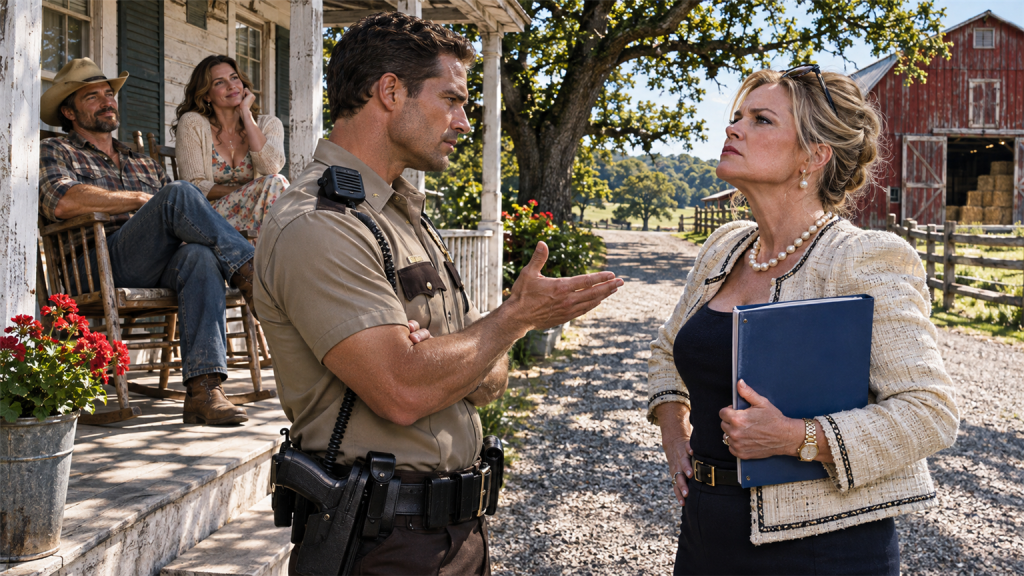
When Cynthia Lowell finally had to prove hers, the blue binder was empty.
THE END



