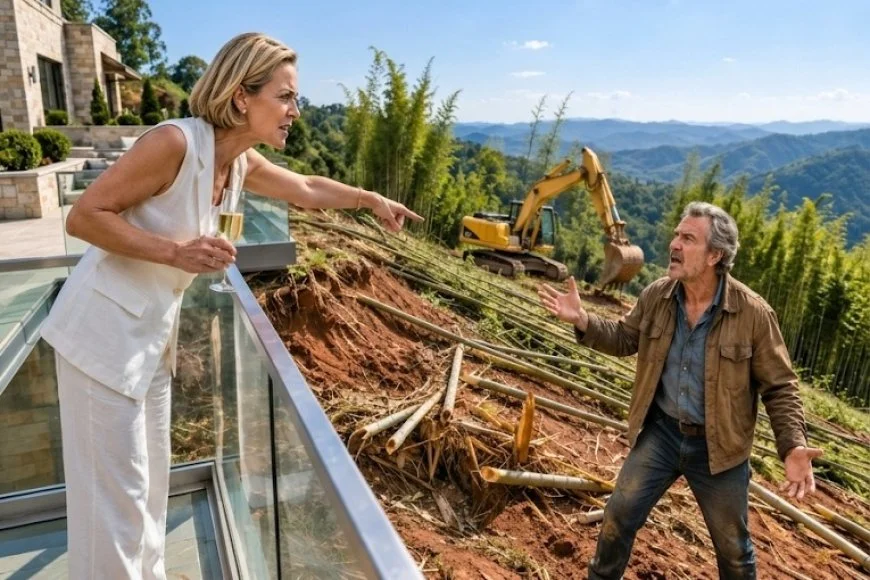
The first thing Rosaline lost was not the house sale.
It was certainty.
I watched that happen on the hillside.
For weeks she had spoken as if every result had already been decided.
My bamboo was an obstruction.
My farm was a nuisance.
Her terrace was legitimate.
The HOA had authority.
The buyer would close.
Then Ingrid read the letter.
Everything became conditional.
Her lawyer asked to see the original.
Rosaline hesitated.
That hesitation told him more than any answer.
Then she reached into the pocket of her coat.
She pulled out an opened envelope.
My envelope.
The same one I had mailed nine weeks earlier.
Her attorney looked at it.
Then at her.
“You told me there had been no correspondence.”
“I forgot.”
He read the letter.
“You opened this?”
“Recently.”
“When?”
She didn’t answer.
The lawyer looked at the survey.
Then the columns.
Then the county notice on the glass door.
He did not embarrass her.
I respected him for that.
He simply said:
“A written license defeats the premise of our adverse-rights argument.”
Rosaline crossed her arms.
“We can still challenge the boundary.”
“The survey appears consistent with the recorded plat.”
“We’ll order another survey.”
“You may.”
Then he lowered his voice.
“But you need separate counsel regarding the permitting issue.”
That was professional language for:
This has become something else.
Dr. Achterberg stood with his wife near the fence.
He looked embarrassed.
“I’m sorry, Mr. Garrity.”
“You didn’t remove anything.”
“No.”
He looked toward the terrace.
“But we were told this was all resolved.”
“I imagine you were told many things.”
Sonova touched his arm.
They left.
Their realtor followed.
By that afternoon, their contract was terminated under the inspection contingency.
The earnest money was released.
Rosaline’s $2.6 million sale disappeared.
I wish I could tell you I felt nothing.
I felt satisfaction.
A lot of it.
I also knew satisfaction was dangerous.
Because I had my own problem.
My compost expansion was still frozen.
Customers were still nervous.
My sour pile still smelled like a brewery had died in the rain.
And winning a property dispute would not pay my operating expenses.
So I went back to work.
Wendell reviewed my modification notice.
Once the boundary filing was withdrawn, the hold could proceed normally.
Rosaline’s lawyer withdrew that dispute three days later.
Not because he had become my friend.
Because the facts no longer supported the claim he had been hired to make.
My county review restarted.
Thirty days later, I received approval for the second pad and additional truck bays, subject to ordinary operating conditions.
No miracle.
No special treatment.
I had filed late.
I served the waiting period.
Then I complied.
The nursery called first.
Their buyer had known me nine years.
“We never thought you were shut down,” he said.
“You stopped ordering.”
“Our lawyers are cowards.”
“Your lawyers are employed.”
“Fair.”
He resumed purchases.
The first vineyard followed.
Then the second.
Not all at once.
Trust returns slower than gossip.
But it returned.
Meanwhile, Cloud Mirror Heights had its own crisis.
Ingrid Solheim had been secretary and treasurer for twenty-two years.
She knew where every minute was stored.
Every reimbursement.
Every committee approval.
Every reserve transfer.
Once the board began reviewing Rosaline’s actions, they found the bamboo removal had cost the association $18,400.
No properly recorded board vote authorized it.
The work order described removal of “vegetative obstruction within community view corridor.”
There was no mention that the plants stood on private land.
No written permission from me.
No survey.
No legal opinion.
No access agreement.
Rosaline had approved the work herself.
That same review uncovered the terrace file.
Eight years earlier, she had chaired the architectural review committee.
Her own terrace application had been approved.
By her.
A variance from ordinary documentation had been approved.
By her.
The internal inspection checklist had been signed.
By her.
Three different lines.
Same signature.
What the file did not contain was a county permit.
That was when the other board members stopped treating the problem as personal hostility between Rosaline and me.
It had become governance.
The board scheduled a special meeting.
Rosaline attended.
So did I.
I sat in the back.
Ingrid read the motion.
Unauthorized expenditure.
Unapproved entry onto neighboring property.
Removal of private landscaping.
Failure to disclose the boundary issue.
Use of reserve funds without sufficient recorded authorization.
Then the terrace permitting problem.
Rosaline spoke for eleven minutes.
She said she had acted for the good of the community.
She said view protection preserved property values.
She said the bamboo was invasive.
She said the terrace boundary mistake came from an old developer plat.
Some of those things were true.
None answered the real questions.
One board member, Patrick Sloan, finally interrupted.
“Rosaline, a mistake is something you discover.”



