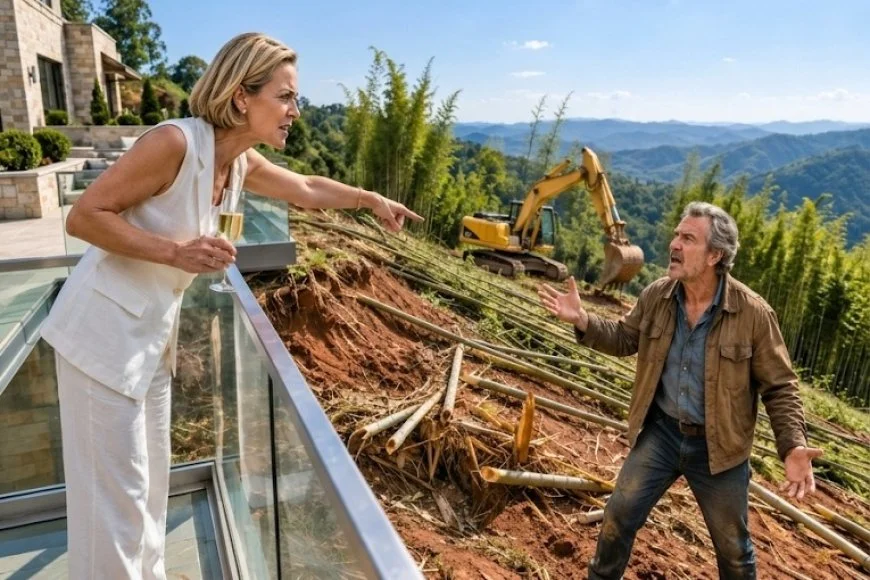
He checked one more box.
“Approved.”
The nursery doubled its order.
Both vineyards returned.
A stable signed a long-term bedding agreement.
The operation became busier than it had ever been.
Not because I had defeated Rosaline.
Because the dispute forced me to stop treating my own lawful business like something shameful that needed hiding.
That was another uncomfortable lesson.
I had allowed the bamboo to become a social contract nobody ever signed.
I hid the farm.
The homeowners pretended it wasn’t there.
Everyone remained peaceful.
Until one person decided the screen belonged to her.
Maybe harmony built on invisibility isn’t harmony.
Maybe it is just delayed conflict.
Rosaline came to my gate once in April.
On foot.
Plain coat.
Small schnauzer.
No champagne.
No board folder.
I was repairing a fence when she stopped outside.
“I want to ask you something.”
“Go ahead.”
“You were two hours away when the excavator came.”
“Yes.”
“Your cameras recorded everything.”
“Yes.”
“You could have stopped it.”
I put the pliers down.
“The entire stand came down in nine minutes.”
“You could have called.”
“Who?”
“The operator.”
“He had a signed work order.”
“The board.”
“You were the president.”
She looked away.
“The police.”
“To report landscaping crews removing plants under an HOA work order while I was two hours away?”
She said nothing.
I stepped closer to the gate.
“The only person who could have stopped it before the first bucket moved was the person who ordered it.”
Her eyes lowered to the dog.
“You wrote that letter because you knew this would happen.”
“No.”
“You knew I wanted the view.”
“Yes.”
“That’s the same thing.”
“No.”
I thought about the wording.
“I wrote it because when somebody starts talking about your property like it belongs to them, you put things in writing.”
She looked up toward the mountains.
“You really kept quiet about the terrace for eight years?”
“Yes.”
“Why?”
“Because it didn’t hurt anything.”
“And then?”
I pointed toward the replacement screen beginning to leaf out.
“Then you removed the thing my permission depended on.”
A light rain began.
She did not move.
After a while, she looked across my farm.
Steam rose from a windrow.
A loader crossed the back pad.
Young cedars moved in the wind.
“It’s still a beautiful view,” she said.
I smiled.
“I know.”
“You don’t mind people enjoying it?”
“Not at all.”
She looked confused.
“Then what was all this about?”
“The difference between enjoying something and believing you own it.”
She absorbed that.
Then turned back uphill.
No apology.
I didn’t ask for one.
By then, I had learned that apologies are useful only when they change what happens next.
The new board had changed what happened next.
Contractor entry onto neighboring land required written owner consent.
Property-line questions required surveys before work.
Board officers could not approve contracts with themselves as sole authorizing authority.
View complaints involving external parcels were outside HOA enforcement.
Reserve expenditures above a set amount needed recorded votes.
Ingrid sent minutes within forty-eight hours.
Boring governance.
Beautiful governance.
The replacement screen grew.
Slowly.
By the second year, the river cane was over my head.
Cedars thickened.
Birds nested in them.
The mountains began disappearing again from the lower portion of Rosaline’s view.
Nobody filed a complaint.
The farm stayed visible through the gaps.
That seemed fair.
One autumn afternoon, Dr. Achterberg mailed me a handwritten note.
Inside was a request for one cubic yard of finished compost.
For roses.
I loaded it into my own truck and delivered it to Atlanta while visiting family.
He offered to pay freight.
I refused.
Sonova showed me the roses.
They were impressive.
“Lionel says this entire mess saved us from buying the wrong house.”
“It wasn’t a bad house.”
“No.”
She smiled.
“It was the wrong story.”
I understood.
Years later, the detail I remember most is not the excavator.
Not Rosaline’s champagne.
Not the survey stakes.
Not the orange unsafe-structure sticker.
It is the certified-mail receipt.
Small green card.
Signature.
Date.
Proof that a warning had reached the place it was supposed to reach.
People think property battles are won by clever revenge.
Most aren’t.
They are won by surveys.
Permits.
Receipts.
Dates.
Letters.
And the discipline to stop shouting long enough for documents to become useful.
I still keep that receipt above my filing cabinet.
Beside it hangs Ingrid’s sentence:
A VIEW IS AN AMENITY. IT IS NOT OWNERSHIP.
From my kitchen window, I can see the new screen.
Beyond it, if I move slightly to the left, I can still see part of Rosaline’s terrace.
Twenty-seven feet now.
Shorter.
Properly supported.
Entirely hers.
Sometimes she stands there near sunset with a glass in her hand.
Below her, my compost windrows steam in cold weather.



