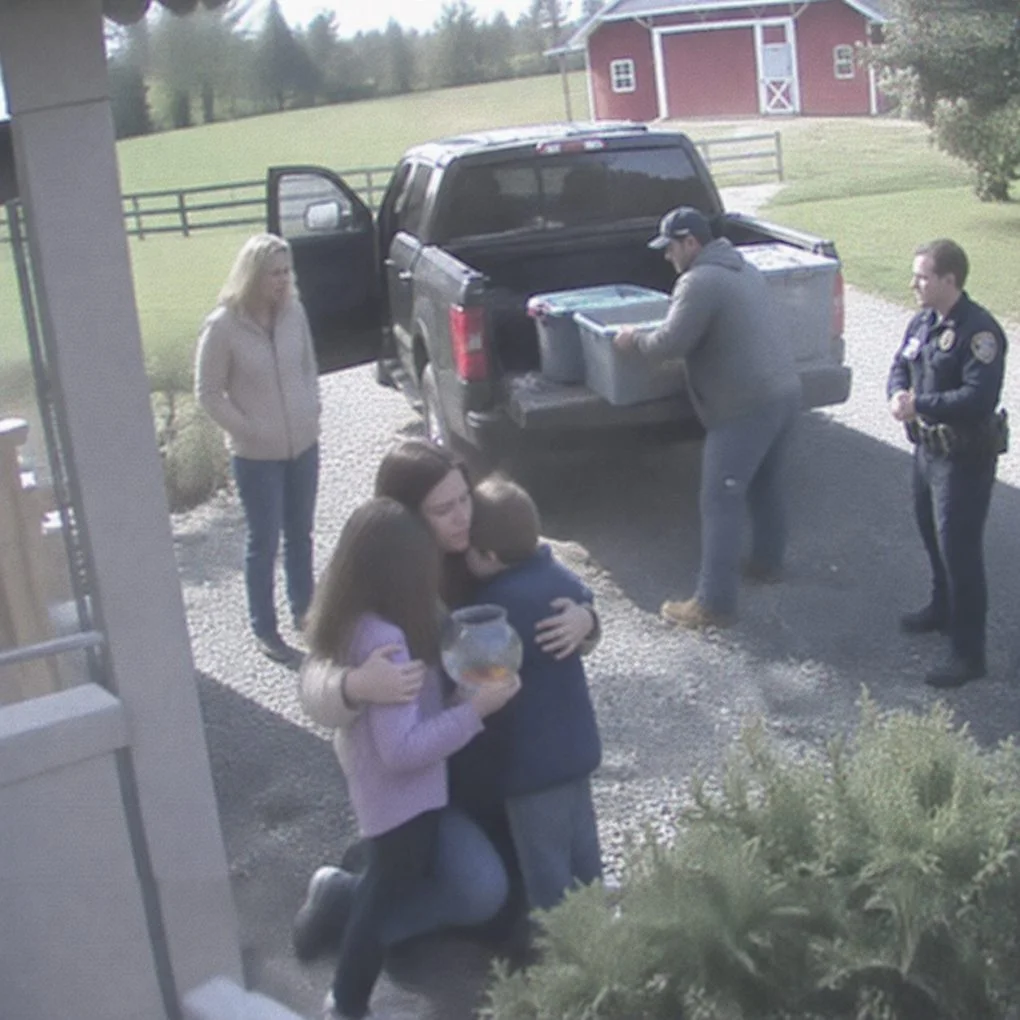
My daughter was only eight when she told me her father had a secret place where he planned to take her and her brother. “But not you, Mommy,” she whispered. “Daddy says you don’t belong with us.” I tried to convince myself it was some strange game. Then, at 4:07 a.m., I walked into their bedrooms and found both beds empty. What I discovered about my husband’s preparations made my blood run cold…
“Mommy, can I bring my goldfish to the bunker?” my eight-year-old daughter asked, balancing a spoon across her cereal bowl. Before I could answer, Lily added, “Daddy says when the bad day comes, he’s taking me and Otis. You can’t come, because you’re not one of us.”
My husband, Adam, was standing at the sink. He kept washing the same coffee mug, even after the water had gone cold, while our five-year-old son pushed his toast into neat little squares. “It’s a game,” Adam said without turning around. “Lily gets carried away.”
But Lily wasn’t smiling. She lowered her voice and asked whether Penny, her little orange goldfish, would be frightened underground, and I noticed Adam’s muddy work boots by the back door even though he’d told me he was spending the week at his electrical supply office.
For eighteen months, he’d been filling our garage with emergency supplies and talking about a day when roads, banks, and phones would stop working. I’d tried to understand his fears, just as he’d once understood mine when my father died and I couldn’t bear to throw away his old flannel shirt. But lately Adam spoke about “protecting the family” as though I were a problem standing outside it.
That night I asked him what Lily meant. He kissed my forehead and said his mother’s old farm had a reinforced storm cellar, nothing more; when I said frightening our children wasn’t preparation, he answered, “You never take me seriously.”
Two mornings later, I woke at 4:03 to a noise I couldn’t place. It took me several seconds to recognize it: the absence of the little filter humming in Lily’s bedroom, where Penny’s bowl stood beside a paper moon she’d taped to the window.
Both beds were empty. Lily’s pink sneakers were gone, along with Otis’s dinosaur blanket, Adam’s overnight bag, and the fishbowl; on Otis’s pillow lay a blue sock he always refused to sleep without.
I called Adam three times, then 911. While the dispatcher asked what the children had been wearing, I opened our doorbell camera and watched Adam load them into his truck at 2:11 a.m.; Lily was holding the fishbowl carefully with both hands, her eyes fixed on our dark front door.
The printer in Adam’s office still held a page headed FAMILY RELOCATION PLAN. Under a line marked “What to tell authorities,” he had typed: “Mother chose not to accompany us. She consented to the children’s relocation.”
Beneath it was my signature. I had never signed a thing.…The rest of the story unfolds here.
The police officer who came to our house looked at the page, then at the video of Lily carrying Penny through the driveway. “Because he’s their father, custody can be complicated without a court order,” she said, “but two missing children and a forged consent are not something we’re going to ignore.” She recorded the information and began a welfare inquiry while I gave her everything I knew about Adam’s mother’s farm.
It was outside Athens, almost two hours from our home in Columbus. Adam’s mother, Ruth, had always called it her refuge, a place with an apple tree and a leaning red barn where the children sometimes spent summer afternoons, but I’d never seen the storm cellar Adam claimed he was repairing.
I kept remembering Lily at breakfast, pressing her spoon into soggy cereal while she tried to understand why Mommy didn’t count. When Otis was born early, Adam slept in a hospital chair for four nights because I was afraid to close my eyes; I couldn’t reconcile that man with the one who had carried our children away while I slept.
At 6:40, Ruth finally answered her phone. “Adam says you refused to come,” she told me, her voice trembling. “He said you wanted out of the marriage and agreed he should take the children somewhere safe.”
“Ruth, he made up my consent. Please look at the children and tell them I’m coming.”
There was silence, followed by a muffled voice in the background saying Ruth should hang up. My husband had spent months teaching the children that the bunker was their special place, and now he was teaching everyone else that I’d chosen to be left behind.



