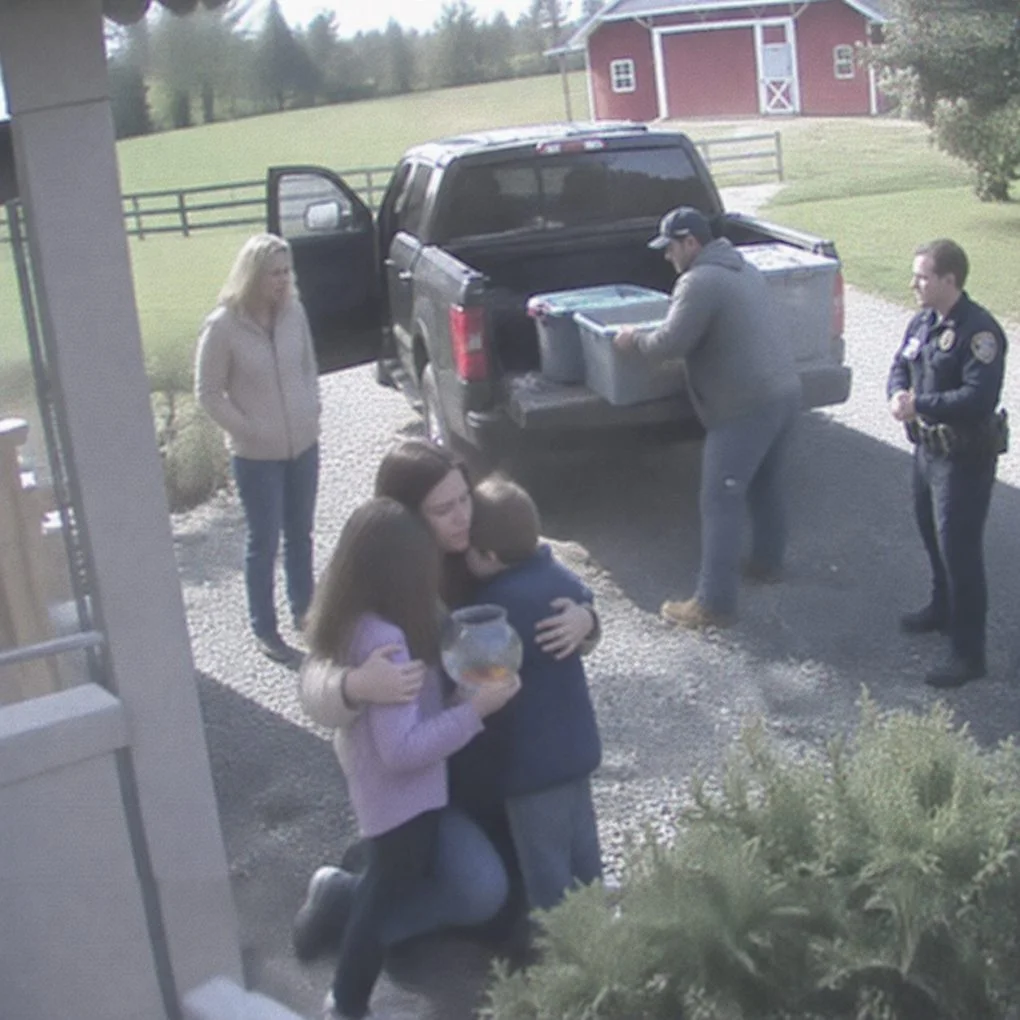
An officer reached the farm that morning and confirmed the children were there and physically unharmed. Adam would not tell me their location directly and insisted they were safer underground, but the deputy arranged for Lily to speak to me while the adults worked out their return.
“Mommy?” she whispered. “Did you change your mind about us?”
I gripped the edge of the kitchen counter until my knuckles whitened. “There is nothing you could do that would make me leave you, sweetheart. I’m coming to get you.”
With my attorney’s advice, I filed for an emergency temporary parenting order, supplying the surveillance video, the forged page, and the messages Adam had sent refusing to disclose the children’s location. The court scheduled an urgent hearing; meanwhile, Ruth persuaded Adam to bring the children upstairs from the cellar and allow her to remain with them.
When I arrived with my sister that afternoon, Lily ran across the farmyard carrying Penny in a plastic travel container. Otis followed in sock feet, dragging his dinosaur blanket through the gravel, and for a moment all I could do was kneel and hold them as if the ground might give way.
Adam watched us from the porch. “You turned my safety plan into a police matter,” he said, but Ruth interrupted him and handed me a thick envelope she had found in the cellar.
Inside were school withdrawal forms, a draft letter claiming I’d abandoned the children, and a bank statement showing $38,600 transferred from our joint savings into an account Adam controlled. Across the top of the letter he’d written a single instruction in red ink: “Give this to the judge if she tries to take them back.”
I held that envelope against my chest while Lily asked whether she could take Penny home. It was a small question, almost ordinary, and I wanted to answer it before anything else, because she had spent two days hearing that a parent could decide she no longer belonged.
“Yes,” I told her. “Penny comes home, and so do you.” Adam stepped toward us, saying he hadn’t agreed to that, but Ruth put herself between him and the children and told him the hiding had gone far enough.
The deputy explained that he couldn’t settle our entire custody dispute in a driveway. Adam finally agreed to let the children leave with me that afternoon, and our attorneys documented the arrangement while we awaited the emergency hearing; I held Otis’s sock in my hand all the way back to Columbus.
At the hearing, Adam said he’d only staged an evacuation drill because he believed a financial collapse was coming. He called the forged page “a precaution” and described me as hostile to preparedness, but my lawyer presented the footage, the school forms, and the letter instructing Ruth to tell a judge I’d abandoned the children.
Ruth testified that Adam had told her I’d consented. When the judge asked whether she had actually spoken to me before the children arrived, Ruth stared at the floor and admitted she hadn’t; I remembered all the times I’d trusted her with school pickups and bedtime stories, and the admission hurt almost as much as Adam’s lie.
When Adam complained that I was turning Lily against him, the judge referred to the recording and the words he had taught her. For once, someone else recognized the cruelty. The court issued temporary orders keeping the children primarily with me and limiting Adam to supervised visits while the case was evaluated.
No judge declared him a stranger to his own children, and I didn’t want that; I wanted Lily and Otis safe with adults who wouldn’t make love sound conditional.
The financial records answered another question. Adam had lost his job six weeks earlier and spent our savings converting Ruth’s storm cellar into a private retreat, too ashamed to tell me and too invested in his plan to let anyone challenge it. Through the divorce proceedings, the withdrawn money was accounted for when the marital assets were divided, although we recovered only part of what he’d spent.
Adam eventually admitted he’d planned to keep the children at the farm until I accepted his conditions for a separation. The unsigned school forms were never processed, and there was no valid consent from me; the court considered his conduct, his later cooperation, and the children’s welfare when setting a longer-term parenting schedule that began with structured visits and counseling.
Lily had nightmares for weeks. She slept with her bedroom door open, and Otis asked me every morning whether I would still be there after breakfast; I stopped saying “Don’t worry” and started saying exactly where I was going, even if it was only to the mailbox.



