She didn’t ask me to forgive her, and I wasn’t ready to promise it. When the nurse brought me a photograph of June through the incubator glass, my mother held the edge of the paper as if it were something too precious to grip tightly, and I realized she’d spent decades learning to love a child from a distance.
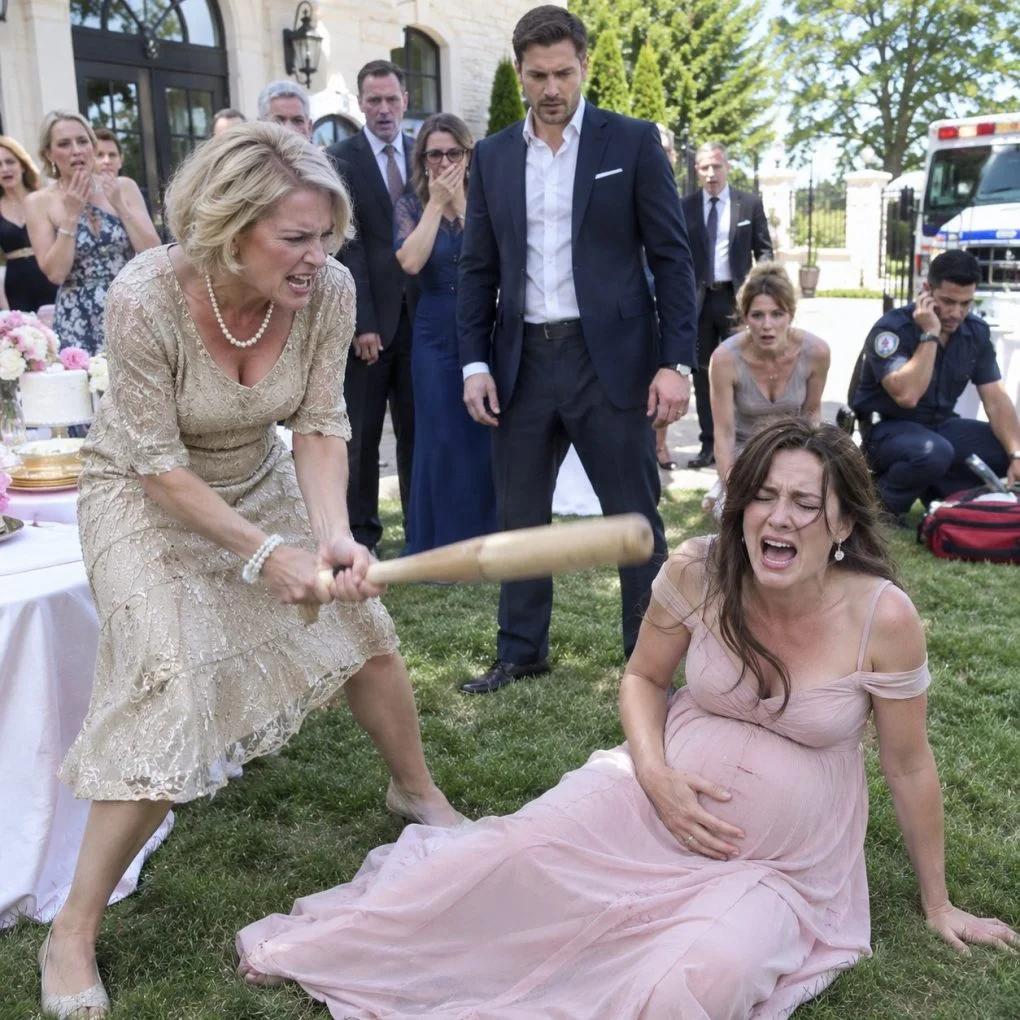
By the time the detective came to interview me, Vivian had already claimed she swung the bat to frighten me and that I stumbled into it. Daniel backed her story, calling it a “terrible accident,” even after the doctor explained what the impact had done.
Nora refused to let that become the official version. She gave investigators the original video from the baby shower’s photographer, who’d been recording the garden speeches when Vivian picked up the bat.
The video showed Vivian striking me deliberately, then stepping away while Nora called for help. It also captured Daniel standing beside her, saying nothing as the guests stopped laughing.
When the detective replayed the audio at the end, I heard a sentence I’d missed in the confusion. It wasn’t Vivian speaking.
It was my husband, moments before the blow: “Mom, I said scare her into changing her mind—not hurt her.”
And suddenly I understood why he’d refused to look at me.
Daniel came into my hospital room that evening with a bouquet of white lilies, the same flowers he’d brought me on our first anniversary. I watched him set them beside June’s tiny hospital bracelet, which a nurse had placed on my tray, and asked him whether he had known what his mother intended to do.
“I thought she’d embarrass you into dropping the reunion,” he admitted. “I never told her to use a bat.”
“You asked her to frighten me while I was carrying our daughter.”
He covered his face. “I was scared of your mother’s history. I didn’t want June anywhere near someone who’d killed a man.”
I looked toward the NICU doors at the end of the hallway, where our daughter was breathing with help from a machine. “My mother killed a man who was hurting us,” I said. “Yours almost killed a child because I wouldn’t obey her.”
The police collected the bat, interviewed the guests, and obtained the photographer’s original recording. Vivian was charged with felonious assault and other offenses arising from the attack, while the investigating officers documented Daniel’s role in planning the intimidation; no one got to call the violence an accident anymore.
My mother paid for the damaged gate and answered questions about driving through it, accepting responsibility for the property damage without trying to excuse herself. She had made a reckless choice to reach me, and she didn’t ask me to pretend otherwise.
The worst days were the weeks June spent in the NICU, when every alarm made me stand too quickly and every doctor visit began with the weight of a question. My mother learned how to wash her hands for the nursery, brought soup I could barely eat, and never once asked me to call her Mom.
As June grew stronger, I filed for divorce, asked a lawyer about protective orders, and moved into an apartment close to the hospital. Daniel’s visits with June were supervised under temporary court orders while our attorneys handled parenting and support; although prosecutors didn’t charge him with the assault, his admitted plan to intimidate me mattered when the family court assessed our daughter’s safety.
Nine months after the party, Vivian pleaded guilty under an agreement that included a prison sentence and an order to avoid contact with me and June. At sentencing, her attorney described her as a devoted grandmother whose actions were “out of character,” but the prosecutor played the recording, and the courtroom fell silent at the sound of the bat hitting my body.
I read my statement slowly, holding the folded photograph I’d carried since childhood. “You told me the woman who protected me was a monster,” I said to Vivian. “But when I was hurt, you stood over me while she ran toward me.”
Vivian stared straight ahead. Daniel lowered his eyes, and for once I didn’t search his face for an apology.
June finally came home after ten weeks, small but growing, with appointments still ahead of her. One afternoon, my mother sat on my living-room floor helping me fold baby clothes, and she stopped when June reached out and closed her hand around her finger.
“Can I hold her?” she asked.
I placed my daughter carefully in her arms, watching that hardened face soften as she whispered June’s name. I’d spent twenty years afraid of the mother people called a killer; now, with my child safe against her chest, I knew exactly who had come when I called.



