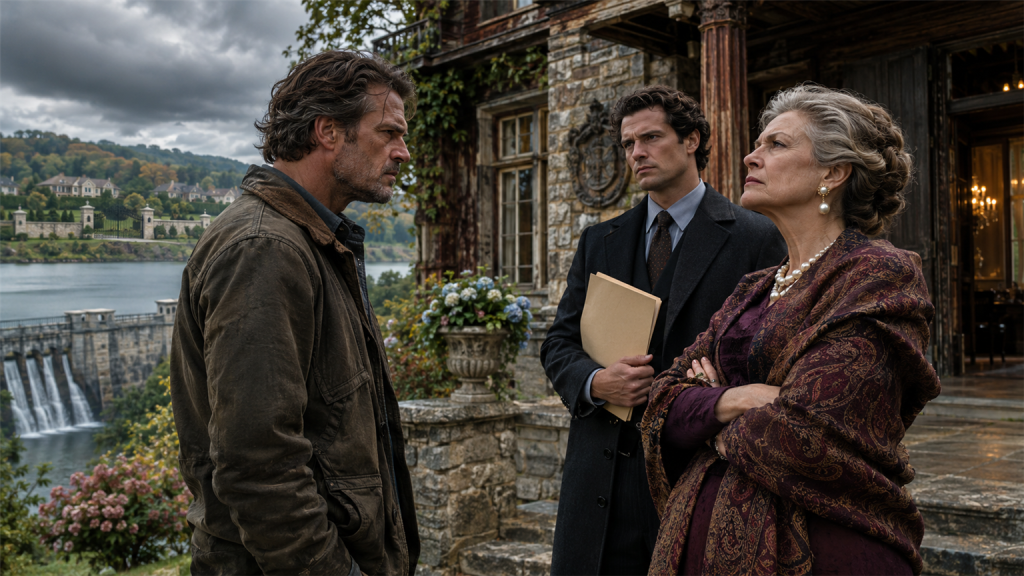
I bought a mansion for one dollar.
That should have been the strangest sentence I ever said.
It wasn’t.
The strangest came two years later, when a woman in a navy coat stood at my gate, pointed toward the lake behind my house, and said, “You own the mansion, Mr. Hale. You do not own the land around it.”
Beside her stood her thirty-year-old son, holding a leather folder as if it contained a royal decree.
I looked past them toward the lake.
The old stone dam.
The gravel road.
The cottonwoods.
The shoreline I had spent two years clearing, repairing, and maintaining.
“All right,” I said. “Show me the deed.”
The woman smiled.
She did not show me anything.
That was how the war started.
My name is Andrew Hale.
Two years earlier, I had attended a county tax auction in western Colorado because I needed something difficult enough to occupy the part of my brain that still woke up looking for my wife.
Lauren had died from cancer seventeen months earlier.
She loved old houses.
Not renovated old houses.
Old houses.
The scars.
The uneven floors.
The hand-cut beams.
She used to stop whenever we drove past some abandoned farmhouse and say, “Someone should save that.”
So when the auctioneer reached Lot 41 and described an uninhabitable 1872 timber mansion on an abandoned ranch parcel, I raised my hand.
Nobody else did.
“Opening bid, one dollar.”
I bid one.
“Sold.”
The room laughed.
I didn’t.
The house looked terrible.
Half the porch had collapsed.
Rain had entered through a damaged section of roof.
Three windows were broken.
Mice had claimed the pantry.
The county wanted the property back on the tax rolls and was willing to transfer it for essentially nothing if I cleared the back taxes and fees.
I spent the next twenty-two months rebuilding it.
Not replacing it.
Saving it.
I restored the stone fireplace.
Repaired the original pine staircase.
Rebuilt sections of the porch using timber milled to match what was there.
The mansion sat on a large ranch parcel that sloped toward a small lake.
An old gravel road crossed the pasture to a stone irrigation dam.
My auction records, tax deed, maintenance files, and modern survey all treated the land as one parcel.
For the first time after Lauren died, I felt like I had built something instead of merely survived something.
Then Eleanor Vance arrived.
She was president of Summit Ridge Estates, the gated HOA bordering my eastern boundary.
Her son, Mason, worked as a private compliance contractor for the association.
Eleanor opened with a sentence she had clearly rehearsed.
“There has been a misunderstanding concerning the western waterfront.”
“What misunderstanding?”
“Mason inherited it.”
Mason stepped forward.
“My family held rights here before Summit Ridge was developed.”
“Then you should have a deed.”
Eleanor looked almost amused.
“You bought a distressed structure at a tax auction.”
“I bought the parcel identified in the tax deed.”
“You bought the house.”
“No. I bought what the deed says I bought.”
Her smile disappeared.
“You should be careful assuming old county records are complete.”
Then they left.
The following morning, I pulled every document I had from my filing cabinet.
Nothing mentioned the Vance family.
Nothing gave Summit Ridge ownership of the lake.
Nothing separated the shoreline from the ranch.
I called attorney Julia Serrano.
She read the modern survey first.
Then the HOA notice Eleanor had left.
Then she took out a ruler.
“These descriptions don’t match.”
“Meaning?”
“The tract they’re citing appears east of an old drainage corridor.”
“My ranch is west.”
“Exactly.”
“So Mason doesn’t own my shoreline.”
Julia shook her head.
“We’re not saying that yet.”
I frowned.
“Their paper is wrong.”
“Yes. But property cases are won by proving what is right.”
“What do we need?”
“The oldest boundary record we can find.”
Three days later, Mason returned with two surveyors.
They were standing inside my pasture when I drove up.
I started recording.
“Who authorized you to enter?”
Mason handed me a violation notice instead.
It ordered me to stop using the lake road.
Remove fencing along the shoreline.
Submit all waterfront work to HOA approval.
Daily penalty: $500.
I read it twice.
“You’re fining me for using my own ranch?”
“Until ownership is resolved.”
“Ownership does not become unresolved because your mother says so.”
Mason’s jaw tightened.
“You’re making this harder than it needs to be.”
“No,” I said. “I’m making it documented.”
The county records office gave us a 1938 survey.
Then a 1916 tax map.
Then an 1894 transfer reference.
Every old record pushed the ranch boundary closer to the lake than the modern HOA map did.
Retired surveyor Frank Dawson walked the land with me and found two buried boundary markers matching the historical measurements.



