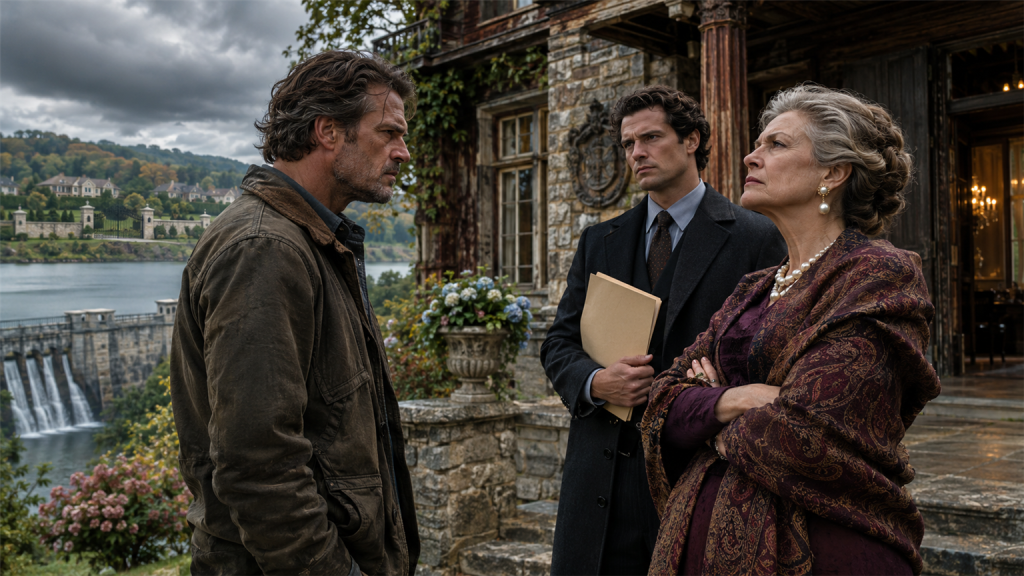
She insisted the dispute was not about money, then praised a proposed development that would bring jobs, infrastructure, new amenities, and increased property values.
When she finished, Julia placed three documents on the projector: the original 1872 plat, my county deed, and Summit Ridge’s recorded subdivision map.
All three showed the same boundary. The ranch road, lakefront, and dam-access strip belonged to my parcel.
Then Julia displayed Meridian Ridge Development’s preliminary agreement, signed by Eleanor’s husband, Richard.
It proposed thirty-four homes, a private marina, and a recreation area—all dependent on gaining access across my shoreline.
of 5
The development agreement had been signed before Summit Ridge issued its first enforcement notice against me.
Diane stepped to the microphone and read old board minutes discussing legal methods to obtain control of the western lakefront. One entry suggested that the owner might become cooperative after sustained compliance pressure.
When Eleanor claimed the notes were incomplete, Diane answered with a single, decisive word.
“No.”
Julia connected the recorder to the hall speakers. Eleanor’s voice filled the room, declaring that I had to be removed before I understood the shoreline’s value. If I resisted, she said, they would make the property impossible to keep. She also admitted that Mason’s inheritance story was false.
Homeowners erupted. They demanded to know why HOA money had funded enforcement serving Richard’s private development agreement.
Eleanor finally lost control and shouted that I had paid only one dollar for the mansion and was blocking a project worth tens of millions because of a rotting nineteenth-century map.
I held up the certified plat.
“It makes the boundary documented.”
Residents then began sharing years of selective fines, intimidation, and threats. Eleanor’s power had depended on making each person feel isolated. That night, nobody felt alone.
Nine days later, Judge Margaret Weston reviewed every deed, survey, tax map, road record, development agreement, and recording. Surveyor Frank Dawson confirmed that the original ranch boundary included the disputed lakefront, private road, and dam corridor.
Eleanor’s attorney could produce no original conveyance, recorded transfer, deed, or probate document supporting Mason’s supposed inheritance.
“There is no documentary foundation for the ownership claim,” Judge Weston concluded.
Eleanor insisted that she believed her family possessed an interest.
“Belief is not title,” the judge replied.
That quiet sentence destroyed the case.
The court ruled that I lawfully owned the mansion parcel, shoreline, road, and dam-access corridor. Summit Ridge had no ownership interest and could neither block my access nor enforce HOA restrictions against the ranch.
Without my voluntary permission, Meridian could not use the property.
The thirty-four-home development collapsed.
of 5
Outside the courthouse, Julia handed me the signed order.
“You bought a mansion for one dollar,” she said, “and the deed defeated a multimillion-dollar project.”
I corrected her. The old boundary had defeated it.
Two months later, Summit Ridge elected a new board. Diane returned as records secretary, the association published its financial records, and a formal acknowledgment was recorded confirming that my property stood outside HOA jurisdiction.
Eleanor resigned. Richard’s partnership abandoned the Meridian Ridge proposal. Mason stopped appearing at my gate, the red flyers vanished, and contractors began returning my calls.
The neighborhood became quiet again.
One Saturday, I found the original auction receipt inside my desk. It contained only two words and one amount: “ONE DOLLAR.”
I carried it onto the porch of the mansion I had spent two years restoring. Below me, evening light moved across the lake. The dam still needed inspection, part of the fence required repairs, and one porch railing continued to lean because I had never found time to replace it.
Lauren would have loved those imperfections.
I framed the auction receipt beside a copy of the 1872 plat. One document showed what I had paid. The other revealed what I had actually purchased.
Eleanor had assumed that a low auction price meant the property itself was worthless. She had been wrong. The county sold me an abandoned mansion, but its true value lay in everything that survived with it: the history, shoreline, road, dam, mountain view, and a forgotten boundary line nobody else bothered to read.
That evening, I remained on the porch until darkness covered the mountains. No SUV entered my gate. No HOA notice waited on the table. No stranger measured my fence.
There was only wind moving through the cottonwoods and water flowing beneath the old dam.
Eleanor once told me that I had bought the house, not everything around it.
In the end, I had not purchased merely a house.
I had purchased a history she never bothered to investigate.
And all it cost at auction was one dollar.
THE END



