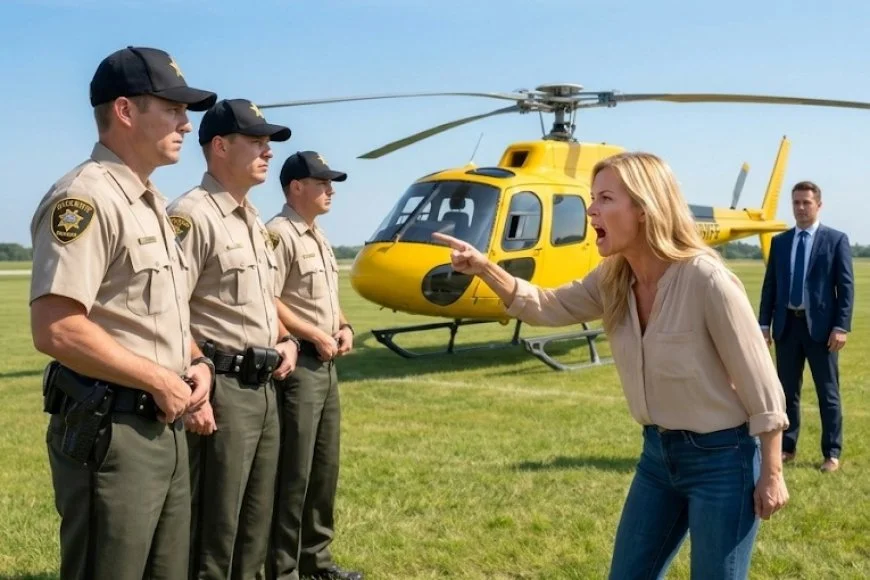
Dale raised his laminated sign.
“You need a guest pass.”
Ray stopped.
“What?”
“This is HOA-controlled territory.”
“This is a designated emergency aviation site.”
“Subject to community standards.”
Trooper Alvarez stepped forward.
“Sir, this is your final warning. Move now.”
Dale’s face reddened.
“You have no jurisdiction over Canyon Crest internal affairs.”
Alvarez looked at Ray.
Ray looked at me.
Then the helicopter descended another ten feet.
The rotor wash sent Dale’s traffic cones tumbling across the field.
His hat blew off.
He still refused to move.
The side door of the helicopter opened.
A woman leaned out holding a radio handset.
Governor Elena Ortiz.
She looked directly at Dale.
The pilot patched her voice through our frequency.
“Mr. Pritchard, this is Governor Ortiz.”
Dale lifted his bullhorn.
“I need to see your HOA guest pass.”
Even Ray stared at him.
Governor Ortiz paused.
Then said:
“Trooper, remove that man from the landing zone.”
Dale pointed his stop sign toward the helicopter.
“I am a community security officer.”
Alvarez reached for her cuffs.
Dale backed up one step.
“You cannot arrest me for enforcing HOA law.”
Alvarez closed the distance.
“Watch me.”
And while the helicopter hovered overhead, Dale finally realized the authority he had been pretending to possess had just collided with the kind that was real…
Trooper Alvarez handcuffed Dale only after giving him one final order to leave voluntarily. Even then, he kept shouting that Canyon Crest regulations superseded state emergency procedures.
The moment he was clear, the helicopter landed.
Governor Ortiz stepped onto the ranch with Fire Marshal Donovan and her security detail. She did not make a speech. She asked one question:
“Has this man interfered with operations before?”
I handed Ray the emails, photographs of the gate, and copies of the notices I had sent Dale.
Within an hour, investigators were documenting everything.
The wildfire assessment continued, but Dale’s arrest became the story every local station wanted.
By evening, residents of Canyon Crest had seen video of their “security chief” standing beneath a rescue helicopter demanding an HOA parking permit.
The next morning, seventy homeowners packed an emergency board meeting.
Clyde Harmon, the HOA president, looked exhausted.
“We have terminated Mr. Pritchard’s security appointment effective immediately,” he announced. “The position itself is dissolved.”
A resident shouted from the back:
“What about his fines?”
That opened another problem.
Dale had issued citations for porch lights, bird feeders, grass height, parked delivery vans, and even “excessive aerial disturbance” after military aircraft passed miles overhead.
The board’s attorney stood.
“Any citation issued outside the HOA’s actual authority will be reviewed and voided.”
Then the treasurer raised a folder.
“There’s something else.”
She looked at Clyde.
“Dale spent association money on gates, radios, uniforms, cameras, and enforcement equipment that the board never approved.”
Clyde’s face changed.
“How much?”
She swallowed.
“More than forty thousand dollars.”
And suddenly, Dale’s helicopter stunt was no longer the only thing the board had to explain…
Part 3
The emergency board meeting lasted four hours.
By the end of it, Canyon Crest residents had learned something uncomfortable.
Dale Pritchard had not become powerful because the HOA gave him enormous legal authority.
He became powerful because nobody kept asking what authority he actually had.
Three years earlier, the board had created a volunteer position called Community Safety Coordinator.
The original resolution gave Dale a narrow job.
Monitor common areas.
Report suspicious activity.
Coordinate with the sheriff when necessary.
Nothing about enforcement.
Nothing about fines.
Nothing about private property inspections.
Nothing about roadblocks.
Nothing about aircraft.
Over time, Dale changed the title himself.
COMMUNITY SAFETY COORDINATOR became CHIEF OF COMMUNITY SECURITY.
He ordered embroidered uniforms.
Bought a bullhorn.
Installed cameras.
Printed laminated identification cards.
Created an “incident citation” form.
Then he began acting as though his reports carried the force of law.
Residents complained.
The board usually told him to calm down.
Dale interpreted that as permission to continue more quietly.
Then came the money.
Treasurer Marlene Cho stood before a projector and walked residents through eighteen months of expenditures.
Portable radios.
$3,800.
Uniforms.
$2,400.
Traffic cones and signs.
$1,100.
Two chain-link gates.
$7,600.
Camera equipment.
$9,200.
Vehicle decals.
$3,100.
Consulting fees to something called Pritchard Community Risk Services.
$12,000.
Marlene stopped there.
Someone shouted:
“Who owns that company?”
Nobody needed three guesses.
Dale did.
The room changed.
Clyde Harmon leaned toward the HOA attorney.
“Was that disclosed?”
The attorney shook his head.
“No.”
Marlene continued.
“There are other smaller expenses.”
“Total?” Clyde asked.
“Forty-three thousand eight hundred and sixty dollars currently identified.”
Nobody spoke.
That explained why Dale cared so much about pretending the security position was indispensable.
It was not merely ego.
He had turned it into income.
The board voted unanimously to freeze all security-related spending and hire an outside accountant.



