The strongest evidence was mundane.
The pilot’s radio transmission.
The landing-site designation.
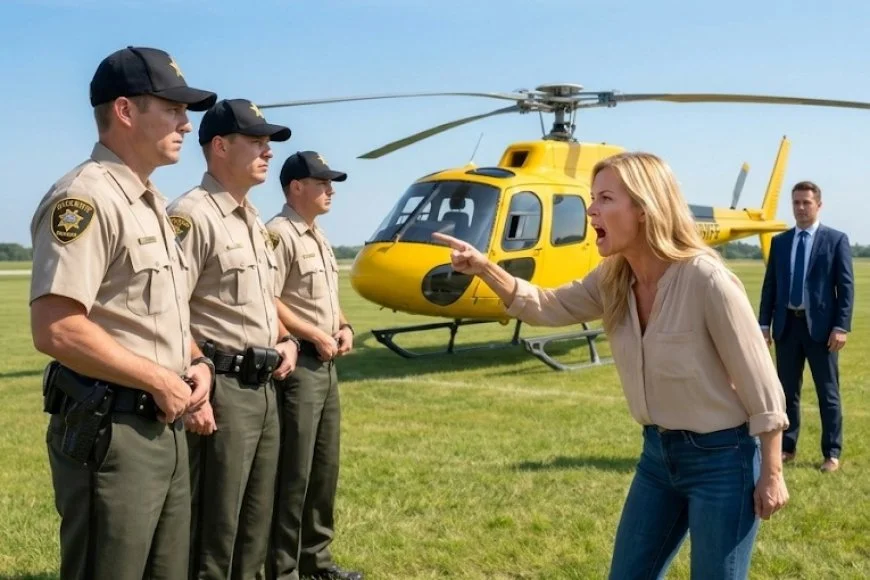
The trooper’s repeated commands.
Video showing Dale refusing to leave.
Fuel logs showing the aircraft had been forced to remain airborne longer than planned.
When Dale finally went to trial, he insisted on testifying.
His attorney looked miserable.
The prosecutor asked one question.
“Mr. Pritchard, did Trooper Alvarez tell you to leave the landing zone?”
“Yes.”
“And did you leave?”
“No.”
“Why?”
“Because she had not established HOA authorization.”
The prosecutor paused.
“Did you believe a homeowners association could override an emergency state aviation operation?”
Dale leaned toward the microphone.
“I believed the community had standards.”
That answer probably ended the case.
His attorney tried to rehabilitate him.
“Were you attempting to harm anyone?”
“Absolutely not.”
“Were you trying to protect residents?”
“Yes.”
“Did you believe helicopter operations created noise and safety concerns?”
“Of course.”
That was more reasonable.
Until Dale added:
“And unconstitutional aerial intrusion.”
His attorney closed his eyes.
The jury convicted him on the principal obstruction-related charges supported by the evidence.
The reckless-endangerment count drew the most argument because the defense challenged how imminent the danger had been.
The court ultimately imposed a custodial sentence followed by probation, fines, and restrictions against interfering with emergency operations.
It was serious.
But it was not the decades of prison that neighborhood gossip had predicted.
Reality rarely satisfies people who want cartoon punishment.
It satisfied me.
Dale had endangered people.
He lost his position.
Lost access to the money stream built around it.
Faced criminal consequences.
And could no longer come onto my ranch pretending to be law enforcement.
That was enough.
Before sentencing, victims and affected parties could submit statements.
I wrote one.
I did not mention clouds.
Bird feeders.
His aviator glasses.
Or the guest pass.
I wrote about the helicopter.
The pilot asking for the field.
The fuel situation.
The wildfire burning north of us.
The firefighters who later needed medical transport.
Then I wrote:
Emergency systems depend on ordinary people moving when told to move.
That was all.
Governor Ortiz submitted something through official channels too, though I never saw the full letter.
After sentencing, Ray called.
“You know what Dale told the probation officer?”
“I’m afraid to ask.”
“He said the state had criminalized community standards.”
“Of course he did.”
“He’s consistent.”
“I’ll give him that.”
Months passed.
The wildfire scar remained visible on the northern ridge.
Blackened trunks stood among surviving juniper.
Winter rains eventually brought small patches of green through the burned ground.
Canyon Crest changed too.
Without Dale patrolling the streets in his utility cart, people discovered the neighborhood did not collapse.
Packages still arrived.
Children still rode bicycles.
Coyotes still ignored HOA boundaries.
The grass did not rise in rebellion.
Marlene became board president after Clyde retired.
At her first meeting, she eliminated five pages of rules nobody could explain.
One required approval for “temporary exterior visual disturbances.”
Another prohibited “excessively reflective garden materials.”
Harold raised his hand.
“Does that mean my bird feeder is free?”
Marlene smiled.
“Your bird feeder has received a full pardon.”
The room applauded.
My relationship with the HOA improved mostly because we stopped having one.
That was ideal.
They maintained their roads.
I maintained my ranch.
During emergencies, the state coordinated the landing zone.
Everybody stayed in the correct lane.
The following summer, another wildfire broke out farther west.
Smaller this time.
A state helicopter arrived before dawn.
I received the notification the night before.
At 5:40 a.m., I unlocked the equipment gate.
Set out wind markers.
Checked the field.
Then made coffee.
The helicopter appeared over the ridge at 6:12.
It descended smoothly.
No cones.
No stop sign.
No bullhorn.
The pilot stepped out.
“You Cole?”
“Yeah.”
He grinned.
“I’ve heard about this place.”
“That worries me.”
“Relax. I brought paperwork.”
He pulled a folded sheet from his flight bag.
At the top, in marker, somebody had written:
HOA GUEST PASS.
I stared at him.
He started laughing.
“Governor’s office sent it.”
I took the page.
At the bottom was a handwritten note:
JUST IN CASE.
—E.O.
I laughed so loudly one of the crew members turned around.
Later that morning, while the helicopter crew prepared equipment, I stood near the edge of the landing zone.
A new sign had been installed beside the old emergency marker.
Marlene’s idea.
It read:
CANYON CREST RESIDENTS SUPPORT EMERGENCY RESPONDERS.
Simple.
No names.
No mention of Dale.
That felt right.
Communities do not improve by building permanent monuments to their worst member.
They improve by changing the conditions that allowed the problem.
Dale had believed authority came from a title.
A badge.
A uniform.
A laminated sign.
A loud enough voice.
The wildfire taught Canyon Crest something simpler.
Authority comes from somewhere.
A statute.



