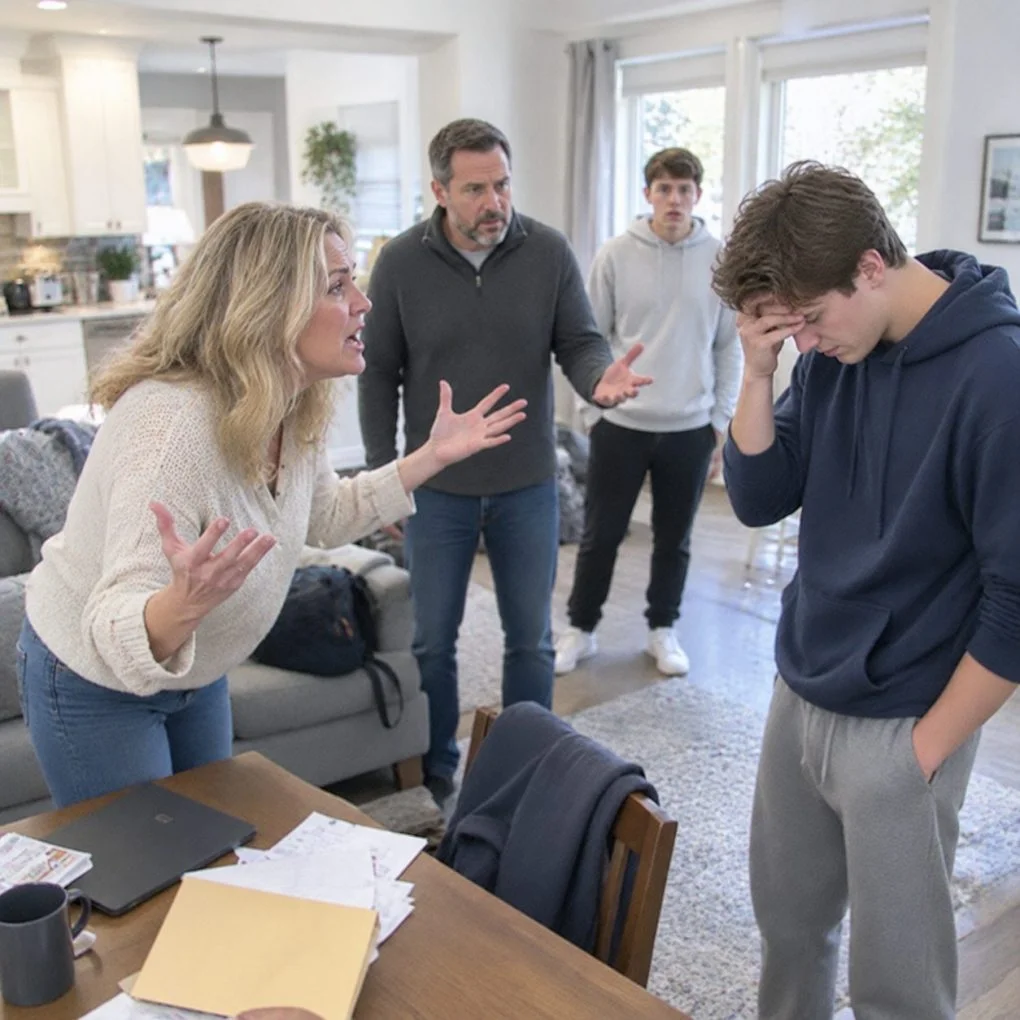
“Mom, please don’t call Ben.” My eighteen-year-old son, Owen, stumbled through our front door, turned the deadbolt twice, and dropped his backpack as though it were burning his hands. He had moved into an apartment with his best friend just forty-eight hours earlier, and now he was shaking so badly he couldn’t hold the glass of water I gave him.
Two days ago, I’d tucked fresh towels into Owen’s moving box and promised not to call every evening; I never imagined he’d come home frightened of the person I trusted most. “What happened?” I asked, reaching for my phone, but Owen caught my wrist and whispered, “Please, Mom. I found something at his parents’ house.”
Ben Carter had eaten at our kitchen table since kindergarten. After my husband Daniel died, Ben was the boy who sat beside Owen at the funeral and quietly put a chocolate bar in his coat pocket; his parents, Mark and Linda, helped us through those first impossible months. I had watched the two boys grow from children building blanket forts into young men carrying boxes up three flights of stairs, and I had believed their friendship was one thing I never needed to worry about.
Owen laid a thick folder on the table. On its cover were the words CARTER RESTORATION — COMMERCIAL CREDIT APPLICATION, and underneath, in tidy type, a request for a $218,000 business loan.
“Why do you have this?” I asked, touching the folder. Owen swallowed before answering, “Ben told me to pick up the old router from his dad’s home office. The folder was underneath it, and I saw your name.”
I opened the first page. Under PERSONAL GUARANTOR it listed Alicia Wells—me—with my salary, home address, and an estimated value for the little house Daniel and I had bought together. On the signature line sat a careful imitation of my handwriting.
I had never agreed to guarantee Mark Carter’s debts. The next page listed Owen as an employee of Carter Restoration, earning $64,000 a year, even though he worked weekends at a sporting-goods store and had never earned anything from Mark.
The application also included a scanned copy of his driver’s license and another signature that was not his. “My license,” Owen whispered. “Ben photographed it for our apartment paperwork.”
He handed me the last sheet, a printed exchange between Mark and Ben dated three days before the move. Mark had written, “Once he’s settled, bring Alicia the tenant guaranty. She’ll sign for her son.”
Below it, Ben had replied:
“She trusts me. I’ll make sure she doesn’t read the rest.”
I kept staring at Ben’s words, remembering the little boy who used to leave his muddy sneakers beside our back door because Daniel had taught him not to track dirt through the house. Owen sat across from me, rubbing his palms against his jeans, and asked a question no mother should have to hear: “Did he ever actually like me?”
“I don’t know what was in his heart,” I said, reaching across the table for his hand. “But what he did was wrong, and none of it is yours to fix.”
We called the credit union named on the application through its published number. Its fraud department confirmed that Mark had submitted a preliminary loan package, but no money had been released and no mortgage had been placed on our house; final approval would have required independent verification, including my genuine consent to any guarantee or security agreement. The officer asked us to preserve the documents, report the suspected forgery, and speak with an attorney.
I called the police nonemergency line to report suspected identity fraud, then contacted a lawyer and froze both our credit files. Owen checked his credit report beside me while I searched for the deed to our house, a document Daniel had filed in a blue folder labeled HOME in his untidy block letters.
Linda Carter arrived that afternoon after I asked whether she recognized my tax records in Mark’s paperwork. For seven years she had prepared my returns, and she admitted that copies were stored on the office computer she shared with her husband; she said she had never authorized him to use them for a loan.
“He told me the business needed time,” she said, looking at the floor. “I thought he was asking friends for help, not putting their names on papers.”
I wanted to shout that her family had been our friends. Instead, I remembered Linda bringing soup after Daniel’s funeral and how grateful I had felt that somebody knew which cupboard held the bowls.
Mark called while she was there. “Alicia, it’s just a financing application,” he said, irritated rather than ashamed. “I kept you afloat after Daniel died. I thought you’d understand helping us now.”



