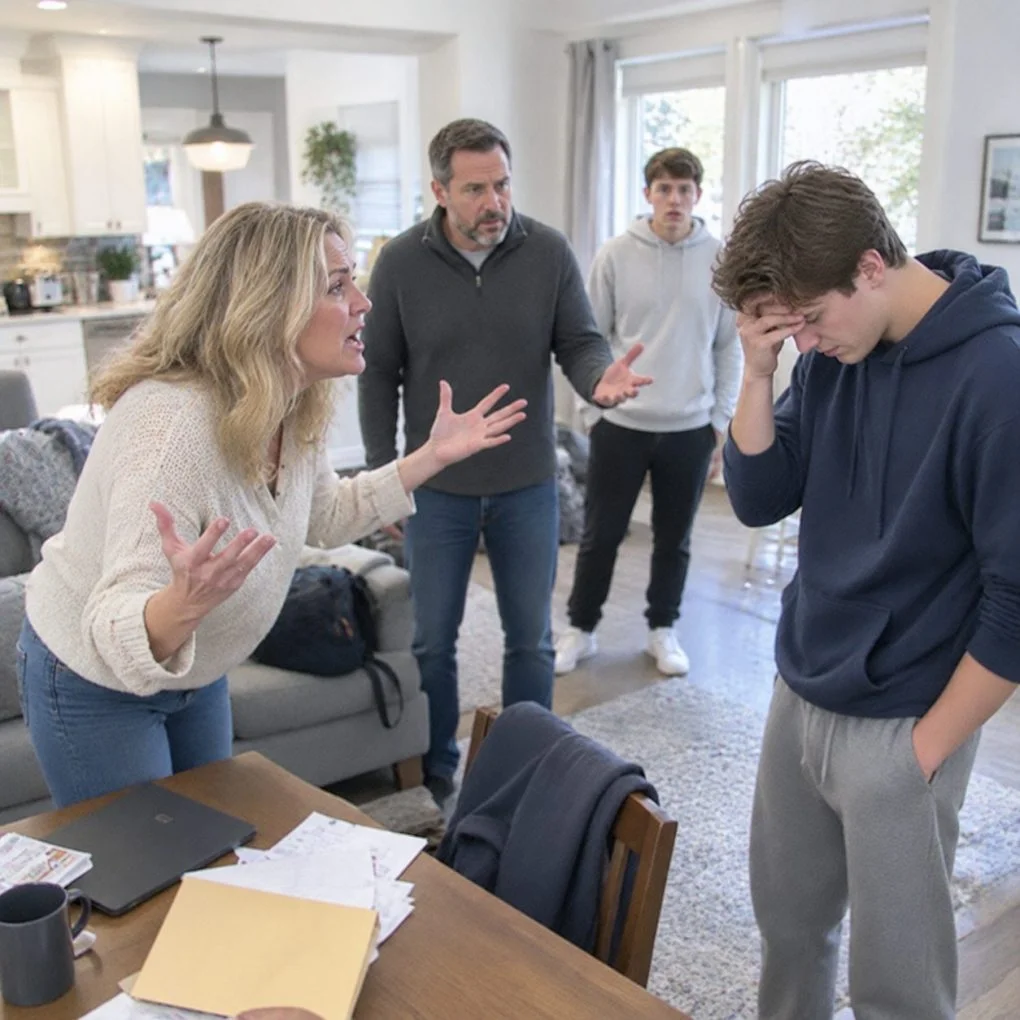
“You gave us groceries,” I answered, watching Owen turn away from the phone. “That didn’t give you permission to sign my name or use my son’s identity.”
At dusk, Ben appeared on the porch, his eyes swollen and his hands buried in his sweatshirt pockets. He admitted photographing Owen’s license, forwarding it to his father, and helping assemble the packet; Mark had promised to cover the boys’ first semester of rent if the financing went through.
“I thought he’d ask you before anything became real,” Ben said, looking down at his shoes. I held up the printed message and asked, “Then why did you write that you’d stop me reading it?”
Ben looked past me at Owen. “Dad said if your mom refused, we’d lose the apartment. I was scared.”
Owen, who had once saved half his birthday cake for Ben when Ben was sick, stepped back from the doorway. “You could’ve told me,” he said. “You knew I would’ve helped you find another place.”
Before Ben left, my lawyer forwarded another document obtained from the credit union’s fraud department with our authorization. It was a draft mortgage naming our home as collateral, awaiting my supposed signature at Monday’s meeting.
At the bottom, next to a blank space for a notary, was a handwritten note from Mark.
“Alicia will think she’s signing Owen’s lease guarantee.”
He hadn’t simply copied my signature.
He was preparing to make me sign away my own security without knowing it.
On Monday, I went to the credit union with my attorney, not to sign anything, but to give its compliance officer the documents we had found. Mark was already in the waiting area, wearing the navy jacket he had worn to Owen’s high-school graduation, and I remembered him cheering when my son crossed the stage.
“Alicia,” he said, standing quickly. “Please don’t do this in front of everyone.”
I set the forged application on the table in the private conference room. “You brought my son into this,” I said. “You made your own son lie to him, and you counted on me loving both boys too much to ask questions.”
The officer explained that the loan would not proceed and the institution was preserving the application, identity-verification records, and draft security documents for investigators. There was no loan balance in our names and no lien against our home; for the first time since Owen came through my door, I felt the floor steady beneath me.
Mark called me vindictive. He said the company was behind on payroll and an equipment supplier was threatening to repossess two trucks, as though his desperation could transform a forged signature into permission.
“I would have listened if you’d told me you were struggling,” I said. “You didn’t ask for help. You tried to take the choice away.”
We ended the apartment lease through a written agreement with the landlord, paying an early-termination fee rather than leaving Owen liable for rent on a place he no longer felt safe entering. Ben stayed with his parents, while Owen moved back home for the semester and began meeting with a counselor recommended by his college.
The investigation took months, not minutes. Mark’s business eventually shut down after creditors reclaimed equipment and he failed to arrange other financing, and prosecutors later charged him with forgery and attempted financial fraud based on the documents and electronic records. He entered a guilty plea under a negotiated agreement that included probation, restitution for documented losses, and financial reporting conditions.
Ben cooperated with investigators and was not charged. He sent Owen a long apology describing how he’d traded their friendship for his father’s approval, but Owen read it once and placed his phone facedown on the table; I didn’t tell him to forgive or forget.
Linda stopped preparing my taxes, and we changed the emergency contacts on every account where I had trusted the Carters. I grieved her friendship too, in a quieter way, whenever I reached for the soup pot she had once brought back after Daniel’s funeral.
One evening I found Owen in the garage opening the box of old photographs we had packed for his apartment. He held up a picture of two boys in paper crowns, sitting beside Daniel with birthday frosting on their noses, and asked, “Do you think Dad would’ve known Ben was going to change?”
“No,” I said, sitting on the cold step beside him. “Your dad believed in people. He also knew that when someone broke your trust, you were allowed to protect yourself.”
Owen put the photograph back without tearing it. By spring he had found a different roommate, and on moving day he let me carry the smallest box upstairs, just as he had let me when he was little and insisted on doing the heavy work himself.



