The HOA had just awarded it a $112,000 pool-renovation contract.
The company’s owner was Garrett Howell.
Renata’s son.
I printed the business registration and brought it to the next meeting.
“Was this relationship disclosed before the vote?”
Renata stared at me.
“All vendors went through our process.”
“That wasn’t my question.”
She adjourned the meeting.
The contract went through anyway.
Odessa began reviewing the original Cresthaven governing documents—not the handbook Renata distributed, but the declaration recorded when the development was created.
One September evening, she called while I was washing dishes.
“Callum, I found something.”
I turned off the faucet.
“What?”
“Any capital expenditure above fifty thousand dollars requires approval by two-thirds of the households.”
I looked toward the window.
“The gate was sixty-three.”
“Yes.”
“The pool was one hundred twelve.”
“Yes.”
“Neither went to homeowners.”
“No.”
Then Odessa went quiet.
“There’s something else.”
My hand tightened around the phone.
“What?”
“I compared the reserve summaries with the transaction records we obtained.”
“And?”
“Callum…”
She took a breath.
“More than thirty-one thousand dollars is missing from the trail.”
And suddenly, the eleven-foot gate was no longer the biggest problem in Cresthaven Circle…
Odessa sent the board a formal demand for complete records and an immediate suspension of the fines against me. Meanwhile, retired investigative reporter Philippa Strand began comparing four years of meeting minutes with vendor payments. She found repeated spending just below the threshold requiring homeowner approval—and emails suggesting Renata had helped structure the pool bidding so her son’s company would win.
Then I reopened the emergency-access file.
The Timber Ridge route had not belonged to the HOA at all. It was a recorded township emergency easement. Cresthaven had fenced it, planted dense shrubs across it, and never obtained permission.
The township ordered the obstruction removed.
It also cited the front gate for inadequate emergency clearance.
Renata ignored both deadlines.
By January, forty-three households had signed my petition forcing a special homeowners meeting. Odessa obtained a temporary court restriction on large reserve-fund spending. A state investigator began reviewing the conflict-of-interest records.
The meeting was scheduled for Tuesday.
Then, on Friday night, I heard sirens.
Orange light flickered two blocks away.
Renata’s kitchen was burning.
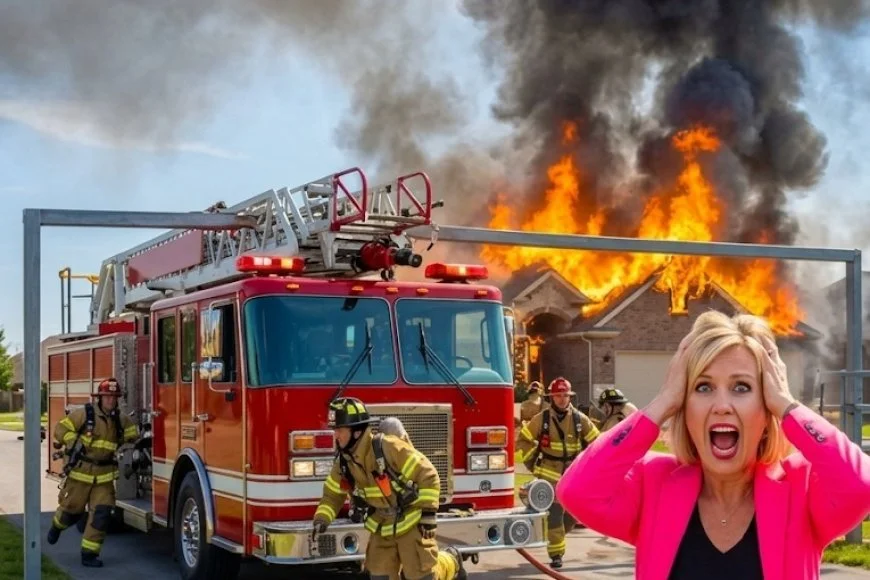
Engine Four reached the Cresthaven entrance and stopped.
The eleven-foot gate blocked the aerial truck exactly as I had warned.
The driver reversed and headed for Timber Ridge.
I watched from my driveway.
Then my stomach dropped.
The fence was still there.
So were the shrubs.
The HOA had received weeks of warning and had removed nothing.
Firefighters jumped out with tools while two crew members grabbed hose and ran toward Renata’s house on foot.
I checked my watch.
The warning I had mailed eighteen months earlier was no longer paper.
It was now a clock…
Part 3
Captain Falk’s crew lost four minutes and twenty seconds getting water onto Renata’s fire.
I know the exact number because it appeared later in the incident report.
The truck reached Cresthaven.
Could not clear the front arch.
Reversed.
Rerouted to Timber Ridge.
Found the emergency access blocked.
Firefighters cut the padlock, opened the fence, then fought through overgrown arborvitae while hose crews continued toward the house on foot.
Four minutes.
Twenty seconds.
Nobody died.
Nobody was injured.
The fire destroyed most of Renata’s kitchen and damaged the adjoining dining area before crews contained it.
Her house survived.
That mattered more than anything else.
Standing in my driveway that night, I did not feel vindicated.
I had spent too many years around industrial accidents to enjoy being right about a preventable hazard.
People imagine warnings feel satisfying when they come true.
They do not.
They feel worse.
You remember the meeting.
The laugh.
The signed receipt.
The sentence somebody dismissed.
Then you watch firefighters work around a problem that never needed to exist.
The following morning, I requested the incident report.
I also photographed the front gate and the obstructed Timber Ridge access.
Not because I wanted Renata punished for having a fire.
Her fire was not evidence of wrongdoing.
The access delay was.
That distinction mattered.
Odessa agreed.
“Do not make this about her house.”
“I won’t.”
“Make it about what the board knew before the house caught fire.”
That we could prove.
My certified letters.
Captain Falk’s measurement.
The township notice.
The emergency-easement order.
Five signed delivery receipts from the original objection.
The board had been warned before construction.
Warned again after construction.
Warned by the fire department.
Warned by the township.
Then warned about the blocked backup route.
Nothing had been corrected.
Three nights later, ninety-one of Cresthaven’s 140 households were represented at the special meeting.
I had never seen the recreation room so full.
Wet winter coats hung over chairs.
People stood against walls.
A reporter from the Columbus paper sat in the back with a notebook.



