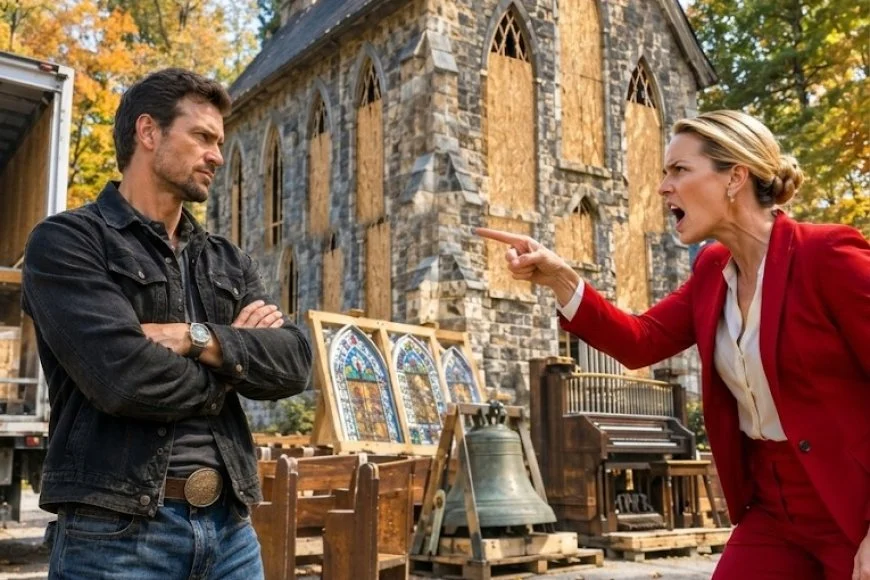
When I came home from an eight-day business trip, the chapel my family had protected since 1890 looked like someone had stripped it for parts.
Eighteen oak pews were gone.
Six stained-glass windows had been pried from their stone frames.
The pump organ had disappeared.
So had the pulpit.
And when I looked into the bell tower, the six-hundred-pound bronze bell my great-great-grandfather helped hang more than a century earlier was missing too.
I stood in the middle of the empty nave and listened to my own breathing.
Fresh sawdust covered the floor.
Long scratches ran toward the side door.
Where colored glass had once filled the room with amber and blue light, sheets of plywood had been screwed over the openings.
Then gravel crunched outside.
Karen Witford climbed the chapel steps wearing a camel-colored coat.
Behind her came two private security guards from Belridge Estates.
She carried a folder.
No apology.
No surprise.
“Mr. Holloway,” she said, “the association conducted an emergency safety remediation while you were away.”
I stared at her.
“What?”
“The structure contained multiple hazards.”
“This property isn’t in your HOA.”
“The chapel affects our community.”
“You entered my building?”
“We acted to protect residents.”
She handed me a notice.
EMERGENCY HERITAGE HAZARD REMOVAL.
Amount due:
$18,400.
I read it twice.
“You’re billing me?”
“For removal and disposal.”
I looked around the empty chapel.
“Where are my pews?”
“Processed.”
“My windows?”
“Processed.”
“The bell?”
“Mr. Holloway, I suggest you cooperate before additional costs accrue.”
My name is Graham Holloway.
I was forty-seven and made my living restoring historic buildings.
For eleven years, Holloway Chapel had been my largest project and the only one I never billed anyone for.
My great-great-grandfather helped build it in 1890 on 2.4 acres that remained in our family.
Belridge Estates came much later.
Its houses surrounded two sides of the property, but the chapel had never joined the association.
Karen knew that.
Three years earlier, she tried to convince me to let the HOA turn the chapel into a wedding venue.
Belridge would manage reservations.
Collect fees.
Use the grounds for private events.
I said no.
She never forgave me.
But this was beyond retaliation.
I pulled out my phone.
“I’m calling the sheriff.”
Karen smiled.
“You’re welcome to.”
While she talked to one of the guards, I began photographing everything.
Missing hinges.
Scraped floors.
Cut window framing.
Splintered wood.
Then something beneath the altar caught my eye.
A torn paper tag.
Heavy cream stock.
Black numbers.
LOT 47.
I picked it up with a clean plastic bag from my restoration truck.
Karen saw me.
For the first time, her expression changed.
Barely.
But enough.
Deputy Reed Callahan arrived forty minutes later.
He walked the chapel slowly.
Karen gave him her paperwork.
She claimed the county building department had requested the emergency removal.
Reed photographed the notice.
Then he looked at me.
“Mr. Holloway, I’ll need documentation showing ownership of the missing contents.”
“I have it.”
And I did.
Eleven years of restoration invoices.
Insurance appraisals.
Historic photographs.
Serial numbers.
Receipts.
Detailed images taken only nine days earlier.
The next morning, my attorney Fay Kesler and I went directly to the county building office.
There was no inspection.
No emergency order.
No complaint.
Then Fay asked the clerk to check the file number on Karen’s notice.
The clerk frowned.
“This case exists.”
Karen had used a real number.
For one hopeful second, I wondered whether there was some explanation.
Then the clerk continued.
“It’s for a collapsed garage twelve miles away.”
“When?”
“Two years ago.”
Fay looked at me.
Someone had copied an old government case number onto fake paperwork.
That afternoon, Belridge’s newsletter went out.
It warned residents about an unsafe historic structure adjacent to the neighborhood and an owner who had “repeatedly failed to cooperate with community safety efforts.”
My name was not printed.
It did not need to be.
Neighbors stopped waving.
Then Karen’s lawyer sent an offer.
The HOA would waive the entire $18,400 charge if I signed a release abandoning all claims regarding property “relocated during emergency remediation.”
Fay read it once.
“She wants you to legalize what she already did.”
I pushed it away.
“No.”
That night, Fay called me just before midnight.
“One phrase in their notice bothers me.”
“What phrase?”
“Secondary disposition.”
“So?”
“Debris gets discarded.”
I sat up.
“Secondary disposition means resale, transfer, auction—something after removal.”
I looked at the evidence bag containing LOT 47.
The next day, I visited the only business on the road leading to the chapel.
Dale Pickett ran an agricultural-equipment repair shop.
His security camera faced the highway.
We pulled footage from the days I was away.
Three box trucks drove toward Holloway Chapel.
Later they came back riding low.
Every truck carried the same logo.



