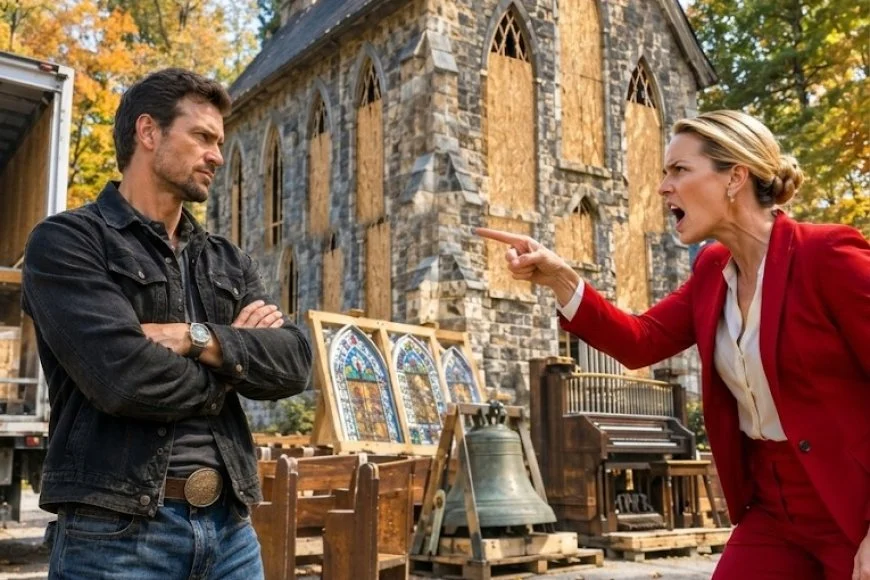
For months, I had thought that was what angered me most.
Eventually, I realized it wasn’t.
Objects can have prices.
Insurance requires them.
Restoration requires them.
The crime was not assigning value.
The crime was deciding that value belonged to her.
By February, some of the earlier Belridge victims began visiting the preservation workshop.
Beverly Stroud came first.
She was seventy-four and carried a photograph of her missing oak doors.
Investigators had recovered one.
The other had been sold out of state.
She stood beside the recovered door for several minutes.
“I let her convince me I was confused,” Beverly said.
“She showed me a maintenance rule.”
“You trusted somebody in office.”
“I should have fought.”
I shook my head.
“You should not have needed to become a detective to keep your front door.”
That sentence stayed with me.
People love stories where victims win because they are clever enough to uncover everything.
But nobody should need archival photographs, truck-camera footage, probate records, expert reports, and a sheriff’s investigation to prove strangers cannot sell pieces of their home.
Accountability mattered.
So did fixing the system that made Karen believable.
The new Belridge board eliminated the vacation-watch database Karen had controlled.
A replacement program went through an independent security company.
Travel dates were no longer accessible to board members.
Property-entry authorization required direct owner confirmation.
Emergency work on private homes required documented conditions and, where appropriate, government involvement—not a president printing something on HOA letterhead.
No contractor could remove privately owned fixtures based solely on an internal association form.
The rules were boring.
Good.
Boring rules are difficult to weaponize.
Spring arrived before Holloway Chapel was ready.
Then summer.
I stopped trying to hurry.
For 136 years, the building had survived wars, storms, neglect, changing roads, changing families.
It could wait for us to do the work correctly.
The criminal case eventually resolved.
Karen faced substantial legal consequences, restitution obligations, and civil judgments tied to conduct prosecutors and plaintiffs could document.
I did not attend every hearing.
My lawyer did.
Detective Callahan testified when needed.
Other victims spoke for themselves.
I stopped organizing my life around Karen.
That felt like progress.
One offer from her attorneys came to Fay.
Cash.
Confidential settlement.
Release of my remaining civil claims.
I declined the first version because it treated the chapel damage like a number detached from restoration.
The final resolution required documented repair costs and confirmed return of every identifiable object investigators had recovered.
I did not get everything back.
No one did.
Some smaller hardware had vanished.
A pair of donor plaques could not be located.
One carved lectern panel had apparently been damaged beyond practical recovery.
Restoration does not mean pretending nothing happened.
Sometimes you rebuild around what is missing.
The following April, eighteen months after I found Holloway Chapel empty, we rehung the bell.
A crane lifted it through the tower opening.
Owen guided the line from below.
Emmett stood in the yard criticizing everyone’s knots.
Rosa threatened to send him home.
When the bell settled into its rebuilt yoke, nobody rang it.
Not yet.
We saved that for opening night.
At 6:30 that evening, cars began coming up the gravel road.
Belridge residents.
Preservation students.
County staff.
Contractors.
Victims from Karen’s other cases.
Dustin Mallery came too.
Some people might have found that strange.
I didn’t.
Dustin had made a serious mistake by accepting paperwork without confirming ownership.
But once he understood what had happened, he preserved evidence, cooperated with police, carried pieces back, and testified.
Accountability and permanent exile are not the same thing.
The eighteen pews stood where they had stood in 1890.
Some had repaired scars.
I left several visible.
The donor plaques were back on the walls.
Copies replaced the two originals that never returned.
The organ stood near the east side.
Every stained-glass window had been reinstalled.
At sunset, colored light fell across the stone floor again.
Blue.
Amber.
Ruby.
Exactly where plywood had covered the openings.
At seven, I climbed the narrow tower stairs.
Below, the chapel was full.
Fay sat beside Reed Callahan.
Adeline sat with members of the preservation trust.
Beverly Stroud was in the front pew.
Owen stood near the door.
I reached for the bell rope.
For one second, I saw Lot 47 hanging from that bell in the auction photograph.
A number.
An estimate.
An object somebody expected to sell before lunch.
Then I pulled.
The bell rang across the trees.
One deep note.
Then another.
People on the road below stopped walking.
Inside the chapel, nobody spoke until the vibration faded.
I went downstairs.
The organ concert began.
Halfway through the first piece, I looked toward Window Four.
Sunlight was passing through the exact repaired lead joints that had helped prove the window belonged here.



