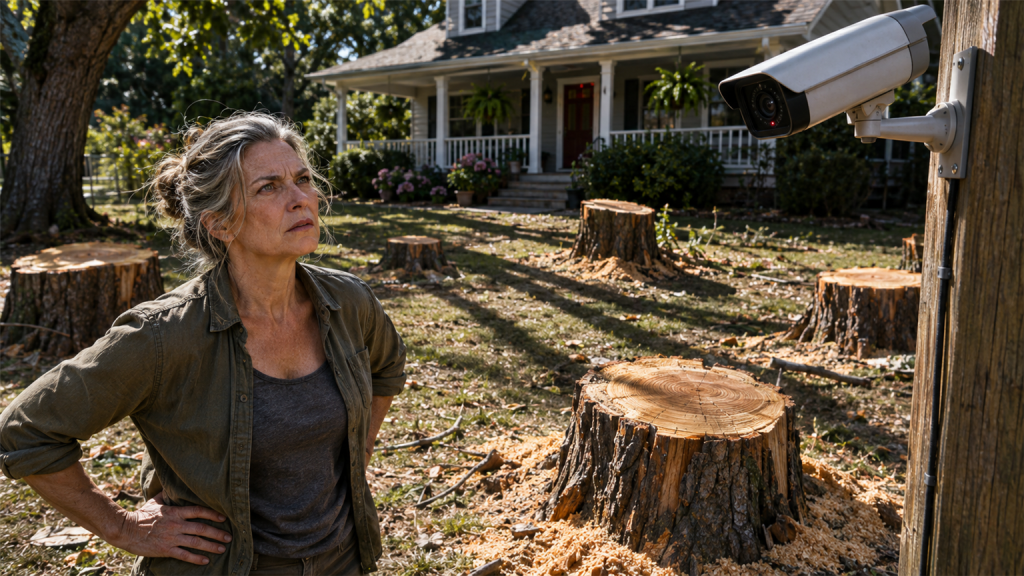
The first thing I noticed was the sunlight.
Too much of it.
For forty-one years, a wall of cedar trees had stood along the back of my property, tall enough to block the houses on Larkspur Ridge above me. My husband Frank planted them the spring we bought the place.
That morning, sunlight poured through a hole where fourteen of those trees had been.
I stood in the grass staring at raw stumps.
Fresh sawdust covered the ground.
Branches lay scattered like broken ribs.
Then I heard my neighbor Gus behind me.
“Joan?”
I turned.
His face changed when he saw the gap.
“Oh, Lord.”
“You heard anything?”
“Saws. Around ten this morning. Maybe forty minutes.”
“And you didn’t think to call?”
“I thought you’d hired somebody.”
I looked uphill.
Through the new opening, a broad cedar deck sat high above us.
Russell Thorne’s deck.
President of the Larkspur Ridge Homeowners Association.
He now had a perfect view across my yard.
Straight toward my back porch.
Straight toward my house.
Gus followed my eyes.
“You want me to call somebody?”
“The sheriff.”
He reached for his phone.
“Not yet.”
I walked toward the side of the house.
A small trail camera hung under the eave.
Frank installed it years earlier after someone stole tools from our shed.
I pulled the memory card.
“First,” I said, “let’s see who came calling.”
The footage showed a white Ridgeline Tree Service truck rolling into my property at 10:07 that morning.
Two men got out.
Neither knocked.
Neither walked toward my house.
They went directly to the cedars.
At 10:47, they drove away.
Forty minutes.
Fourteen trees.
No hesitation.
“They knew you weren’t home,” Gus said.
That sentence bothered me almost as much as the stumps.
Every Tuesday, I volunteered at the county recorder’s office until five.
I had done it for six years.
Someone knew my schedule.
Deputy Everly arrived that afternoon.
He photographed the stumps, the truck footage, and the tracks leading from the gravel path above my property.
“If these trees are yours,” he said, “we’re looking at trespass and criminal mischief.”
“They’re mine.”
“Anybody with a reason to want them gone?”
I looked uphill.
“Anybody with a deck.”
Two days later, he called.
The truck belonged to Ridgeline Tree Service.
The owner said Larkspur Ridge HOA had booked the work.
“They told him the strip was common area,” Deputy Everly said.
“There is no common area on my side of that path.”
“I know. I’m working on it.”
The next morning, I went to the HOA clubhouse.
A woman named Melissa Moore met me in a conference room.
She was the community manager.
She already had a folder open.
“Mrs. Hartley, I want you to know we understand how upsetting this must be.”
“Do you?”
She folded her hands.
“There appears to have been a misunderstanding regarding boundary vegetation and community sightlines.”
“Sightlines?”
“Several ridge homeowners had expressed concerns.”
“About looking across my yard.”
She avoided that.
Then she slid a check toward me.
Twelve hundred dollars.
I looked at it.
“You had this ready.”
“We like to be prepared.”
I turned the check over.
Tiny print covered the endorsement area.
ENDORSEMENT CONSTITUTES FULL AND FINAL SETTLEMENT OF ALL CLAIMS.
I almost smiled.
For thirty years, I had worked recording deeds, easements, plats, releases, liens, and property transfers.
I knew exactly what that sentence meant.
“You’re not compensating me.”
“We certainly are.”
“You’re buying a release.”
Melissa’s expression tightened.
“Mrs. Hartley—”
“How old do you think those cedars were?”
“I honestly couldn’t say.”
“Forty-one years.”
I pushed the check back halfway.
“My husband planted every one by hand.”
She said nothing.
“So tell me, Ms. Moore. How many years does twelve hundred dollars buy?”
I took the check.
Not to cash it.
To preserve it.
When I got home, Gus was waiting.
I showed him the back.
“That’s dirty.”
“That’s paperwork.”
Then we walked the boundary.
I had pulled my deed and subdivision plat from the county archives.
The HOA’s gravel walking path ran near the rear edge of my property.
My line followed its lower side.
Every cedar they cut stood between twenty-two and thirty-eight feet inside my parcel.
Not close.
Not ambiguous.
Inside.
Then Gus stopped.
“What’s that?”
Three black poles stood along the HOA path.
Small devices flashed on top.
Cameras.
A sign read:
PERIMETER SECURITY.
Gus walked to the first.
“That’s pointed at your porch.”
The second aimed lower.
Toward my back door.
The third—
He stopped talking.
“What?”
“Joan.”
I followed the angle.
The lens pointed directly toward my bedroom window.
Something cold moved through me.
Last summer, the HOA had mailed me a letter asking whether I would trim the cedars “for the benefit of community views.”
I had written back no.



