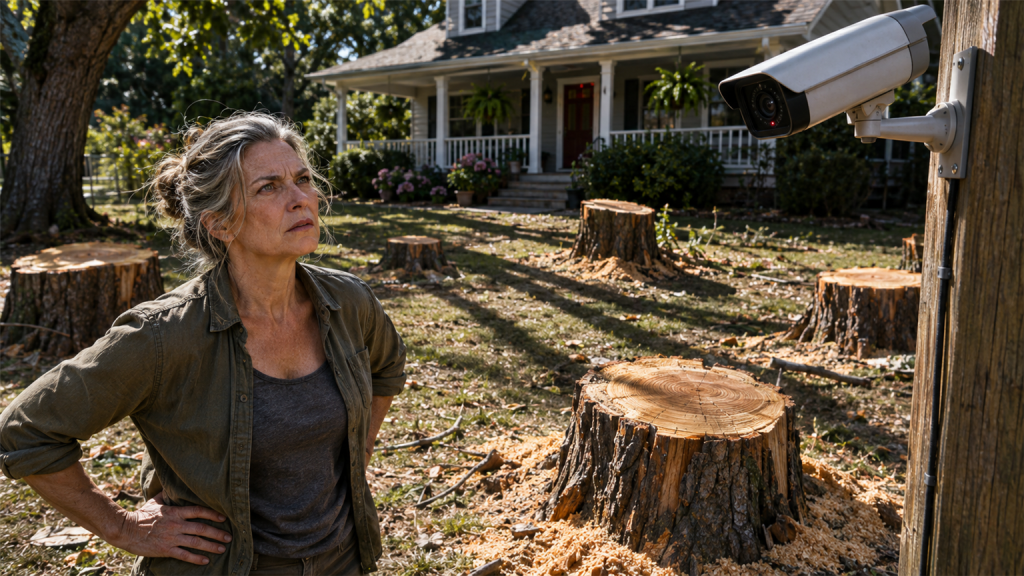
I had assumed that ended the matter.
But the cameras had been there almost a year.
They had watched my porch.
My door.
My bedroom window.
And every Tuesday, they had watched me leave for the county office.
Gus looked at me.
“That’s how they knew.”
I stared at the blinking red light.
The trees were not the beginning.
They were what happened after someone spent a year learning exactly when I would not be home.
Deputy Everly told me he could investigate the cutting, but the camera poles sat on HOA land, so removing them would require more than my anger. I understood. Frank would have marched uphill with a shovel. I decided to do it on paper.
I called Hank Dolan, a surveyor I had known for decades. He spent a full day locating the recorded monuments and checking the line twice. His conclusion was simple: the gravel path belonged to the HOA, but my property ran right to its edge. The fourteen cedars were twenty-two to thirty-eight feet inside my land.
Then Hank smiled.
“County will permit an eight-foot privacy fence here.”
The cameras sat about seven feet high.
An eight-foot fence on my side of the line would block every lens legally.
“Then that’s what I’m building.”
My attorney sent preservation letters to the HOA, Ridgeline Tree Service, several ridge homeowners, and the association’s insurer. An arborist valued replacement of the fourteen mature cedars at $126,400. If the cutting proved willful, potential damages could be much higher.
Then Ridgeline sent us its work order.
AUTHORIZED BY: RUSSELL THORNE.
Below it was another line:
APPROVED BY BOARD.
That bothered me.
I had worked with records too long to trust a checked box.
So I requested the HOA meeting minutes.
The board secretary called me herself.
“Mrs. Hartley, I wrote those minutes.”
“Was tree removal ever approved?”
“No.”
“Any vote?”
“No.”
“Any discussion?”
“Never.”
Russell had not acted for the board. He had acted alone.
And the insurance company had just informed my lawyer that deliberate, unauthorized cutting might not be covered.
Meaning the bill might land exactly where the signature was. On Russell Thorne.
of 5
The eight-foot cedar fence went up on Thursday, entirely inside my surveyed boundary with a county permit displayed on the contractor’s truck. By sunset, all three HOA cameras had lost their view of my bedroom, porch, and back door.
Russell Thorne arrived twenty-three minutes later and called the fence excessive and harmful to property values.
“It was built for those,” I said, pointing toward the cameras.
He claimed they provided community security.
“Then point them at the community.”
When Russell cited HOA fence restrictions, I reminded him that I did not belong to his association. Its authority ended at my property line.
The next morning, my attorney, Lydia, reported that the HOA’s insurance company had examined Ridgeline’s work order. Russell’s signature appeared beneath a statement claiming board approval, but no vote had ever occurred. The insurer warned that it might refuse coverage if the tree cutting proved deliberate and unauthorized.
I continued building my file: the HOA’s request to trim the cedars, my refusal, trail-camera footage, the survey, police report, work order, board minutes, secretary’s statement, settlement check, camera photographs, and arborist report.
Russell then offered me $5,000 and demanded that the fence come down as part of the settlement. I refused. Replacing the fourteen mature cedars was estimated at $126,400, and the fence was staying.
At a formal meeting with the entire board, Lydia placed Russell’s signed work order on the table. The secretary confirmed that nobody had approved the cutting. Board members also saw photographs showing a camera pointed directly at my bedroom.
The insurer’s warning and arborist’s estimate alarmed them, but Russell kept defending himself. Finally, he said the neighborhood had spent years suffering obstructed views because I refused a reasonable request.
That sentence exposed everything.
There had been no boundary confusion. Russell had asked me to cut the trees. I said no.
A year later, he hired someone to do it anyway.
of 5
After an executive session, the board offered a resolution. Larkspur Ridge would pay to replace the fourteen cedars with the largest viable specimens available. The HOA would remove or redirect every camera capable of recording my home, reimburse my survey and legal expenses, acknowledge the true boundary in writing, and allow my fence to remain.
Russell would also sign an apology.
I added one condition: the letter had to state exactly what he had done. There would be no passive language about mistakes or confusion.
Three days later, the certified letter arrived.
Russell admitted that he had authorized the cutting of trees on my private property without proper board approval. He also acknowledged permitting cameras to capture portions of my residence. He stated clearly that those actions were wrong.



