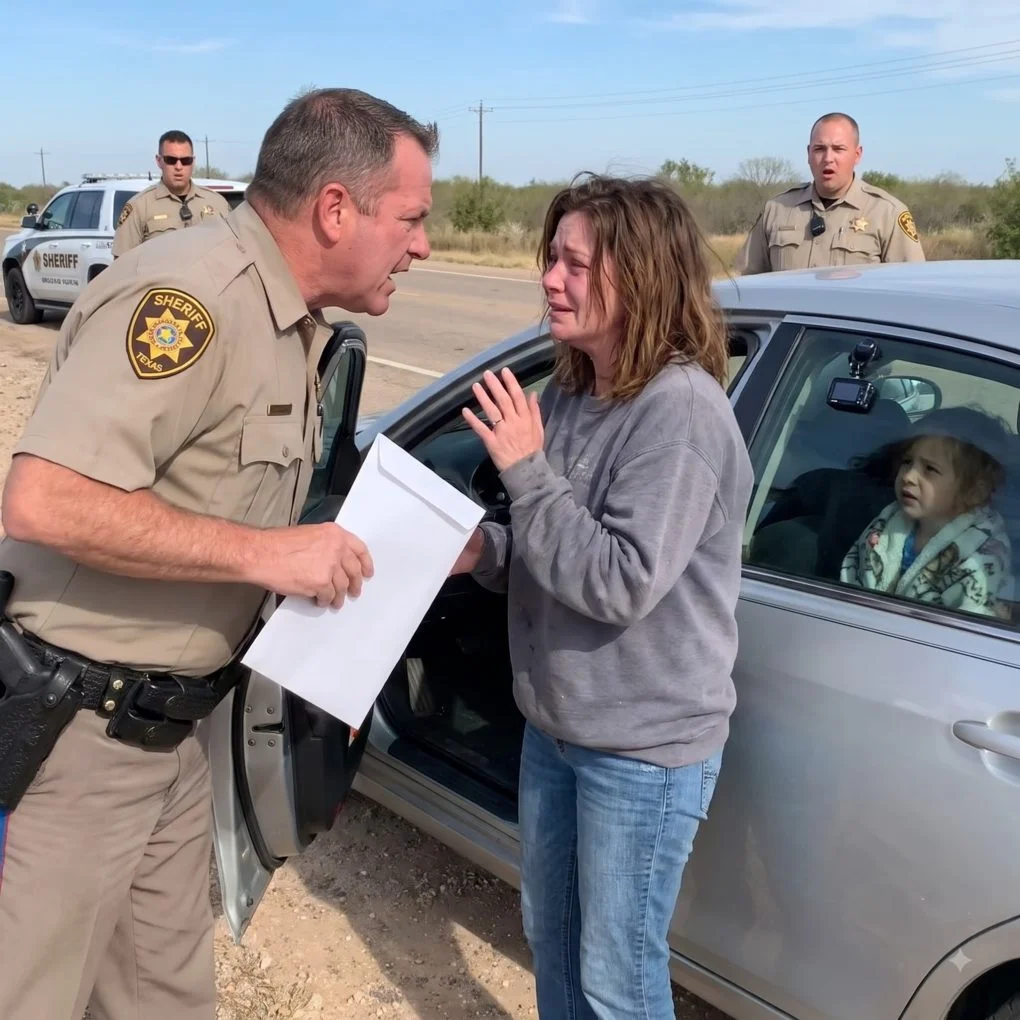
The following Tuesday, a lieutenant called to say Kessler’s report described a voluntary surrender of $400 in suspected drug proceeds. It said I had declined a receipt, that no child was in the vehicle, and that his body camera had failed before he approached my car.
I stared at Lucy’s cereal bowl on the table, the spoon balanced across its chipped rim. That morning she’d asked whether we would have to leave her school, where she’d finally made a friend who didn’t laugh at her inhaler.
Caroline requested an independent review, and the district attorney’s office referred the allegations to state investigators. A Texas Ranger named Elena Vargas interviewed me for two hours, asking questions that made my palms sweat: how the bills were bundled, what the deputy touched, precisely when he’d unplugged the camera.
I answered each one, even when I wanted to go home and hide beneath a blanket beside Lucy. Vargas explained that other drivers had complained about Kessler’s stops, but without clear recordings their accounts had been difficult to prove; my footage allowed investigators to examine his reports against something more than his word.
A week later, Caroline called after receiving permission to share an update. Investigators had located a second driver whose money was reported as “voluntarily surrendered,” and bookkeeping records showed discrepancies in several more stops.
Then Caroline’s voice tightened. “Hannah, there’s one document you need to see.”
It was Kessler’s official narrative, signed the morning after our encounter. At the bottom he’d written that I had been traveling alone and that I offered him the money because I knew it came from drugs.
And beneath that lie was a signature, forged in my name.
I used to think revenge meant shouting loudly enough that the person who hurt you finally understood. Sitting in Caroline’s office with that forged form in my lap, I discovered I wanted something quieter and harder: for Wade Kessler to tell his story where someone could compare it with the truth.
The investigator kept the original memory card and obtained the dashcam’s unedited files through a forensic copy. The recording didn’t show every dollar individually, but it captured Kessler counting the entire envelope, my explanation about the credit-union withdrawal, and Lucy asking whether we could go home; bank and evidence-room records supplied the missing financial trail.
Investigators found that Kessler had logged only $400 of my money, and the remaining $2,000 had never entered the evidence system. His financial records and similar discrepancies in earlier stops gave prosecutors more than my accusation, while a handwriting examiner concluded that the signature on his surrender form wasn’t mine.
Other people began coming forward. There was an older mechanic whose week’s wages disappeared during a roadside search, and a grandmother who’d been threatened with jail after withdrawing cash for a used car; each thought the shame belonged to them until they learned how many others he’d targeted.
Kessler was placed on leave, then fired as the investigation widened. Eleven months after he stopped me, he pleaded guilty to theft by a public servant and falsifying official records, received a prison sentence, and was ordered to pay restitution to the drivers whose losses prosecutors could establish.
At sentencing, the prosecutor played a short section of my recording after I gave permission. In the quiet courtroom, Lucy’s tired little voice filled the speakers: “Mommy, are we going home?” followed by Kessler saying someone could collect my kid if I didn’t cooperate.
Kessler kept his eyes on the table. When I was invited to speak, I held the edge of the wooden lectern because my hands were shaking again, just as they’d shaken that night beneath his flashlight.
“You took money I earned helping elderly residents bathe, eat, and find their feet again,” I told him. “But the worst thing you took was the certainty my daughter had that asking a police officer for help would make her safer.”
I didn’t ask him to look at me. When the judge imposed sentence and the bailiff came forward, I thought of his laugh beside my car, and for the first time that memory didn’t make me feel small.
We kept our apartment. The rental-assistance program covered part of our overdue balance, and Mrs. Patel accepted the rest in installments while the criminal case moved forward; when my $2,400 restitution finally arrived, I used it to replace the money I’d borrowed and rebuild our emergency savings.
Lucy recovered from pneumonia long before the case ended, but she still went quiet whenever a patrol car followed us. I never told her all police officers were bad or that one conviction could erase fear; I told her grown-ups, including people in uniforms, have rules they must follow.



