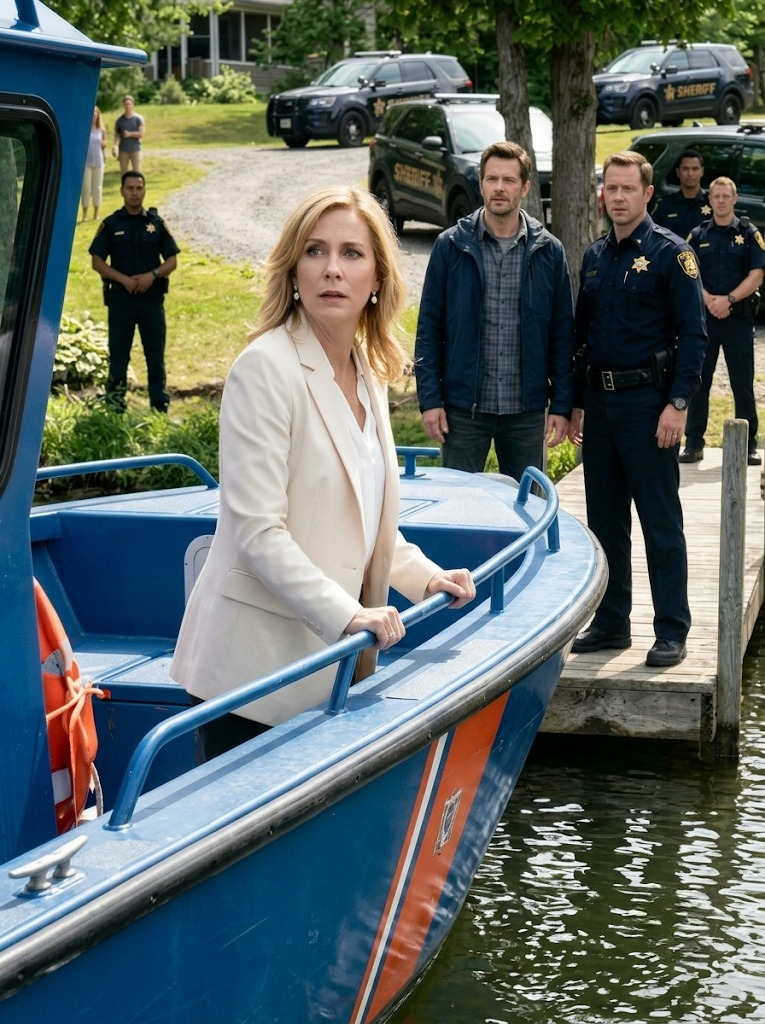
Caroline hesitated.
“Of course.”
Natalie held up the transfer agreement.
“Did you tell our insurance company Pinewater Shores owned Evan’s boat?”
“We described the association’s operational interest.”
“That’s not what I asked.”
The room shifted.
Caroline stared at her.
Natalie repeated it.
“Did you represent to the insurer that Pinewater Shores owned Bluebird?”
“Our broker handled the details.”
Natalie opened another page.
“The application says ‘owned vessel.’”
She held it toward the room.
“It lists the HOA as owner.”
Caroline’s voice sharpened.
“The board had an agreement.”
“No.”
Natalie placed the disputed transfer on the table.
“This?”
“Yes.”
“I didn’t sign this.”
Murmurs spread across the room.
Caroline raised one hand.
“We are investigating how that signature was inserted.”
Natalie looked directly at her.
“My signature was copied from a reimbursement approval.”
People began whispering louder.
Then Natalie projected the two documents.
Her genuine reimbursement signature.
The witness signature on the transfer.
Same flourish.
Same tiny piece of printed box beside it.
One homeowner said, “Oh my God.”
Caroline reached toward the laptop.
“This has not been forensically established.”
Natalie pulled her hand away from the controls.
“Neither has Evan’s signature.”
I finally stood.
“I can establish where mine came from.”
I held up the original form Caroline had given me three weeks earlier.
My signature appeared on the acknowledgment line.
The same slight break ran through the B.
The same pen mark appeared beneath the final s.
The room went silent.
“I signed this page to confirm I received Caroline’s proposal.”
I held up the false transfer.
“I did not sign this.”
Someone asked Caroline, “Did he ever agree?”
She looked toward the board attorney.
He did not answer for her.
“No,” she said eventually.
That single word damaged her more than any accusation could have.
I had refused.
She knew I had refused.
Yet days later, the HOA insurance records represented Bluebird as association property.
Natalie moved to the money.
She projected payments to Lakesafe Response Partners.
$8,500.
$12,000.
$13,500.
Thirty-four thousand dollars total.
A homeowner near the front raised his hand.
“What is Lakesafe?”
Caroline said it was an emergency-response vendor.
“Who owns it?”
No answer.
Natalie clicked the next slide.
State business registration.
Owner:
Douglas Price.
Caroline’s brother.
People started shouting.
The vice president, Mark Ellis, struck the gavel.
“Quiet.”
It took nearly a minute.
Mark turned toward Caroline.
“Was this relationship disclosed?”
“Yes.”
Natalie shook her head.
“Not in the minutes.”
“It was known informally.”
“That’s not disclosure.”
Caroline looked furious.
“You’ve spent forty-eight hours assembling an attack.”
“No,” Natalie said. “I’ve spent forty-eight hours figuring out where our money went.”
That was the sentence that turned the meeting.
Until then, some homeowners still viewed the boat dispute as a fight between Caroline and me.
Now it belonged to them.
Their dues had paid Caroline’s brother.
Their HOA had insured my boat.
Their records contained signatures we disputed.
Their president had used association authority to create the appearance that privately owned property belonged to everyone.
Then Sergeant Harris entered the clubhouse.
He was not there to arrest anyone.
That disappointed the part of the room interested in drama.
He was there because several homeowners had requested guidance about preserving association records.
He stood near the door until Mark recognized him.
Harris explained carefully.
The sheriff’s office was investigating the unauthorized use of the vessel and the disputed documents.
No conclusion had been reached about criminal responsibility.
No one should destroy, alter, or rewrite records connected to the matter.
That was all.
But it was enough.
Caroline stopped calling the issue an administrative error.
The board voted that night to suspend her financial and contracting authority pending independent review.
Four to one.
Caroline voted against.
She left without speaking to me.
The following morning, Natalie and Mark met with the HOA’s bank.
They froze further payments to Lakesafe.
Then the insurer called.
Pinewater Shores’ water-response policy had been issued using an asset schedule stating Bluebird was owned by the HOA.
The insurer opened its own investigation.
Douglas Price, Caroline’s brother, claimed he had assumed all equipment listed by the HOA was legitimately available.
Maybe he had.
Maybe not.
That question took longer.
What was clear was that Lakesafe had marketed Pinewater Shores as possessing “professional volunteer rescue capacity.”
They had produced brochures.
Bluebird appeared in them.
My county rescue decals had been digitally removed.
A Pinewater Shores logo replaced them.
One brochure advertised private emergency support for community events, holiday regattas, and premium waterfront activities.
That explained Saturday.
The party was not random.
It was a demonstration.
Caroline had invited donors and residents to see the HOA’s new lake-response program.
My boat needed to be there because without it the program looked like what it was:
Two small maintenance boats and a consulting company.



