I read every word.
The county could request assistance during emergencies.
I remained the owner.
I remained responsible for maintenance.
If I was unavailable, nobody could simply take the boat.
Deployment required my consent unless I separately authorized an operator in advance.
Emergency equipment standards were written clearly.
Either party could terminate the agreement.
I signed it.
Mark joked about the irony.
“You refused our paperwork and signed theirs.”
“Theirs says what it means.”
He nodded.
“Fair point.”
Two months later, Bluebird made its first rescue under that agreement.
A thunderstorm crossed Lake Harrison faster than forecast.
A fishing boat carrying a father and two teenagers lost power near the western reeds.
Wind pushed them toward submerged timber.
The sheriff’s marine unit was twenty minutes away.
I was six.
Sophie heard the radio call from the kitchen.
“Go.”
“You sure?”
She looked at me like the question was insulting.
“Dad.”
I ran.
Bluebird launched in less than three minutes.
The lake was rough enough to slap spray over the bow.
I found the fishing boat drifting sideways.
One teenager was crying.
The father was trying to restart the engine.
I threw them a line.
Towed them clear of the timber.
Then brought them back to the public ramp.
No ticket.
No donor badge.
No community package.
Nobody asked whether they lived in Pinewater Shores.
That is what the boat was for.
When I returned home, Sophie was waiting on the dock.
She helped secure the stern line.
Then she looked toward the neighborhood clubhouse.
“Think they finally understand?”
“What?”
“What rescue means.”
I looked at Bluebird.
“I think most of them always did.”
That was important.
Caroline did not represent every homeowner.
Most Pinewater residents never asked her to take my boat.
The passengers at the party believed she had permission.
Natalie exposed the paperwork.
Mark helped remove her authority.
Neighbors voted her out.
It is easy to tell stories where an entire HOA becomes the enemy.
Reality is usually messier.
Institutions are made of people.
Some stay quiet too long.
Some trust the wrong person.
Some eventually stand up.
The problem was never that Pinewater Shores existed.
The problem was that Caroline started believing the title “president” changed the meaning of ownership.
It did not.
Being responsible for community safety did not make my rescue boat communal property.
Running an event did not create permission.
Buying insurance did not create ownership.
Printing my name did not create consent.
And putting twelve smiling people on the deck did not transform theft into a community program.
Two years later, the old photographs still surface occasionally.
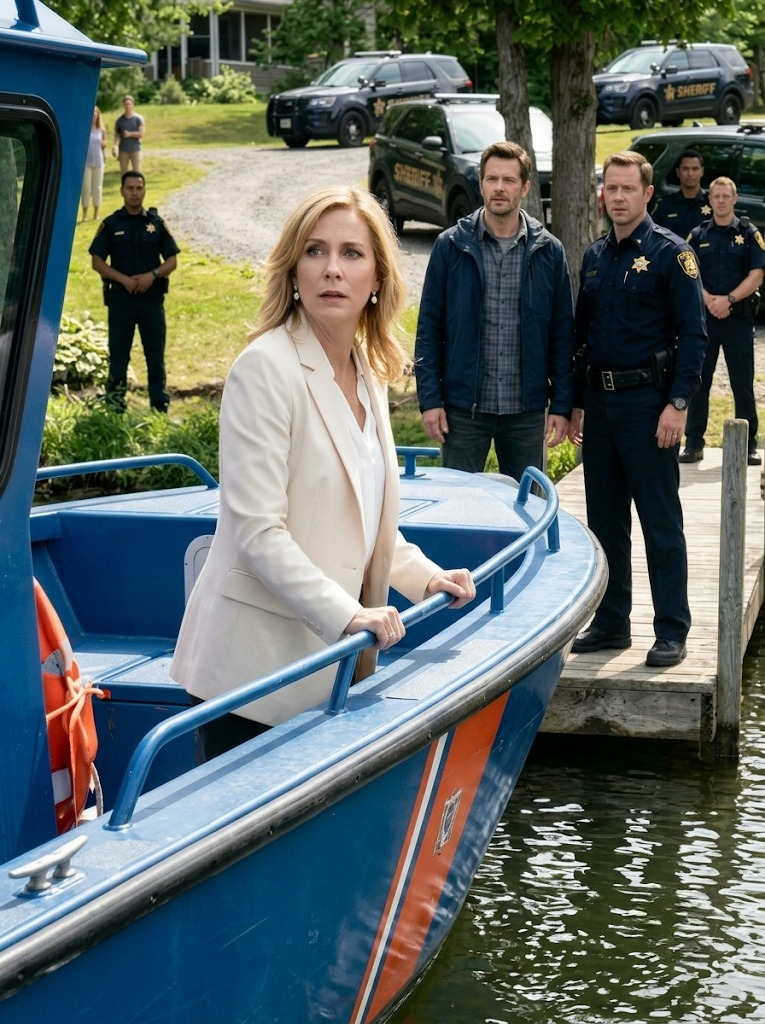
Caroline in her cream blazer.
Champagne glasses.
My boat beneath an HOA banner.
Six sheriff’s deputies waiting at the dock.
People usually laugh when they see that final picture.
I don’t.
I remember Sophie standing beside me.
I remember seeing my rescue ropes thrown underneath a seat.
I remember realizing that if an emergency had happened during those hours, the boat built for exactly that purpose would have been carrying party guests instead.
That was the part I never found funny.
Today Bluebird sits at my dock beneath a small security camera.
The rescue insignia is back where it belongs.
Underneath it, Sophie convinced me to add one new line in smaller letters:
PRIVATE VESSEL — EMERGENCY VOLUNTEER SERVICE
Clear enough for everybody.
Mark once asked whether the “PRIVATE VESSEL” part was necessary.
I looked at him.
He laughed.
“Never mind.”
Every spring, I inspect the flotation gear.
Replace expired medical supplies.
Check the radio.
Run the motor.
Repack the lines.
Sophie usually helps.
She is seventeen now.
Old enough that I have begun teaching her how to operate the boat safely.
One morning she took Bluebird away from the dock by herself for the first time while I stood beside the boathouse watching.
She made a wide turn.
Returned slowly.
Centered the hull.
Shifted into neutral.
Perfect.
“Permission?” she called.
I laughed.
“Granted.”
She smiled.
That word meant something different to us now.
Permission.
Not assumption.
Not authority invented after the fact.
Not somebody deciding they know what is best for property they do not own.
Permission is simple.
You ask.
The other person answers.
And if the answer is no, you respect it.
Caroline could have saved herself a year of legal trouble, her HOA presidency, her reputation, and thousands of dollars by understanding that one ordinary rule.
Instead, she believed the position she held gave her rights that belonged to someone else.
For a few hours on that Saturday, she even managed to make it look true.
The photographs looked official.
The banner looked official.
The insurance papers looked official.
The transfer form looked official.
Then six deputies asked one question:
“Did the owner give you permission?”
Everything else collapsed behind it.



