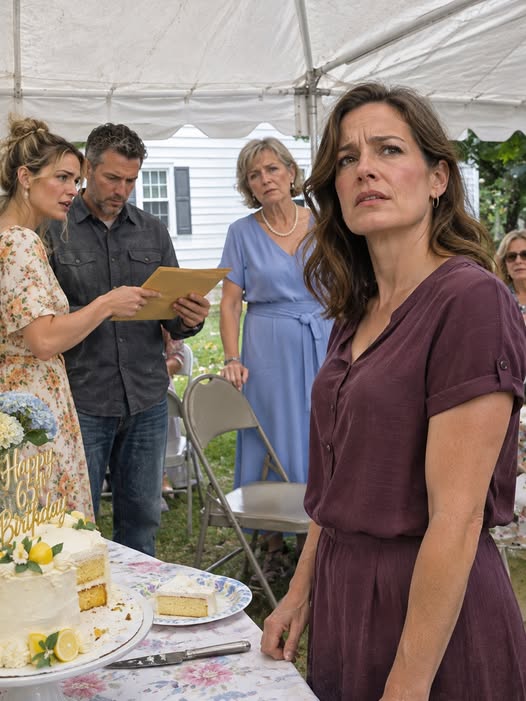
That Thanksgiving, Aunt Carolyn left a warm apple pie on my doorstep with a note telling me she knew what people were saying.
Then, in December, Dad appeared in my driveway.
He sat in his truck with the engine running until I invited him inside.
We drank coffee and talked about ordinary things.
Before leaving, he said, “Whatever your mother told you about yourself, it isn’t true.”
I thought he meant her accusations about Kayla.
I thanked him.
He left his thermos behind.
I kept it.
Eventually, Kayla allowed me back into family gatherings because Owen kept asking for Aunt Pay.
And in April 2026, a new patient arrived at my cardiac rehabilitation clinic.
His name was Dennis Albright.
He’d survived a cardiac arrest the previous December and had an implanted defibrillator.
His diagnosis was hypertrophic cardiomyopathy, a condition that can dangerously affect the heart’s rhythm.
A note on his referral said he’d requested me personally.
At his first appointment, he watched me attach the monitoring leads.
Then he asked, “You still ring that bell, Paige?”
I looked up.
“The one on your red bicycle,” he added. “You rang it every time you passed my garage.”
I remembered the smell of cedar.
The red bicycle.
The brass bell.
“Mr. Albright?”
He smiled.
“Dennis is fine.”
His cardiologist had given him a list of rehabilitation programs. He’d found my name and photograph on the clinic website.
During our sessions, he asked about Kayla.
He asked about Owen.
He wanted to know whether anyone in the family had ever fainted or complained about a racing heartbeat.
I assumed he was lonely and curious about people he’d known years before.
Then, on May 7, Dennis asked me to walk him to his truck.
He took a photograph from the glove compartment.
A newborn baby in a pink knit hat was sleeping against my mother’s chest.
It was Kayla.
I recognized the photograph from our family album.
Dennis told me to turn it over.
On the back, in Mom’s unmistakable handwriting, were the words:
She has your eyes. Please, Dennis, stay away.
I looked at him.
“Are you telling me that I’m—”
“No,” he said gently. “You’re Phil’s.”
He waited until I was looking directly at him.
“Kayla is my daughter.”
For three years, I’d believed I was the child who didn’t belong.
Now the man from across the street was telling me the truth had been the other way around.
But Dennis wasn’t asking me to help him reclaim a daughter.
He put a hand over the spot where his defibrillator sat beneath his shirt.
“I’m here because her boy might have what I have.”
THE NEXT PART IS BELOW
Don’t forget to switch from “Most Relevant” to “All Comments” to continue reading more
Dennis explained that his genetic testing had identified a disease-associated variant in the MYBPC3 gene.
A child of a parent carrying that variant could have a fifty-percent chance of inheriting it.
Kayla might have it.
And if she did, Owen might have inherited it from her.
Dennis had already written to Mom in April, enclosing his genetic report and a family letter prepared by his genetic counselor.
She’d never responded directly to his concerns.
Instead, she’d left an angry voicemail threatening to accuse him of stalking if he contacted her daughter.
That meant she’d known about the possible risk to Owen before I ever saw Dennis’s photograph.
The following morning, I arranged to transfer his rehabilitation care to my colleague Joanne Pruitt.
I couldn’t continue treating someone who was now so personally involved in my family.
Dennis and I agreed to meet outside work, on Thursday afternoons at Harbor Light, a cafe overlooking the Portland waterfront.
Nathan insisted I verify Dennis’s story before taking further action.
On May 14, Dennis brought an old shoebox to the cafe.
Inside were letters from my mother, dated between October 1991 and August 1993.
I compared them with a birthday card she’d recently sent me.
The handwriting matched.
Dennis had moved onto Larch Street in 1989.
I’d been born in March 1986.
The dates confirmed what he’d told me.
I wasn’t his child.
Kayla was.
He also played Mom’s voicemail, dated April 3.
“I got your letter. There’s nothing wrong with my family. If you come near my daughter, I’ll tell everyone you’re a stalker.”
I saved the recording.
Then I told Dennis that Owen’s health had to come before exposing the affair.
He agreed to give me time.
On June 27, Owen collapsed during a soccer tournament in Scarborough.
Jake, my brother-in-law, texted me.
Owen had regained consciousness, and urgent care attributed the incident to dehydration.
I reviewed the discharge paperwork.
Given what Dennis had told me, I couldn’t dismiss a fifteen-year-old athlete fainting during exercise.
I called Kayla and recommended a cardiac evaluation, including an echocardiogram.



