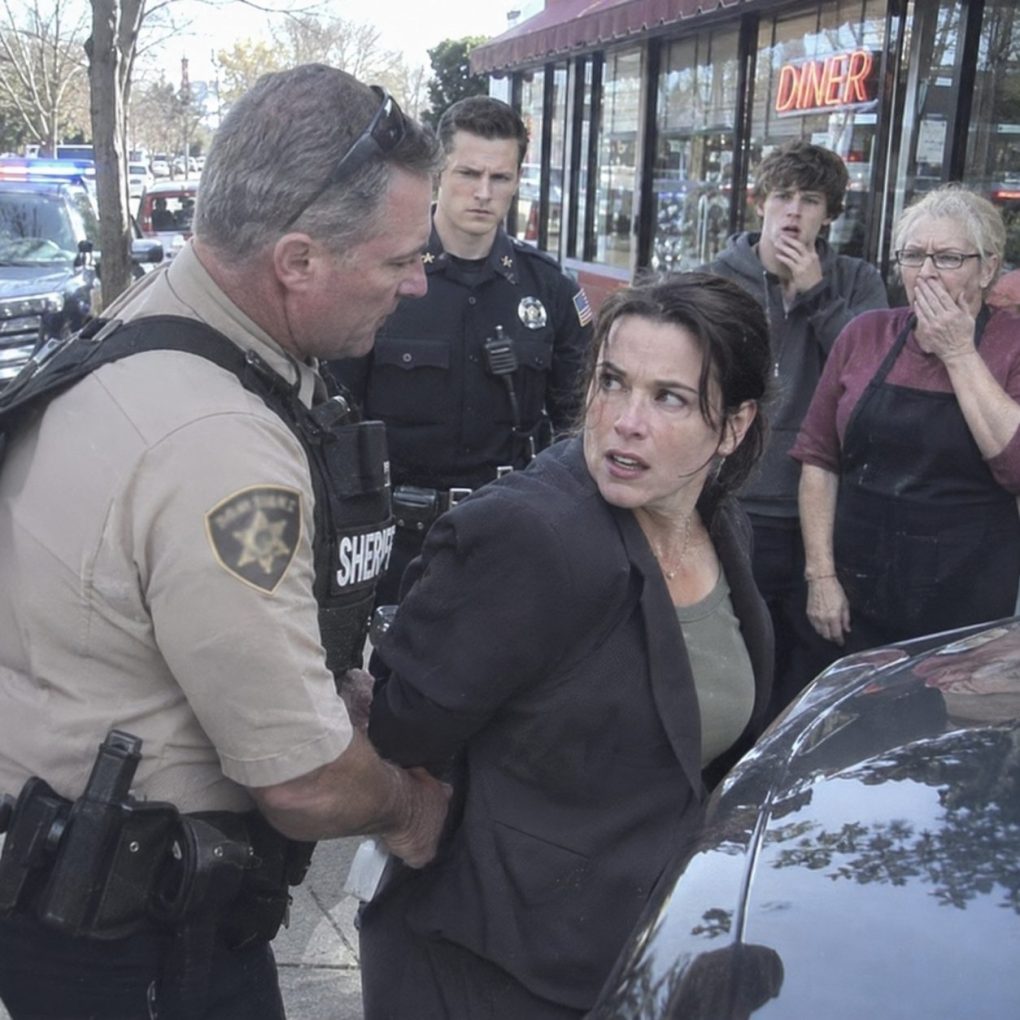
The sheriff shoved me against his patrol car and sneered, “Let’s see who comes to save you now.” I remained silent as he arrested me without explaining the charges. Two hours later, his deputy discovered my federal judge identification. Then he checked the arrest report—and immediately called his supervisor…
“You think you’re above the law?” Sheriff Dale Rourke laughed as he pushed me against his patrol car outside the Red Oak Diner. My coffee was still on the counter, and a teenage busboy stood frozen near the entrance while half a dozen customers watched.
“I’m standing on a public sidewalk,” I told him. “I moved back when you asked.”
“Then you should’ve kept your phone in your purse.” He tightened the handcuffs until the metal pressed against the bone in my wrist, and when I asked what I was being charged with, he leaned close enough for me to smell the peppermint on his breath. “Obstruction. We can discuss the rest at the station.”
I didn’t tell him I was a federal district judge. I had come to this small Ohio town in jeans and an old gray cardigan to collect the last of my late mother’s belongings, not to sit in a courtroom, and I didn’t believe my job title should determine whether an officer treated me decently.
Ten minutes earlier, I’d seen Rourke shouting at nineteen-year-old Eli Lewis beside a tow truck. Eli had questioned an $860 impound bill for his sister’s car, and when the sheriff ordered him to stop filming the exchange, I had taken out my own phone from several yards away. A young deputy stood nearby, his body camera facing us.
“Ma’am, leave the scene,” Rourke had barked. I stepped backward to the diner wall, lowered my phone, and said I wasn’t interfering; he crossed the sidewalk anyway, snatched my arm, and announced I was under arrest.
Inside the patrol car, I watched Eli’s grandmother, June, emerge from the diner with her apron still tied around her waist. She had served my mother coffee every Saturday for twenty-seven years, and when she spotted me behind the glass, she pressed one shaking hand to her mouth.
At the station, a young deputy named Mason Price took my personal belongings for the booking inventory. He found my driver’s license first, then the federal judiciary identification card tucked behind it, and his expression changed so sharply that he read the card twice.
“Judge Evelyn Carter?” he asked quietly.
I nodded. “I would like to call my attorney, Deputy.”
He went to the sheriff’s office with my wallet. Through the partly open door, I heard Rourke say, “She still broke the law,” followed by a pause and the rasp of a desk drawer.
Then Mason spoke, his voice unsteady. “Sir, why does the arrest report say she struck you?”
I looked down at my bruising wrists.
Because I had never laid a hand on him.…Want to know what happens next? Read on here.👇
Mason’s question hung in the hallway. From the sheriff’s office came the scrape of a chair, followed by Rourke’s voice: “She grabbed my sleeve. Write it up properly.” Mason answered that he had been standing close enough to see my hands, and neither of them spoke for several seconds.
I was fifty-one, a United States district judge in Cleveland, and I had spent seventeen years as a lawyer before taking the bench. I knew an official title did not make me immune from arrest, but I also knew the difference between asking an officer a question and striking him. My left wrist was beginning to swell around a thin red line where the cuffs had pinched.
Mason returned my wallet and brought me to a quiet interview room. He apologized for the cuffs, then said, “I was there when he arrested you. My body camera was recording.” His face was pale, not because he had found someone powerful, but because he understood what his supervisor wanted him to say.
I asked for my telephone call and contacted a lawyer outside my court’s district, Laura Chen. She told me not to debate the accusation with Rourke and said she would contact the county prosecutor and arrange for my statements and medical photographs to be preserved. As soon as I could, I notified my court’s chief judge, because I wanted no question that I was trying to use judicial authority to settle a private grievance.
While I waited, I remembered my mother at the Red Oak counter, counting tips into little paper stacks after the closing shift. She raised me on waitress wages and a stubborn insistence that I never treat anyone as less important because of the work they did. When I passed the bar exam, she hung the congratulatory letter above the coffee machine until the ink faded.



