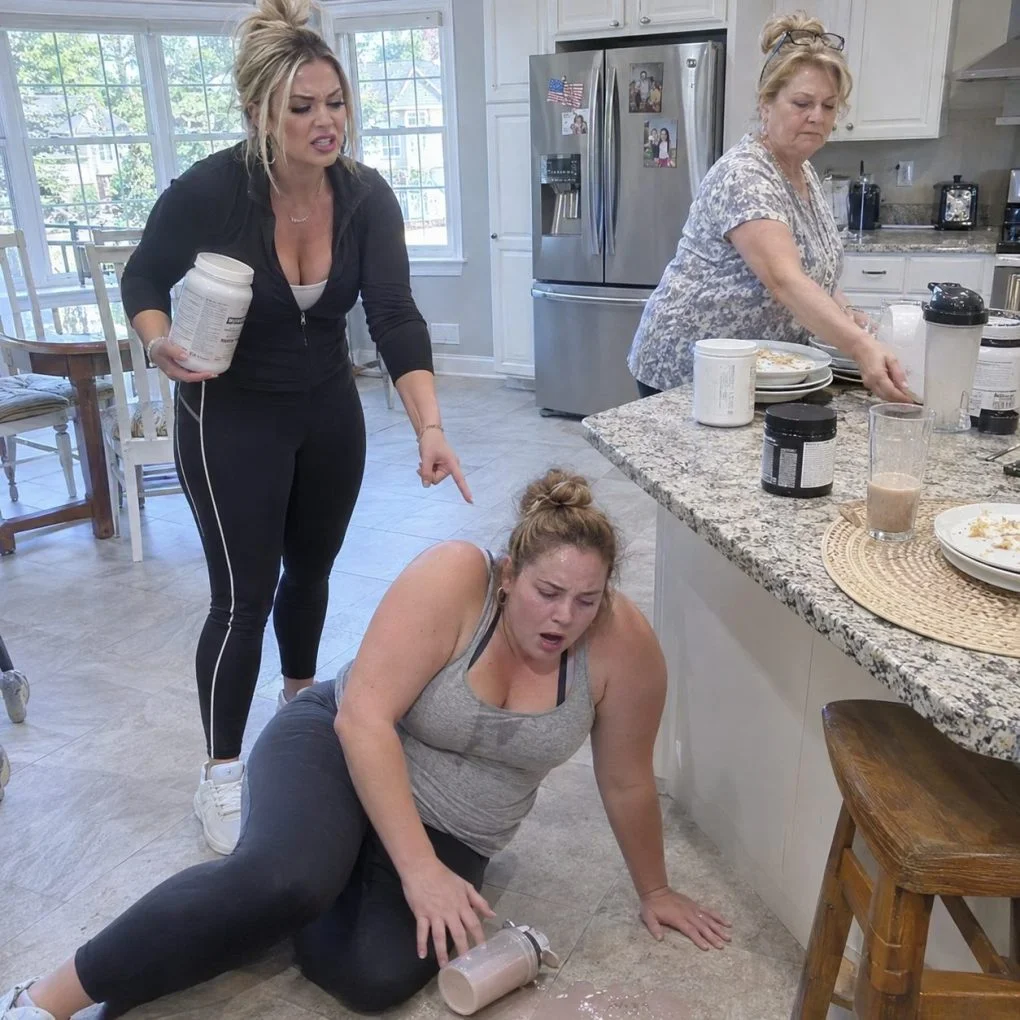
During a family birthday dinner, my vision blurred and I fell against the table. My sister blamed my weight and her strict meal plan; my parents agreed. At the hospital, the physician reviewed my results and asked who’d been preparing every meal. Then she called the police…
““You’re just fat and lazy, Rachel! Stop embarrassing yourself and get up!”
My sister Vanessa stood over me in our parents’ kitchen while I lay on the cold tile floor, struggling to focus on the ceiling lights. My hands were trembling, my heart was racing, and the last thing I remembered before everything went dark was Mom saying, “She’s always been dramatic.”
I was thirty-one, living in Columbus, Ohio, and I’d spent the previous three weeks following Vanessa’s “special diet program.” She was a popular wellness influencer with nearly 80,000 followers, and she’d convinced our parents that helping me lose weight would be her next great success story.
What nobody mentioned was that I’d never asked to become one.
I’d gained weight after a difficult year working double shifts as a hospital billing coordinator, and Vanessa had turned every family gathering into a public discussion of my body. When I finally agreed to try her program, she’d promised balanced meals, professional supervision, and a chance to feel healthier.
Instead, she handed me unmarked containers of powdered supplements and demanded that I replace two meals a day with her homemade shakes. Whenever I complained about dizziness, she’d smile into her phone and tell her followers that I was experiencing “normal detox symptoms.”
Three days before I collapsed, I’d begged her to let me eat a proper dinner.
“Your body is fighting the process,” she’d said, taking the sandwich from my hands. “If you quit now, you’ll prove everyone right.”
Dad had nodded without looking up from the television.
Now, on the kitchen floor, I could hear Vanessa complaining that I’d ruined the video she was filming for her followers. My mother eventually called 911, but only after I failed to respond when she shook my shoulder.
At Riverside Methodist Hospital, an emergency physician named Dr. Rebecca Collins ordered blood tests and began treating me for severe dehydration and dangerously low potassium. When she asked what I’d been eating, Vanessa answered before I could speak.
“She’s on a medically designed wellness program,” she announced. “She’s just not following it properly.”
Dr. Collins turned toward me.
“Rachel, have you been taking any medications or supplements?”
I nodded weakly and described the powders Vanessa had mixed into my drinks. My sister immediately interrupted, insisting that everything was natural and completely safe.
Then the doctor reviewed my results again.
“Your potassium is critically low,” she said. “And your kidney function is abnormal. We need to know exactly what you’ve been given.”
Vanessa reached into my bag and tried to remove the supplement containers.
“Those are proprietary,” she said sharply. “You can’t take them.”
Dr. Collins asked her to stop, then requested a private conversation with me. When I explained that Vanessa controlled every meal and had ignored my repeated complaints, the doctor’s expression changed.
She contacted the hospital social worker and asked security to preserve the containers while she discussed making a police report.
But the real shock came when I checked my phone and discovered Vanessa had already posted a video of me collapsing—with a caption claiming I was faking it.
I watched the video three times before I could understand what I was seeing. Vanessa had edited out the moment I hit the floor and kept the part where she stood over me, shaking her head as though I were a disobedient child refusing to finish her homework.
The caption read, Some people want results without doing the work. Accountability isn’t abuse.
By morning, thousands of strangers had commented on my body, my appearance, and my supposed lack of discipline. Vanessa had even replied to one woman who suggested I needed medical attention, writing, She’s fine. She just hates being challenged.
I wasn’t fine.
My potassium level had fallen low enough to put me at risk of a dangerous heart rhythm, and my kidney function showed signs of acute injury. Dr. Collins explained that dehydration, inadequate nutrition, and excessive laxative use could contribute to those findings, but she needed more information before determining what had happened.
When I mentioned the frequent diarrhea I’d experienced since starting Vanessa’s shakes, she asked whether I had knowingly taken any laxatives.
“No,” I whispered. “Vanessa said the powder was a metabolism booster.”
The hospital kept me for treatment and monitoring, while a social worker helped me document the food restrictions and Vanessa’s refusal to let me stop the program. Because I was an adult and could speak for myself, the hospital couldn’t simply accuse my sister of a crime based on abnormal bloodwork, but staff helped me contact police to report that I suspected I’d been given substances without my knowledge.



