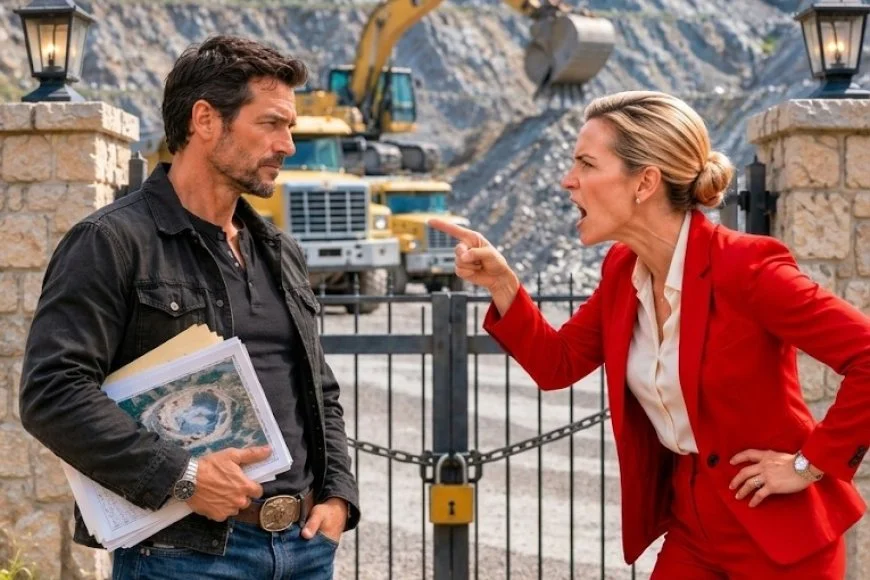
The first warning came at 6:15 on a Monday morning, when I found an excavator parked across the gate of my family’s quarry.
The second was the eviction notice taped to it.
And the third was Karen Strickland smiling beside the machine as if sixty years of ownership had just disappeared because she had printed something on HOA letterhead.
“By Friday,” she said, “every truck and piece of equipment on this property belongs under association control.”
I looked past her toward the limestone benches my grandfather had opened in 1964.
Then I asked one question.
“Karen, have you ever read the deed to your clubhouse?”
Her smile vanished.
Only for a second.
But I saw it.
My name is Graham Fenwick. I was fifty-two years old, and Millstone Quarry had supported three generations of my family and fourteen employees who depended on it every week.
My grandfather bought the land when the hillside was mostly timber and exposed blue-gray limestone. My father expanded the operation, surveyed the boundaries, and built Stone Cut Lane so loaded trucks could reach the county highway without passing through neighboring farms.
I grew up believing deeds were boring.
By that Monday morning, I understood boring documents could save a man’s life.
Karen was president of Stonecrest Bluffs, an eighty-six-home development built along the ridge above us.
She spread a glossy map over the hood of her SUV.
The quarry was shaded green.
STONCREST COMMON RESOURCE RESERVE.
According to Karen, the HOA had controlled the sixty-one acres for years. I was supposedly operating there only because previous boards had failed to enforce their rights.
“From whom did you buy it?” I asked.
“That’s all in the association records.”
“What deed?”
“You’ll receive everything through counsel.”
Two security men began photographing my loaders, crusher, wire saw, and finished stone. One started attaching orange inventory stickers to equipment.
I pulled the first sticker off.
“Leave.”
Karen smiled.
“Careful, Graham. Interfering with HOA property could become expensive.”
I didn’t threaten her.
I photographed everything.
That afternoon, her attorney filed for an injunction to stop quarry operations.
Within days, Karen contacted my three largest customers and warned that stone purchased from Millstone might be subject to litigation.
One contractor suspended a $180,000 order.
Then she blocked Stone Cut Lane.
A portable steel barrier appeared where quarry trucks entered the county road.
Fourteen employees showed up the next morning.
Half my trucks couldn’t leave.
I paid everyone anyway.
My foreman, Cal Morris, stood beside me watching idled dump trucks.
“How long can we do this?”
He meant financially.
I didn’t answer.
Karen arrived later with a cameraman.
She wanted me angry.
She wanted footage of a quarry owner tearing out an HOA barricade with heavy equipment.
I left the loader parked.
Instead, I photographed the barrier, logged the hours, recorded every delayed shipment, and called Dileia Carver.
Dileia was a real-estate litigator who had once handled a contract dispute for us.
She listened, then said, “Don’t fight Karen at the gate.”
“What do I do?”
“Make her explain that gate under oath.”
That evening, I received a strange phone call.
Beatrice Lowry, Stonecrest’s treasurer, spoke so quietly I could barely hear her.
“Did Karen ever negotiate with you for quarry stone?”
“No.”
“Did you agree to supply the clubhouse expansion?”
“What expansion?”
Silence.
Then Beatrice said, “I shouldn’t have called.”
The line went dead.
Two nights later, Stonecrest held an emergency homeowners meeting.
Karen showed photographs of our quarry, called my operation an illegal extraction business, and promised residents walking trails, a restaurant, and a scenic overlook once the land was “reclaimed.”
Then I walked in with Dileia.
Karen gave me three minutes.
I used less.
“Who sold Stonecrest the quarry?”
No answer.
“What price did the HOA pay?”
No answer.
“Which recorded conveyance bears the lawful owner’s signature?”
Karen’s jaw tightened.
“Pending litigation prevents us from discussing privileged documents.”
Then she changed the subject to truck safety.
Fear worked better than deeds.
Some residents applauded her.
As I left, Beatrice pressed an envelope into my hand.
Inside was an HOA budget resolution dated six months before Karen first claimed my land.
One line stopped me.
PROJECTED REVENUE — QUARRY STONE SALES.
Dileia read it twice.
“She was counting your money before she ever claimed your property.”
The first hearing came two weeks later.
Karen’s attorney approached the judge carrying a certified document.
A 2011 amended development plat.
Recorded.
Stamped.
Official.
Across the sixty-one acres of Millstone Quarry were four words:
STONCREST COMMON RESOURCE RESERVE.
Karen hadn’t forged the map.
Judge Meredith Voss refused to decide ownership immediately and ordered both sides not to alter the disputed area until a full survey and title review could be completed.
My most productive quarry face shut down overnight.



