Victor’s nighttime trucks had removed stone from inside that buffer.
Leah Brandt, our geotechnical engineer, showed photographs of fresh cuts and measurable movement near the toe of the bluff.
She was careful.
She did not claim the clubhouse was about to collapse.
She said continued excavation could destabilize the slope and recommended immediate structural evaluation.
The county agreed.
The clubhouse closed temporarily.
Then the bank acted.
Karen’s $3.6 million loan had been secured by the clubhouse.
Funding froze while engineers determined the cost of stabilization.
Estimated repairs exceeded $2 million.
And Beatrice’s financial records showed that Karen’s repayment plan depended partly on selling stone from a quarry the HOA never owned.
Victor’s deposition made things worse.
He admitted receiving a title-review warning that questioned Stonecrest’s rights before some of the nighttime hauling occurred.
Karen’s story of an innocent misunderstanding collapsed.
So did her presidency.
Stonecrest homeowners removed her within weeks.
I asked Dileia for one thing during the damages phase.
“Don’t make eighty-six families pay for Karen.”
She understood.
Claims focused on responsible parties, contractors, available insurance, and transactions actually connected to the damage.
Stonecrest still had a serious problem.
Its clubhouse needed repairs, and the construction loan remained outstanding.
Eventually, the association and lender agreed that selling the clubhouse property was better than dragging residents through years of litigation.
I submitted a bid.
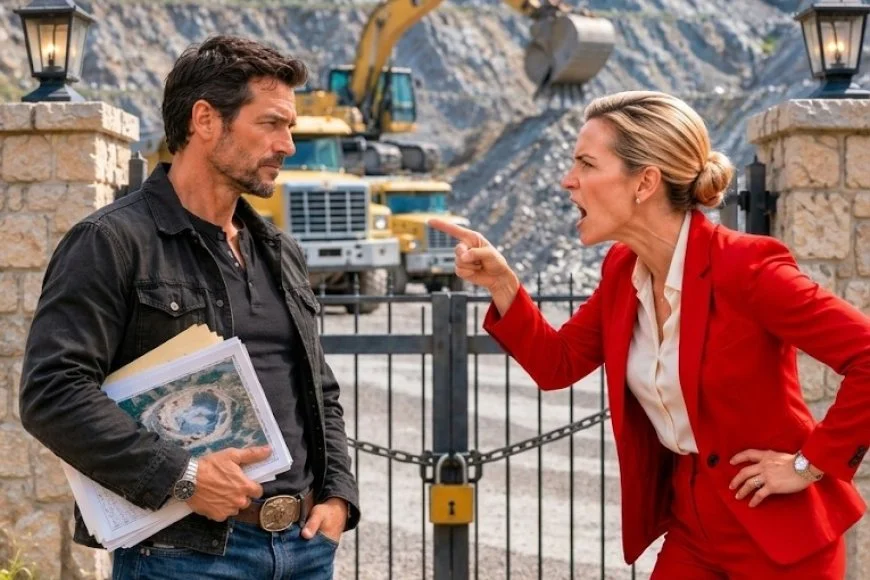
When word reached Karen, she appeared at the clubhouse on closing day.
She stared at the deed in my hand.
“You bought this just to humiliate me?”
“No.”
“Then why?”
I looked past her toward the bluff.
“Because you taught me what happens when somebody controls land they don’t understand.”
I didn’t turn the clubhouse into a trophy.
The slope was stabilized first.
Engineers repaired what could be repaired.
Only after the county cleared the building did it reopen.
Part of the main hall became a small exhibit about local quarrying and stonework.
The new Stonecrest board was allowed to use a meeting room under a written agreement anyone could read.
No hidden rights.
No creative maps.
No assumptions.
Back at Millstone Quarry, I framed two deeds.
One belonged to the quarry.
The other belonged to the clubhouse.
Between them, I hung Karen’s old development map.
Sometimes visitors ask why.
Because that map looked powerful once.
It had official markings, planning language, signatures, and county stamps.
Karen believed it so completely that she tried to take sixty-one acres with it.
But maps can describe intentions.
Boards can approve plans.
Banks can finance projects.
None of those things answer the simplest property question in America.
Who owns the dirt?
For that, you follow the title.
Karen came to my gate convinced one document could destroy my family’s quarry.
She was right about one thing.
One document did destroy her claim.
It just happened to be the deed to her own clubhouse.
The end
Disclaimer: This content is entirely AI-generated for fictional and entertainment purposes only. Any resemblance to actual persons, living or dead, events, or locations is purely coincidental, and the creator assumes no liability for any interpretation of this content.



