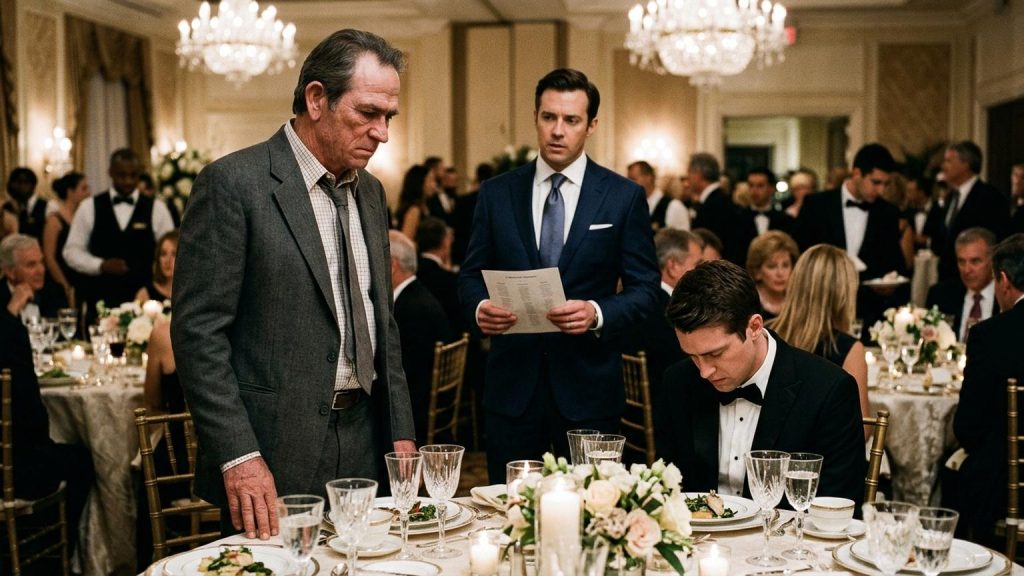
For twenty-seven years, I’d built Harborline from a used van and four cleaning contracts into a regional facilities business employing nearly two hundred people. I still visited job sites in work clothes because I wanted to know what our employees actually faced.
Charles had joined us five years earlier.
He knew exactly who I was.
“Patricia,” he said sharply, “you need to apologize.”
She straightened.
“I made an innocent mistake.”
“Then why did you keep humiliating me after I told you I was Noah’s father?” I asked.
She had no answer.
I set the seating chart on the table and reached for my coat. Olivia stood immediately, telling her mother that the evening was over, but Noah remained in his chair.
Outside, Charles followed me into the parking lot.
“Daniel, I know this looks terrible,” he said. “Please don’t let a family misunderstanding affect our professional relationship.”
I watched him adjust the expensive watch he’d been admiring all evening.
“This isn’t a business meeting, Charles. But since you mentioned work, we need to discuss the payroll review scheduled for Monday.”
His expression tightened.
“What payroll review?”
“The one involving the overnight cleaning crews in Cincinnati.”
Charles looked away.
For six weeks, employees had been reporting that their recorded hours didn’t match the hours they were actually required to work. Our payroll manager had discovered unusual adjustments across three properties, all under Charles’s regional supervision.
I’d already authorized an independent review before attending the engagement dinner.
Now Charles was standing in front of me, asking whether I’d seen the preliminary figures.
“Not the final report,” I said. “The reviewers are still collecting records.”
He nodded too quickly.
“I’m sure it’s a misunderstanding.”
The following Monday, the review widened after two supervisors provided copies of written instructions about overtime reporting. Charles was placed on paid administrative leave while independent counsel examined those records.
Two weeks later, our attorney called me into a conference room.
“Daniel,” she said, sliding a folder toward me, “we’ve confirmed substantial unpaid working time.”
Then she showed me the email Charles had sent to his supervisors.
Keep payroll within budget. Anyone who needs extra time can finish after clocking out.
Beneath it was another message.
If the workers complain, remind them how easily they can be replaced.
I stared at those words, remembering the dirty plates Patricia had pushed into my hands.
Then our attorney turned the page.
And I discovered that Charles hadn’t merely been underpaying our employees.
He’d tried to make the people who reported it lose their jobs.
The investigation uncovered more than unpaid overtime.
Charles had ordered supervisors to change employee schedules after several workers complained about missing wages. Three employees had been reassigned to less desirable shifts, and one woman, a fifty-four-year-old cleaner named Rosa Martinez, had been threatened with termination after asking why twelve hours were missing from her paycheck.
She’d worked for Harborline for nineteen years.
I remembered Rosa bringing homemade tamales to our warehouse every December. She always made an extra container for me because she knew Catherine had loved them.
I sat in the conference room reading the report, my hands resting on the same table where I’d once interviewed Charles for his position.
“What’s the total?” I asked.
Our attorney turned a page.
“Approximately $86,000 in unpaid wages and related adjustments, pending final verification.”
I closed the folder.
“Then we pay every dollar owed, with any additional amounts legally required.”
The company arranged restitution, corrected its timekeeping procedures, and cooperated with the appropriate wage authorities. Charles was terminated after the investigation substantiated his role in the violations and retaliatory decisions.
He threatened to sue.
Our attorney handled the correspondence.
I didn’t need to threaten him back.
Three weeks later, Patricia called.
Her voice was almost unrecognizable without the sharp confidence she’d displayed at the engagement dinner.
“Daniel, Charles is devastated. His career is ruined, and Olivia barely speaks to us anymore.”
I stood beside my kitchen window, watching rain gather on the bare branches outside.
“Patricia, your husband made employees work without paying them. He threatened their livelihoods when they complained.”
“But you could have protected him.”
I thought about Rosa, who’d been afraid she’d lose her health insurance if she reported her missing wages.
“I protected the people he was responsible for,” I answered.
Patricia began crying.
Then she said something that reminded me exactly who she was.
“All this because I mistook you for a waiter?”
“No,” I replied. “The investigation began before we met. And even if I had been a waiter, you had no right to treat me that way.”
I ended the call.
That evening, Noah appeared at my door carrying a small brown package.
For a moment, he looked twelve again, standing outside our apartment after being sent home early from school.



