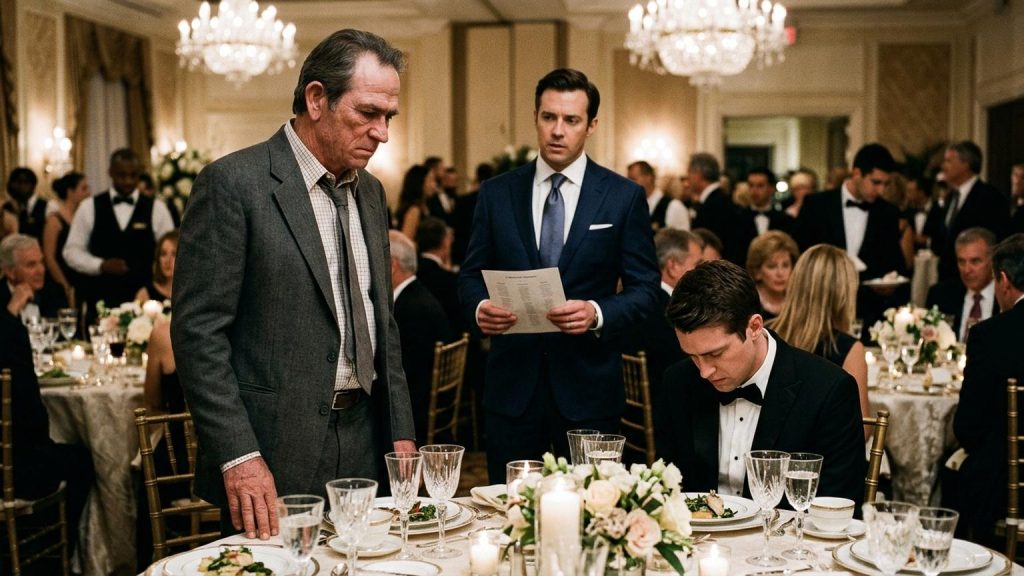
“Dad, I know I don’t deserve you listening to me,” he said.
I stepped aside.
He placed the package on my kitchen table and opened it.
Inside was a pair of leather work gloves.
Not new ones.
The same pair he’d bought me when he was twelve, carefully repaired along the torn seams.
“I found them in the box you kept from our old apartment,” he whispered. “I remember how proud I was when you wore them.”
His voice faltered.
“Somewhere along the way, I started caring more about impressing people than remembering who raised me.”
I looked at the gloves.
“You let them treat me like dirt, Noah.”
He nodded.
“I know. And I can’t take that back.”
He told me Olivia had postponed the wedding after learning he’d personally requested my seat by the kitchen. She’d asked him how they could build a marriage if he was willing to humiliate someone he loved just to keep her mother happy.
“I didn’t have an answer,” he admitted.
I didn’t tell him everything was forgiven.
But I made coffee.
We sat together for almost an hour, talking more honestly than we had in years.
Six months later, our company held an employee appreciation dinner at the same restaurant where Noah’s engagement celebration had taken place.
This time, the invitations went to our cleaning crews, maintenance technicians, warehouse employees, and their families.
Rosa received recognition for her nineteen years of service, and several employees who had helped uncover the payroll problems were thanked for speaking up. The evening wasn’t meant to make me look generous; it was meant to recognize people who’d spent years doing work that too often went unnoticed.
Noah attended with Olivia.
They weren’t married yet, but they were working through what had happened, including the boundaries they needed with her parents.
Near the end of dinner, a young server approached our table carrying a stack of plates.
I stood to help her.
She smiled.
“Thank you, sir, but I’ve got these.”
Noah rose beside me.
“Let me get the door for you.”
I watched my son hold open the kitchen entrance while she passed through.
Such a small gesture.
And yet, for the first time since that engagement dinner, I could see the boy who’d once waited up for me after my late shifts.
Nine months later, Noah and Olivia married in a small ceremony, with fewer than thirty guests. Patricia and Charles weren’t invited; Olivia had made that decision herself after months of unsuccessful attempts to get her parents to acknowledge their behavior.
Noah asked me to stand beside him.
When the photographer called both families together, my son put his arm around my shoulders.
“Dad,” he whispered, “right here. Next to me.”
I looked toward the camera.
I was wearing the same charcoal suit.
Only this time, there were no dirty plates in my hands, no kitchen door beside my chair, and no one pretending I didn’t belong.
Years earlier, I’d washed dishes to give my son a future.
For one terrible evening, he’d been ashamed of the very hands that helped build it.
But standing beside him that day, I finally understood something.
My greatest victory wasn’t that his future father-in-law lost his job. It was that my son had begun learning the difference between looking important and becoming a man worth respecting.



