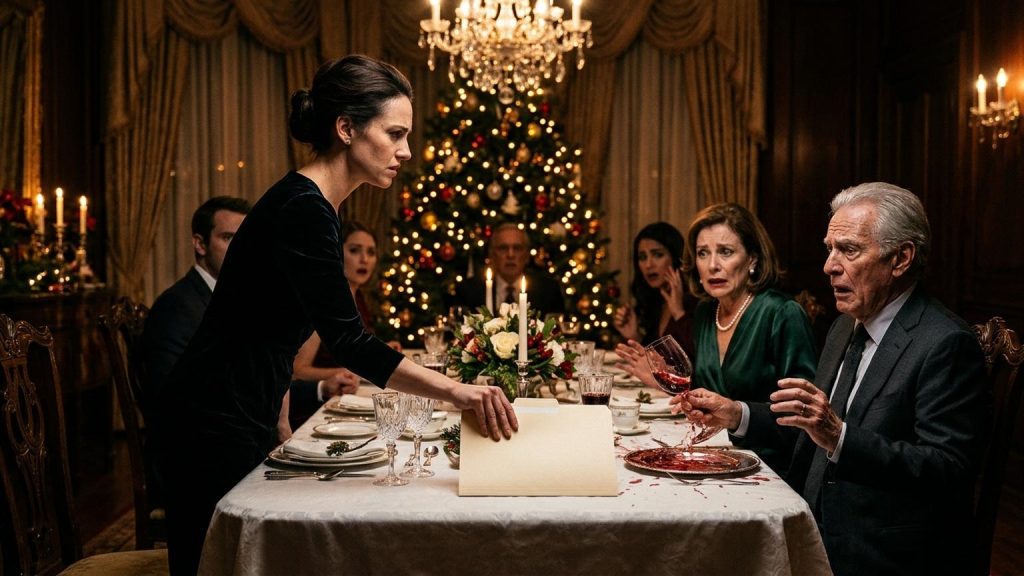
Later, she wrote on Facebook that some people would destroy their families for money.
A cousin messaged privately to ask whether Mazie was all right.
He was one of the few people who did.
Then Dad sent a text that explained more than he probably intended.
Tell the judge why you should get my father’s inheritance when you’re not even mine.
I sat beside Mazie, who had fallen asleep against the couch cushions, and read it again.
My father had spent my entire childhood suggesting I might not be his biological daughter.
Now he was using that suspicion to argue I had no right to be included in Grandpa’s estate.
I sent the message to Rebecca.
Two days after Christmas, she called.
My parents had responded to the petition.
They wanted it dismissed and were seeking sanctions against me for filing it.
Their argument relied heavily on my father’s claim that I wasn’t his daughter.
Rebecca told me not to get distracted.
“My name is in the trust,” I said.
“Exactly. We need the financial records. Let the documents establish what happened.”
I asked whether a paternity test would help.
“Not with the trust accounting,” she answered.
I still wasn’t sure what I wanted to know about my biological father.
But I understood that I didn’t have to settle that painful question before asking where my inheritance had gone.
That afternoon, Rebecca showed me an initial report from the trust administrator.
I read the first figure.
Original trust principal: $480,000.
The intended distribution was fifty percent to Chelsea and fifty percent to me.
My share was $240,000.
I looked at Rebecca.
“For years, they told me Grandpa left me nothing.”
She nodded and pointed to another line.
Current trust balance: $38,000.
I stared at it.
Most of the original funds were gone.
Rebecca showed me a preliminary summary of distributions.
There were payments associated with Chelsea’s down payment, a vehicle purchase, education, and other expenses.
Some had been classified as family or medical support.
I recognized the date of the vehicle purchase.
It was the same period when I’d been trying to move Mazie into a safer apartment.
My parents had refused to help because they supposedly couldn’t afford it.
Now the records suggested money designated for me had been used to support Chelsea.
I thought about that conversation in Dad’s kitchen.
He’d laughed at me for asking.
I’d left feeling ashamed of needing help.
All the while, there had been money in a trust intended for my benefit.
Rebecca told me we needed the complete accounting before drawing final conclusions about each transaction.
I agreed.
I wasn’t interested in guessing.
I wanted the records.
Meanwhile, Mazie was having a harder time than she admitted.
One evening, while I brushed her hair, she asked whether she should apologize to Grandpa.
“Apologize for what?”
“For making him mad.”
I put the brush down.
“You didn’t make him push you. He chose to do that.”
She looked at me in the mirror.
“You don’t have to apologize when somebody else hurts you,” I told her.
It was a lesson I wished someone had taught me at her age.
I also realized the Christmas incident couldn’t be treated as an argument I would eventually smooth over.
I stopped arranging visits to my parents’ house.
I didn’t answer their calls.
I made it clear that nobody should arrive at our home unexpectedly.
Mazie needed a break from people who made her question whether she belonged.
The first court hearing concerned the trust records and preserving what remained.
My parents attended with their attorney, Janine Keller.
She argued that the family had always understood my grandfather’s intentions differently.
She also raised questions about my biological relationship to Dad.
Rebecca kept the focus on the trust.
She asked the court to preserve the financial records and stop further movement of the funds while the accounting was completed.
The judge granted those requests.
My parents were required to produce the statements, transfer records, and trustee approvals.
We left the hearing without a final ruling on the money.
But the records were going to be examined.
A week later, Rebecca asked me to come to her office.
She had received additional documents.
She placed a page in front of me and pointed to the authorization column.
There were signatures approving distributions.
I recognized Dad’s.
Then I saw Mom’s handwriting.
More than once.
I sat looking at it.
Until that moment, I’d believed my father had made most of the financial decisions and Mom had simply gone along with him.
But the records showed she’d signed off on payments herself.
She hadn’t merely repeated Dad’s explanation that I was entitled to nothing.
She’d participated in the decisions that kept the money from me.
That realization hurt differently.



