Mom asked whether she could at least speak to Mazie.
I said no.
I wasn’t going to make my daughter responsible for helping adults feel better about what they’d done.
Mom stood outside for another moment.
Then I closed the door.
When Mazie came home from school, I didn’t burden her with every detail of that conversation.
I told her Grandma had visited and that I’d handled it.
Later, she asked whether we were going back for another family dinner.
“No, sweetheart.”
She climbed onto the couch beside me.
And for the first time in weeks, she didn’t ask another question.
Four months later, the money from the judgment reached my account.
My parents had sold the family house to cover what they owed.
The payment included the funds the court had ordered returned, along with the additional amounts awarded.
I didn’t celebrate their moving.
That house held memories of my grandfather and of birthdays when I’d still hoped Dad might treat me differently.
But I wasn’t going to refuse the money that had been designated for me because recovering it had consequences for the people who’d taken it.
I paid off what needed attention and set money aside for Mazie’s future.
I wanted her to have choices I’d struggled to afford.
A safer place to live.
Education.
The knowledge that she wouldn’t have to ask people who looked down on her for help she was entitled to receive.
My parents downsized.
Some relatives stopped calling once the judgment had been paid.
Others still believed I should have handled everything privately.
I didn’t argue with them.
Anyone who had watched my daughter get shoved to the floor and remained silent didn’t get to decide how gently I was required to respond afterward.
Chelsea continued defending our parents.
We no longer had a relationship.
There wasn’t a dramatic final confrontation.
I simply stopped returning to the places where Mazie and I were expected to accept being treated as less important.
Over time, the difference became visible in my daughter.
She laughed more.
She slept through the night.
She stopped asking whether she was real family.
I noticed it one evening while she was doing homework at the kitchen table.
She had papers spread around her, a pencil tucked behind one ear, and a mug of cocoa beside her.
She looked up and asked whether I could help with a question.
I sat beside her.
We worked through it together.
There was no one waiting to correct her for speaking.
No favored child whose needs had to come first.
No grandfather deciding which seat she deserved.
Just my daughter, comfortable in her own home.
I still think about the paper place card Chelsea had set beside Dad’s chair on Christmas Eve.
It was such a small thing.
A folded piece of paper with a little girl’s name written on it.
Mazie had believed that if her name was there, she was welcome.
My grandfather had written my name into a trust, too.
For years, the people controlling it had acted as though the name didn’t count.
The documents eventually proved otherwise.
But I don’t want Mazie growing up believing she needs a place card, a court order, or a DNA result to establish her worth.
She deserves to be treated with kindness because she’s a person.
She deserves to feel safe because I’m her mother.
And she deserves to know that when somebody hurts her, I won’t ask her to stay quiet just to keep the family comfortable.
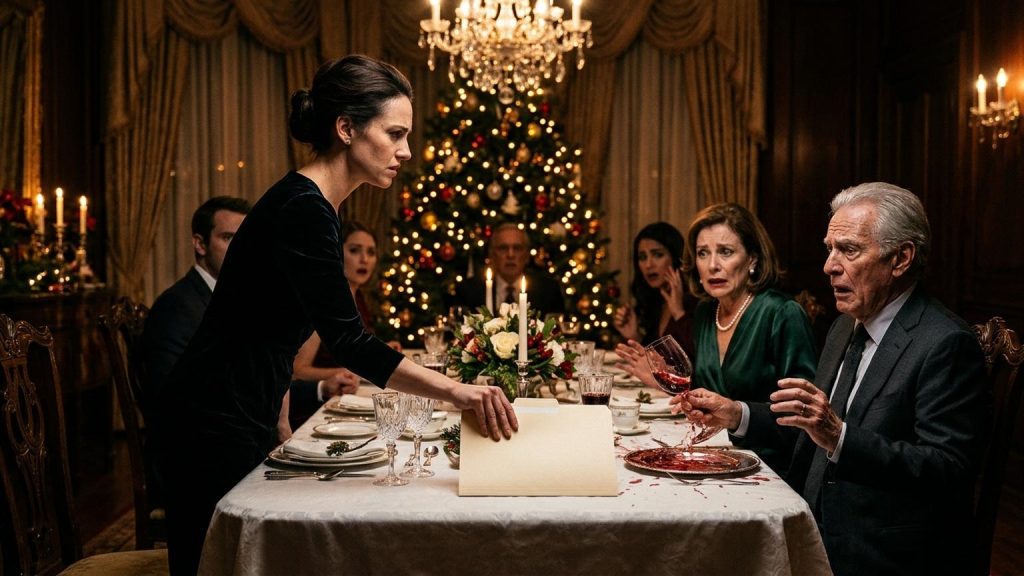
That Christmas, I walked into my parents’ house still hoping we could all get through another holiday without trouble.
I walked out knowing I would never ask my daughter to endure what I’d spent my childhood accepting.
The court gave me back the money.
The paternity test gave me an answer.
But the most important thing I took home that night was Mazie.
I held her hand all the way to the car.
And I’ve been keeping my promise to protect her ever since.
THE END.
I’ve shared the complete story, and I truly hope it touched your heart. If this story moved you, please leave a comment, like, and share the post. Thank you for reading!



