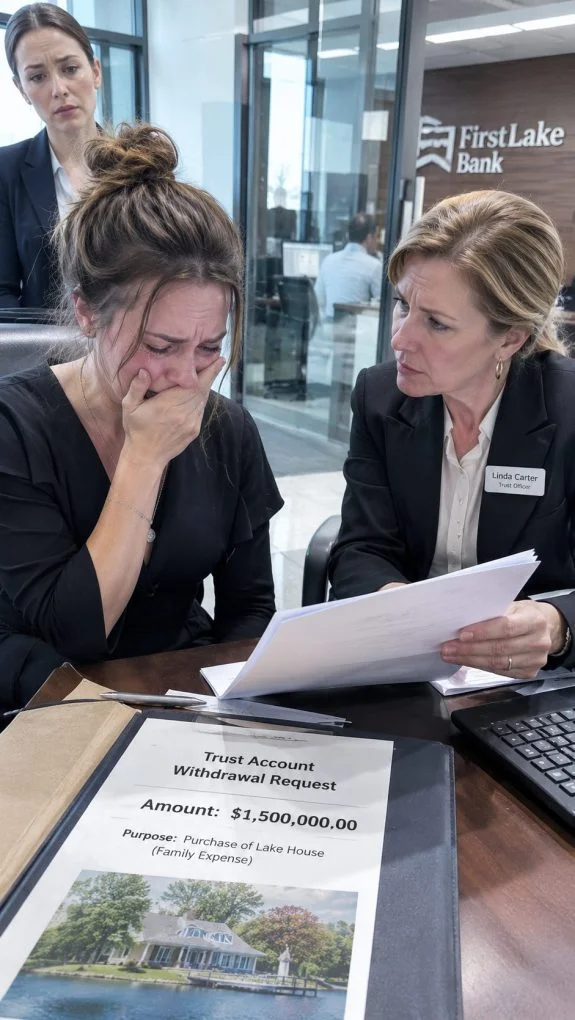
“Your son is gone, Claire. That money isn’t doing him any good sitting in a bank.”
My mother said those words over the phone while I stood beside my eight-year-old son’s grave, holding the little blue toy car he used to sleep with. Behind her voice, I heard champagne glasses clinking and my sister laughing about the enormous kitchen in a $1.5 million lake house.
It had been six weeks since I buried Owen.
And apparently, six weeks was long enough for my family to start spending his money.
“Mom,” I whispered, “what money?”
She sighed, irritated.
“Owen’s trust, sweetheart. Your father found a beautiful property near Lake Geneva. Your sister’s children will love it, and we thought having a family place might help everyone heal.”
I looked down at the small photograph beside Owen’s headstone.
He was smiling in his favorite dinosaur sweatshirt, holding the same blue car I now carried everywhere.
“That’s not your money,” I said.
My sister, Brooke, took the phone.
“Claire, don’t be selfish. You can’t just sit around crying forever. The rest of us deserve some happiness.”
I ended the call.
My name is Claire Parker. I’m thirty-seven, and I live outside Madison, Wisconsin, in a house that still has eight-year-old handwriting on the refrigerator.
Owen had been sick for much of his childhood. His paternal grandmother, Ruth, established a $2.4 million irrevocable trust after selling her medical equipment business, intending to provide for his treatment, education, and future needs.
An independent trust company managed the money.
My parents had never contributed a dollar.
For years, I’d balanced hospital appointments with my job as an insurance claims specialist, often falling asleep beside Owen’s bed while the little blue car rested on his pillow.
My family rarely visited.
Now they were choosing a lake house.
At 3:42 p.m., my phone rang again.
This time, it was Helen Brooks, the trust officer.
“Mrs. Parker, I’m sorry to disturb you, but we’ve received an unusual request involving Owen’s trust.”
I leaned against my car.
“What kind of request?”
“A $1.5 million property purchase, described as a family residence necessary for his care. Your parents submitted it through a real estate attorney.”
My chest tightened.
“Owen died six weeks ago.”
“I know,” Helen said gently. “That’s why our compliance department flagged it immediately.”
Then her voice changed.
“Claire, there’s something else. The request includes an authorization bearing your signature.”
I stared at the blue toy car in my palm.
“Helen, I never signed anything.”
She paused.
“Then you need to see the second document. It says you authorized this purchase three days after your son’s funeral.”
The following morning, I sat across from Helen in a quiet conference room overlooking downtown Madison. She had placed a box of tissues beside my chair, along with a folder containing the documents my parents had submitted.
I didn’t touch the tissues.
I opened the folder.
The first page described a luxury waterfront property with six bedrooms, a private dock, and a heated swimming pool. The purchase price was $1.5 million, and the proposed buyer was a family-owned LLC registered in my sister’s name.
Then I saw the second page.
Beneficiary Family Authorization.
My name appeared beneath a statement claiming I approved the property purchase as necessary for Owen’s long-term care.
The signature looked like mine.
But I recognized where they’d taken it from.
Four months earlier, Mom had asked me to email a signed medical authorization so she could accompany Owen to an appointment if I was working. I’d sent the document because, despite everything, I still wanted my mother to be part of his life.
Now that signature was attached to a request for a lake house.
Helen watched me carefully.
“Did you authorize your family to submit anything on your behalf?”
“No.”
“Did you know about the proposed purchase?”
“Not until yesterday.”
She nodded.
“No funds have been released. Your parents aren’t trustees, and this document doesn’t give them authority over the account. We contacted you because of the apparent misrepresentation.”
I finally reached for a tissue.
Not because of the money.
Because I remembered Owen asking whether Grandma would come to his birthday party last year.
She hadn’t.
Brooke’s youngest daughter had a dance recital that afternoon, and Mom said she couldn’t disappoint the children.
Owen had waited beside the window until his birthday cake was cold.
“I guess Grandma’s busy,” he’d whispered.
I’d told him she loved him.
Sitting in that conference room, I wondered how many times I’d made excuses for people who couldn’t even spare an afternoon for my son.
Helen explained that Owen’s trust contained specific instructions for what would happen after his death.



