“We bulldozed your grandfather’s house,” Dad announced over the phone, laughing as though he’d finally won an argument. “Your tenant is out, Nathan. You should have given us half that inheritance when we asked.”
I was standing beside a hotel window in Denver, watching rain streak the glass after a work conference. On my laptop, the video he’d just sent showed an excavator driving its bucket through the porch where Grandpa used to sit with me on summer evenings.
For one strange second, I laughed too, a dry sound that came out before I could stop it. That house wasn’t part of the $5 million Grandpa left me, and the woman Dad called my tenant was its legal owner.
“Did you check who owns that property?” I asked.
Mom took the phone. “Don’t get clever. We warned you what would happen if you kept all that money to yourself.”
Grandpa Walter had been a carpenter in rural Pennsylvania, a man who saved bent nails in coffee tins and wrote birthdays on the kitchen calendar. When Grandma died, he asked his longtime renter, seventy-year-old Ruby Ellis, to keep an eye on the farmhouse as his health declined.
Ruby had lived in the attached apartment for nearly twenty years and brought him meals after his heart surgery. Two years before he died, Grandpa sold her the farmhouse and its two-acre lot through a properly recorded deed, with a substantial discount because he wanted her to have a permanent home.
His remaining farmland and investments passed to me after his death, worth roughly $5 million altogether. Dad, whose failing equipment dealership Grandpa had already rescued twice, demanded $2.5 million as his “rightful share,” even though the will made Grandpa’s intentions clear.
I’d refused, but I hadn’t imagined Dad would destroy the only place where Ruby felt safe. I replayed the video and watched the excavator crush the porch steps Grandpa and I had repaired together, while a bright strip of survey ribbon fluttered beside the machine.
“Where’s Ruby?” I asked.
“Gone,” Dad said. “She took her cat and ran to the neighbors. Stop worrying about an old renter and start worrying about what you owe us.”
I ended the call and dialed Ruby, whose number I knew by heart. She was safe at the neighbors’ house, trembling so badly she could barely hold the phone, and she told me police had already been contacted.
Then she sent a photograph of the paper Dad had handed the demolition crew. It was an authorization supposedly signed by the owner, granting permission to tear down the farmhouse.
The signature at the bottom was mine
I called my attorney, Sarah Mitchell, before I called either parent again. She told me not to argue with Dad or delete anything, and within an hour she had the recorded deed, the demolition video, and Ruby’s photograph of the forged authorization.
“Your father has two problems,” Sarah said. “The house belonged to someone else, and he used your name to make the contractor think he had permission.”
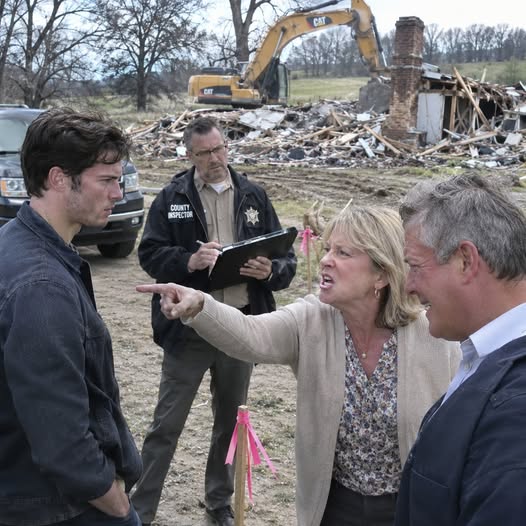
I caught the first flight home. By the time I reached Grandpa’s land, the farmhouse was a collapsed pile of timber, shingles, and plaster, with the brick chimney standing above it like a broken tooth.
Ruby sat on the neighboring porch wearing Grandpa’s old wool cardigan, the one she’d saved after his funeral. Her cat slept in a carrier beside her, and she kept rubbing her thumb across the seam of her sleeve as she told me how Dad had ordered her off the property.
“He said you wanted me gone,” she whispered. “I told him Walter had sold me the house, but he said I couldn’t possibly understand the paperwork.”
I crouched beside her. “Grandpa knew exactly what he signed, Ruby. I have the deed, and so does the county.”
When I asked whether she wanted to see the rubble, Ruby shook her head and looked down at my shoes. “I left Walter’s photographs on the mantel,” she whispered, and I couldn’t bring myself to tell her that the mantel was gone.
The contractor had begun demolition without verifying title or obtaining the required permit. A local code investigator had stopped the work after a neighbor reported the excavator, but by then the walls were down and Ruby’s furniture, family photographs, and medicine had been buried beneath the wreckage.
Dad arrived in his pickup while the investigator photographed the site. Mom stepped out behind him, holding a folder of Grandpa’s probate records and wearing the expression she used whenever she expected me to apologize.
“This could all go away if you give us what we asked for,” she said.
Ruby looked toward her, then back at the rubble. I felt the shape of Grandpa’s old pocketknife in my coat pocket, a keepsake he’d given me when I was thirteen, and forced myself to keep my voice level.



