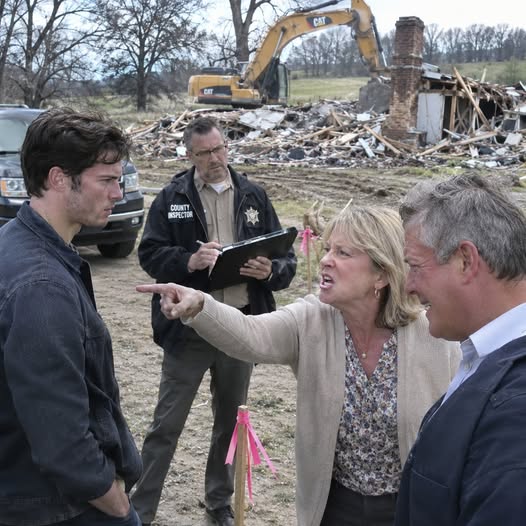
“Dad’s business debt is not a reason to destroy somebody’s home,” I said. “And you don’t get to bargain with Ruby’s loss.”
Dad jabbed a finger toward the land. “That house stood on my father’s farm. I know what belongs to this family.”
Sarah arrived with a copy of the county parcel map. The boundary markers separated Ruby’s two acres from my inherited fields, and the deed bore her name, Grandpa’s signature, and a recording date from two years earlier.
Dad barely glanced at it. “Then sue me. You’ll spend your entire inheritance trying.”
That evening, Mom sent messages to every relative, claiming I had arranged the demolition myself to collect insurance money and blame them. I forwarded the messages to Sarah, who added them to the evidence file, then helped Ruby find temporary accommodation near her church.
A week later, the investigator received the contractor’s saved emails. Dad had not simply made a mistake about the parcel: Ruby’s attorney had warned him in writing that she owned the home, and he had replied anyway.
Sarah read me the final line from Dad’s message, dated three days before the demolition.
“I know whose name is on the deed. Knock it down before Nathan gets back, and she won’t have a house left to fight over.”
At the civil mediation nine months later, Dad appeared with a new lawyer and a thinner version of his old confidence. Mom sat beside him, turning her wedding ring while Sarah laid out the recorded deed, the fake authorization, the contractor’s emails, and photographs of everything Ruby had lost.
The contractor admitted he had accepted an authorization bearing my forged signature without checking title or obtaining a permit. His company faced separate penalties for the unapproved work.
Dad’s lawyer called it a family misunderstanding. Ruby unfolded the letter warning Dad not to enter, its delivery receipt still attached.
“He knew,” she said, in a voice so steady it surprised me. “I told him in person, and my lawyer told him on paper.”
Dad looked at me instead of Ruby. “All this because I asked for help when my business was failing?”
I remembered him teaching me to drive beside Grandpa’s fields, one patient hand near the gearshift. But the man across the table had destroyed an innocent woman’s home and still expected me to pay.
“You asked for money,” I said. “Then you chose to hurt Ruby because I said no.”
The civil case settled after damage estimates were reviewed. Dad and Mom agreed to pay a substantial sum, and the contractor contributed separately, covering Ruby’s lost belongings, temporary housing, and the rebuilding costs through a structured settlement.
Sarah made sure that Ruby’s rights as the property owner remained central to the settlement. I’d helped pay for temporary accommodation while the case proceeded, but I refused to let my parents use that kindness as an excuse to shift responsibility away from themselves.
Prosecutors separately pursued the forgery and property damage. Dad pleaded guilty to reduced charges, received probation and restitution, and sold his fishing boat and recreational land to pay; Mom settled her civil liability but was not criminally charged.
Grandpa’s $5 million inheritance stayed mine, including the farmland and investments. I refused every invitation to “put this behind us” by paying Dad’s business loans.
Ruby’s new home took eleven months to finish. It was smaller, with a wide front step and a kitchen window facing Grandpa’s old apple tree.
The morning we brought her the keys, she stood on the porch for a long time without going inside. Then she took a folded photograph from her pocket: Grandpa sitting outside the old farmhouse, holding two mugs of coffee, one for himself and one for her.
“He told me this place would always be mine,” she said.
“It is,” I answered.
Mom wrote once, asking whether I would come to Christmas dinner. I replied that I needed distance until she could acknowledge what they had done without excuses.
I never got that acknowledgment. What I did get was a quiet Sunday with Ruby, who invited me for soup at her new kitchen table and insisted on sending me home with leftovers, just as Grandpa used to do.
Before leaving, I walked to the apple tree and touched the rough bark beneath its lowest branch. I could still see the farmhouse in my memory, the porch steps and the old nail tins, but the tree had survived the machines, and Ruby was safe behind a door only she controlled.
Dad had laughed when he told me the house was gone, certain he’d finally found a way to take my inheritance. He lost his own property paying for what he destroyed, while the five million dollars he wanted never became his.



