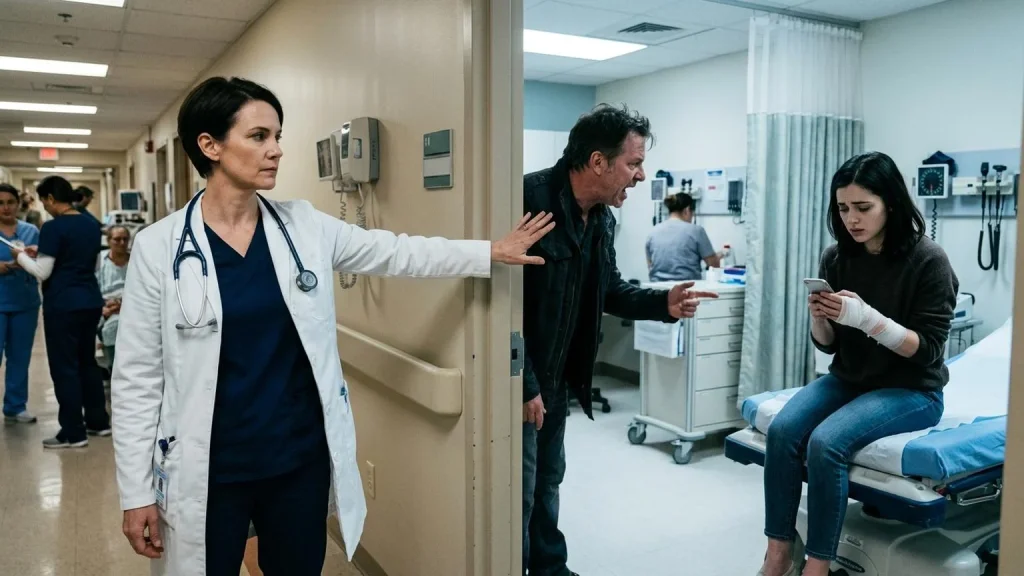
The social worker listened carefully, writing down dates and locations without interrupting. I hadn’t realized how much I’d been holding inside until I heard myself describe incidents I’d spent years pretending were ordinary accidents.
Later that evening, Eli sent me the recording through a secure file-sharing link.
The camera faced the kitchen island, capturing the Thanksgiving table beyond it. I watched myself smiling when I announced the job offer, then saw Dad rise, seize my wrist, and force my arm backward as I tried to pull away.
The sound was worse than the image.
“You think you can leave this family whenever you want?” Dad shouted.
Then came the impact against the counter and my own frightened cry.
On the recording, Mom stood frozen beside the sink.
Eli had been standing near the refrigerator, watching everything.
I stopped the video before it ended.
My cousin Grace, who lived twenty minutes away, arrived at the hospital after I called her. She’d known for years that I was afraid of upsetting Dad, but I’d never told her how often he’d physically hurt me.
“You’re coming home with me,” she said, gently covering my uninjured hand with hers.
I looked at the hospital discharge paperwork waiting beside my bed.
“What about Eli?”
“We’ll make sure he isn’t left to deal with this alone.”
With my permission, the investigating officer obtained the recording and arranged to preserve the original file. The medical documentation established that my arm was fractured, while the video provided evidence of the force Dad had used.
By the following afternoon, I was resting at Grace’s apartment with my arm immobilized when Mom called.
“Anna, your father says you’re accusing him of abuse.”
“I told the police what happened.”
“He’s furious.”
I stared at the pale blue blanket covering my knees.
“Mom, did you see him grab me?”
There was a long silence.
“Yes.”
“Then why did you let him tell everyone I fell?”
Her breathing became uneven.
“Because I thought if I kept him calm, things wouldn’t get worse.”
I closed my eyes.
“Mom, things have been getting worse for years.”
She began crying, but I couldn’t comfort her.
That night, Eli called from his bedroom, speaking so quietly I could barely hear him.
“Dad found out I saved the video,” he whispered.
My stomach tightened.
“Where is he now?”
“Downstairs. He told me I’d better keep my mouth shut.”
Then Eli said something that made me sit upright.
“Anna, he said if I show that recording to anyone else, I’ll find out what a broken arm really feels like.”
I called Grace before Eli finished speaking, and within minutes she was contacting the detective who’d taken my statement. She told him about Dad’s threat, then stayed beside me while I called Mom and asked her to take Eli somewhere safe.
For once, Mom didn’t tell me to calm down.
She drove Eli to Aunt June’s house that night and informed the detective where they were staying. When she called me afterward, her voice sounded hollow.
“I’m sorry, Anna. I should’ve stopped this a long time ago.”
I wanted to tell her everything would be fine, but I was tired of promising other people comfort when I was the one who had been hurt.
“Then help us make sure it doesn’t happen again,” I said.
Over the following days, investigators interviewed Eli, reviewed the original video, and obtained my medical records. They also spoke with Mom, whose account of Thanksgiving finally contradicted the story Dad had given the emergency room staff.
Dad insisted I’d exaggerated the incident.
Then investigators showed him the recording.
He could no longer claim I’d simply fallen while carrying dinner, because the camera showed his hands on my arm and the moment he forced me against the counter. It didn’t establish every incident from my childhood, but it documented what happened on Thanksgiving.
Criminal charges followed, and the court imposed no-contact conditions while the case proceeded.
Dad continued telling relatives that I’d betrayed him. He claimed I’d turned a family disagreement into a criminal investigation because I wanted to punish him for refusing to let me move away.
Then Aunt June received the recording from the investigator through the appropriate process and heard what had actually happened. She’d spent years defending Dad whenever I canceled family visits, believing his complaints that I was too sensitive.
She called me crying.
“I wish I’d asked why you were afraid of him.”
I looked at the graduation gown hanging behind Grace’s bedroom door.
“Me too.”
Three weeks after Thanksgiving, I walked across the stage to receive my degree, my right arm still supported in a sling. The applause sounded strangely distant until I spotted Mom, Eli, Grace, and Aunt June standing together in the audience.
Eli was waving both hands.



