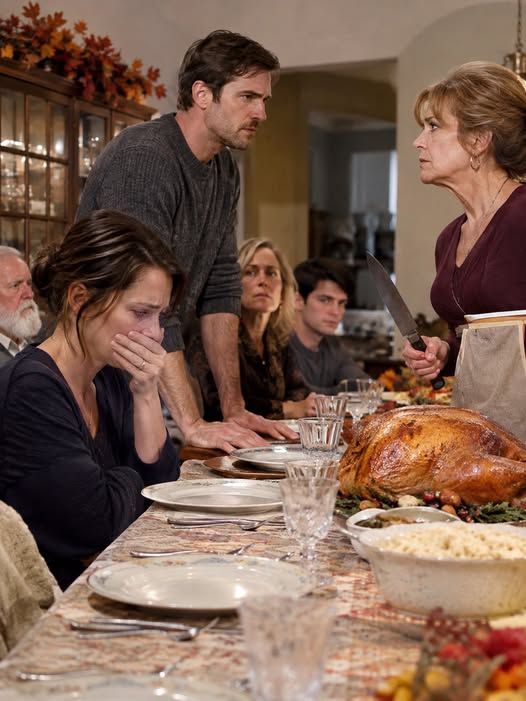
My mother-in-law was holding the carving knife when she announced that my husband was leaving me.
Fourteen people were gathered around her Thanksgiving table. The turkey was still untouched, the plates were empty, and Charlene Herrick had decided that before anybody ate, she needed to make an announcement.
“Elliot has decided to leave his wife.”
Then she looked directly at me.
“Danica, honey, you’re still family in this house. That isn’t going to change.”
I remember looking at my husband, waiting for him to deny it.
Elliot placed his napkin on the table, stood up slowly, and looked at his mother.
“That’s not what I told you, Mom.”
Charlene tightened her grip on the knife.
“Then tell them.”
“I can’t.”
That was all he would say.
My sister-in-law, Jane, disappeared into the kitchen and began washing dishes that hadn’t been used. Someone’s child asked whether we were going to eat. The other relatives stared at their plates.
I sat there wondering how a marriage of eleven years could end in front of an entire family without either spouse having a proper conversation about it.
Nobody ate Thanksgiving dinner that night.
At 9:40, Charlene packed the food into containers and labeled everything with masking tape.
That was her habit whenever something went wrong. She couldn’t always control people, but she could control what went into the refrigerator.
On the nineteen-minute drive home, I asked Elliot whether he was leaving me.
“No.”
“Then what did you tell your mother?”
“I can’t tell you.”
“Elliot, she just announced our divorce to fourteen people.”
“I know.”
We stopped at the light at Battlefield and Campbell.
Then he said something I couldn’t understand.
“I have a lawyer.”
A moment later, he told me the lawyer had instructed him not to discuss the situation with anyone.
“Even me?”
“Especially you.”
He apologized and drove the rest of the way home without another word.
For the next six days, he slept in the den.
I began looking at one-bedroom apartments.
There had been signs, or at least things that looked like signs once Charlene supplied an explanation.
Elliot had spent two months taking phone calls in the garage. He had gone somewhere on a Saturday in October and returned with a coffee-shop receipt from Nixa. He had become distant during the summer.
I was convinced there was another woman.
What else was I supposed to think?
The worst part was that Elliot wouldn’t defend himself. He wouldn’t tell me what his mother had misunderstood or explain what the lawyer had to do with our marriage.
And I worked for his mother.
For nine years, I had been the scheduler at Herrick Medical Transport, the family business Charlene had built with her late husband.
We operated twenty-two vehicles, transporting elderly and disabled patients to appointments throughout Greene County, Missouri.
I knew which patients needed wheelchair vans, whose houses had difficult steps, and which drivers could safely handle the steepest ramps.
Charlene had hired me after I noticed the chaotic scheduling board during a visit to the office.
She liked that I wasn’t afraid to tell her something needed fixing.
For years, we worked well together.
Her husband, Karsten, had been the quiet half of the business. Charlene made decisions; he managed the vehicle yard and occasionally told her no.
After his fatal heart attack in March 2020, the company struggled.
Medical appointments were canceled during the pandemic, but dialysis patients still needed transportation. Vehicles ran half-empty while fuel, insurance, payroll, and maintenance bills kept arriving.
Charlene refinanced her house to avoid laying off employees.
“I am not letting sixty people go, Danica,” she told me.
I believed her.
And when she complained that state reimbursement rates couldn’t cover the real cost of transportation, I agreed.
I had no reason to suspect that her solution would eventually put my own future in danger.
The Monday after Thanksgiving, I arrived at work at 4:55 a.m., as usual.
My computer login failed.
Three attempts. Three rejection messages.
Jane came out of the back office and said there had been a software update.
“Marlon is working on it. Just use the board.”
Marlon was her husband’s twenty-four-year-old nephew, the family’s unofficial computer expert.
So I returned to the large whiteboard beside the garage door.
Twenty-two vehicle numbers ran down one side. Appointment times ran across the top.
It showed which vehicle was assigned to every trip.
I had complained for years that we erased that board every morning without preserving a photograph.
The computerized system held the official records.
But the whiteboard showed what was actually scheduled to happen.
Three days later, on December 2, a certified envelope arrived.
Jane signed for it.
Charlene wasn’t in the office, and the envelope sat on the front counter long enough for me to read the heading.



