I don’t blame them for being angry about losing their livelihoods, even though the investigation would have continued whether I cooperated or not.
Their bills didn’t disappear because the company had committed fraud.
Neither did the patients’ medical needs.
Mrs. Osmond’s daughter eventually had to take time away from work three times a week to transport her mother.
I thought about that whenever someone described the outcome as a victory.
The people who needed those vans hadn’t caused any of this.
Neither had the drivers who showed up every morning.
Elliot met me in the parking lot on the day the company closed.
He was standing beside my car, holding his rolled-up tie.
By then, he had moved out of the den.
We were still married.
I reminded him that his mother had announced our divorce to fourteen relatives.
“I know.”
“You could have told me something that night. One sentence.”
“I know that, too.”
He opened my car door.
He had been doing that for eleven years.
We drove home.
In July, Charlene was indicted on eleven counts.
Jane eventually accepted deferred prosecution and surrendered her billing certification for five years.
She found work at a dermatology office.
Elliot was not charged.
His voluntary disclosure was determined to be complete.
That was why he had contacted a lawyer back in October 2025, before investigators came looking.
He had been trying to separate himself from the company’s wrongdoing.
Charlene had learned pieces of what he was doing, including information from his email.
Instead of understanding that he was leaving the business, she interpreted his words as a decision to leave his wife.
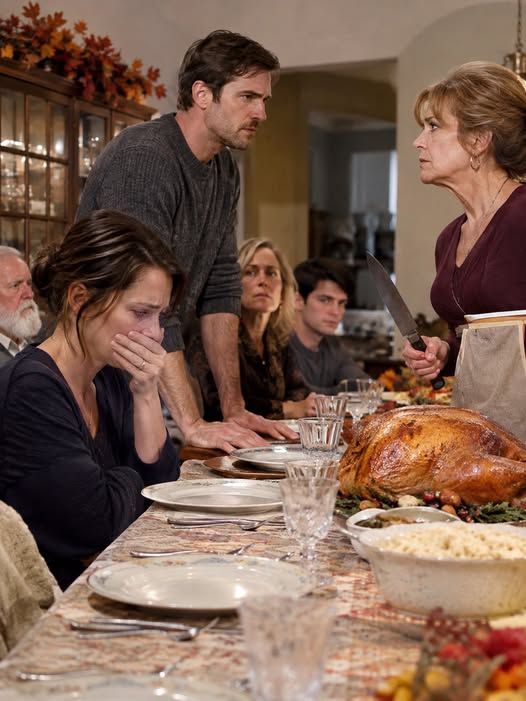
And she announced that interpretation at Thanksgiving in front of the family.
I don’t believe it was an innocent misunderstanding.
She was trying to get everyone on her side before whatever she feared became public.
She chose the explanation that suited her, even though it devastated me.
On July 9, Farah called with news about the indictment.
My name wasn’t on it.
I asked whether that meant I was safe.
She explained that I might still testify, but I was being treated as a witness, not a defendant.
The twenty-year exclusion I had feared wasn’t happening.
The evidence had allowed investigators to distinguish my work from what happened in billing.
I sat on the back steps after that call and felt almost nothing.
Nine days later, I cried in the cereal aisle of Price Cutter while holding a box of shredded wheat.
A young employee asked whether I needed help finding something.
I couldn’t explain why I was crying.
In November, Charlene pleaded guilty to three counts.
The resolution included $2.1 million in restitution and a thirty-three-month sentence.
She went to a facility in Vandalia.
She hasn’t written to me.
I haven’t written to her.
I still think about the woman who started that company because her own father needed transportation to medical appointments.
I believe she wanted to help people.
I also believe she knowingly allowed false billing records to accumulate and expected other people to carry the consequences.
Those facts don’t cancel each other out.
Sometimes I think about what would have happened if I had never argued with Jane about Tuesdays.
I wouldn’t have started photographing the whiteboard.
I wouldn’t have had 412 photographs sitting in an old phone.
And I might never have been able to demonstrate what those trips actually were.
I also think about Thanksgiving.
The full table. The untouched turkey. The relatives who avoided looking at me.
For months, I believed that was the evening my husband had decided to abandon me.
It wasn’t.
It was the evening his mother tried to control a story she didn’t fully understand.
Elliot and I are still married.
What happened didn’t disappear just because we stayed together. He knows what his silence cost me, and I know why he believed it was necessary.
We don’t pretend those nine months were harmless.
But there are things I understand now that I didn’t understand while sitting at Charlene’s table.
A person can build a business for a good reason and still make terrible decisions to preserve it.
A family can love you and still place its own survival ahead of yours.
And a marriage can survive something that neither spouse handled perfectly.
I still remember Mrs. Osmond sitting in her wheelchair with her purse in her lap, trusting that someone would arrive and take her to her appointment.
She never knew her ordinary Tuesday ride had become part of a criminal investigation.
She didn’t need to know.
She needed a van.
And I needed the truth about the records carrying my name.
Those were two different needs, and neither deserved to be sacrificed to protect the people who altered the bills.



